Format: Short Film / Anthology Episode | Est. Length: 10-12 minutes
This story serves as a standalone entry in a speculative anthology series titled The Entropy Ledger, which explores a near-future world where reality is physically degrading due to collective existential exhaustion. Each episode examines a different "glitch" or anomaly—a manifestation of human desire attempting to override a crumbling, resource-depleted environment. The series arc follows a loose network of "Reality Auditors" who track these phenomena, questioning whether humanity should cling to the harsh truth or succumb to the seductive, fatal comfort of artificial illusions.
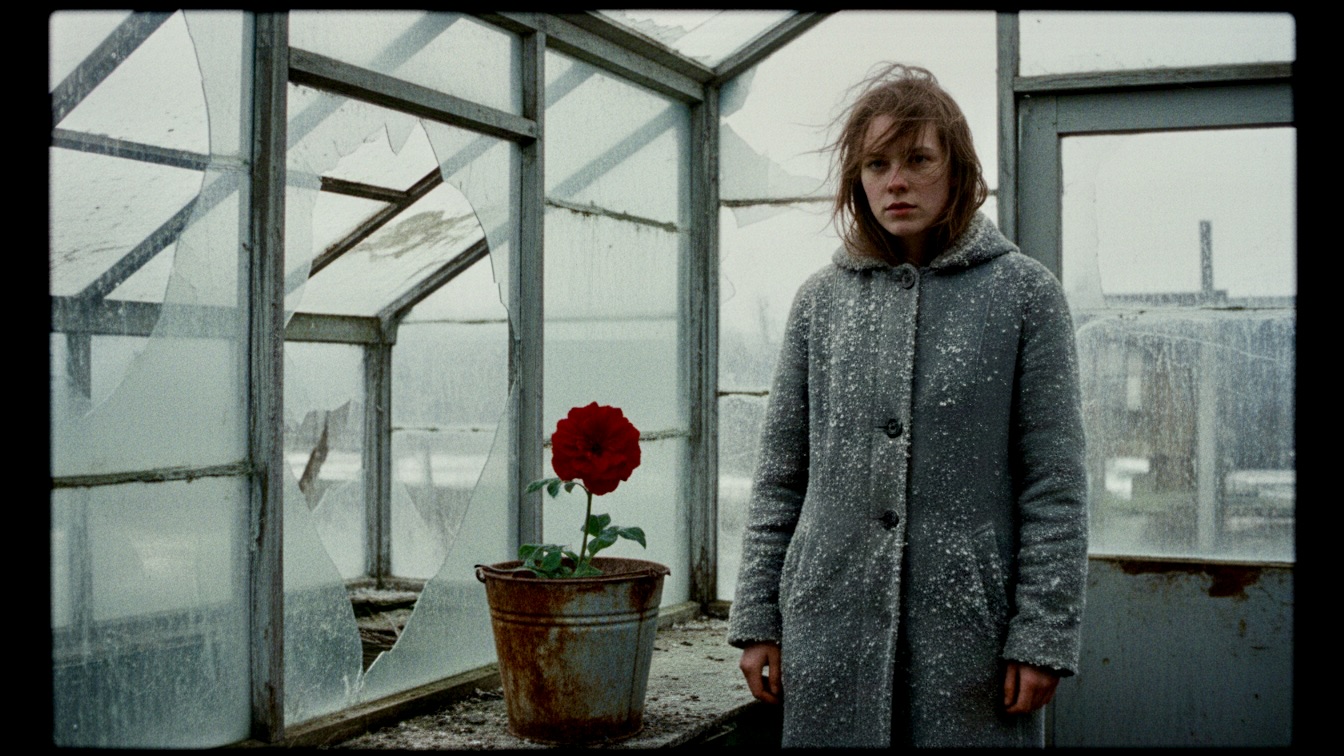
In a derelict, frozen greenhouse, Mia discovers a single, impossibly vibrant red flower that pulses with unnatural warmth against the backdrop of a decaying, gray world. As she reaches out to touch the bloom, the environment around her begins to dissolve, threatening to pull her consciousness into a hallucination of a life she can no longer afford.
A desperate woman discovers an anomalous flower that offers a portal to an idealized, warm past. She must choose between the fatal comfort of a beautiful lie and the brutal, freezing reality of her own existence.
The episode explores the tension between escapism and survival, positing that hope, when untethered from reality, becomes a parasitic force. It examines how trauma and economic despair create a psychological vacuum that "glitches" in reality are all too eager to fill, questioning whether a painful truth is inherently more valuable than a blissful delusion.
The narrative also touches on the performative nature of human interaction in times of collapse. By framing the world as a "stage," the story highlights how characters adopt rigid, theatrical personas as a defense mechanism against the encroaching chaos of their environment.
The stakes are both psychological and existential; if Mia succumbs to the flower’s allure, she will surrender her agency and eventually her life, becoming a permanent fixture in a frozen, dream-induced grave. Conversely, Julian risks his own sanity by acting as a gatekeeper, constantly suppressing his humanity to maintain the "budget of reality" that keeps him tethered to the physical world.
The primary external conflict is the "metabolic fire" of the flower, a sentient anomaly that feeds on human will and body heat to sustain its illusion. Internally, Mia battles her own crushing despair, while Julian struggles with the performative coldness he adopts to survive, creating a friction between two people who both desperately want to escape the gray, yet fear the cost of doing so.
Mia, living in a city choked by decay and cold, wanders into an abandoned greenhouse and encounters a mysterious red flower that transports her into a vivid, warm memory of a life with her partner, Julian. The dream is a perfect, golden-hued sanctuary that offers relief from the crushing anxiety of her daily life, but she soon realizes the dream is a trap, flickering with the encroaching darkness of the reality she left behind.
Julian, appearing in the greenhouse, reveals himself to be an enforcer of sorts, warning Mia that the flower is a "biological thief" that consumes the dreamer's life force. In a climactic confrontation, Julian destroys the flower to save Mia, forcing her to confront the harsh, gray world once more as the only way to remain truly alive.
Mia begins the episode as a woman hollowed out by societal decay, seeking any form of warmth to numb her pain. By the end, she is forced into a state of painful, sharp-edged clarity, accepting the cold as proof of her own existence.
Julian is a man who has weaponized performative stoicism to survive the collapse, acting as a tragic, self-appointed guardian of reality. His arc reveals a man who is terrified of his own vulnerability, ultimately choosing to destroy the very thing that could have offered him comfort to ensure his survival.
Mia enters the greenhouse and finds the flower, experiencing the initial sensory shock of its unnatural heat. The dream sequence unfolds as a golden, high-definition sanctuary that seduces her, only to be interrupted by the flickering, shadow-filled edges of the real world.
Julian confronts Mia, the tension escalating as he explains the parasitic nature of the anomaly while the shadow mass grows to threaten them both. The midpoint shift occurs when Julian forces Mia to acknowledge that the dream is a death sentence, shattering the illusion through a violent, visceral act of destruction.
The climax sees Julian crushing the flower, causing the immediate, painful collapse of the dream and leaving them both in the silence of the ruin. The final beat finds Mia alone, reaching out to the last remaining petal, only to find the shadow mass shifting its attention toward her, suggesting the danger is far from over.
The episode begins with a sense of oppressive, muted gloom, transitioning into a sudden, jarring burst of golden, nostalgic warmth during the dream sequence. As the illusion shatters, the mood descends into a sharp, biting cold, ending on a note of lingering, existential dread that leaves the audience questioning if the "reality" they returned to is any safer than the lie.
The season arc would focus on the increasing frequency of these "glitches" as the world’s "budget" continues to deplete, forcing the Auditors to make increasingly difficult choices about which realities to "liquidate." As Julian’s backstory is revealed, it becomes clear that he was once a dreamer himself, and his current coldness is a direct result of a past failure to protect someone he loved from a similar illusion.
The visual style contrasts the "low-res," desaturated, and claustrophobic aesthetic of the greenhouse with the hyper-saturated, golden, and wide-angle cinematography of the dream kitchen. The tone is akin to The Leftovers or Black Mirror, favoring a grounded, minimalist approach to sci-fi that prioritizes character-driven dread over spectacle.
The target audience is viewers aged 25-45 who appreciate slow-burn psychological sci-fi, philosophical dramas, and anthology series that challenge the viewer’s perception of reality. It is designed for streaming platforms that cater to cerebral, high-concept storytelling.
The pacing is deliberate and atmospheric, mirroring the slow, freezing decay of the greenhouse environment. The first act establishes the lethargy of the setting, the second accelerates into the frantic, dream-like quality of the anomaly, and the final act settles into a sharp, rhythmic tension that emphasizes the finality of Julian’s actions.
The production should utilize practical, tactile effects for the greenhouse—real frost, breath condensation, and rusted textures—to ground the surreal elements in a tangible reality. The flower itself should be the only vibrant, high-contrast element in the entire film, potentially using subtle, non-CGI lighting effects to give it an "unnervingly warm" glow that interacts with the actors' skin.
The shadow mass requires a blend of practical lighting and subtle, organic-looking VFX that mimic ink dispersing in water, ensuring it feels like a physical, heavy presence rather than a digital overlay. The sound design is critical; the transition from the "hissing" wind of the greenhouse to the "clean, domestic" sounds of the kitchen should be jarringly distinct to emphasize the psychological divide between the two states.


