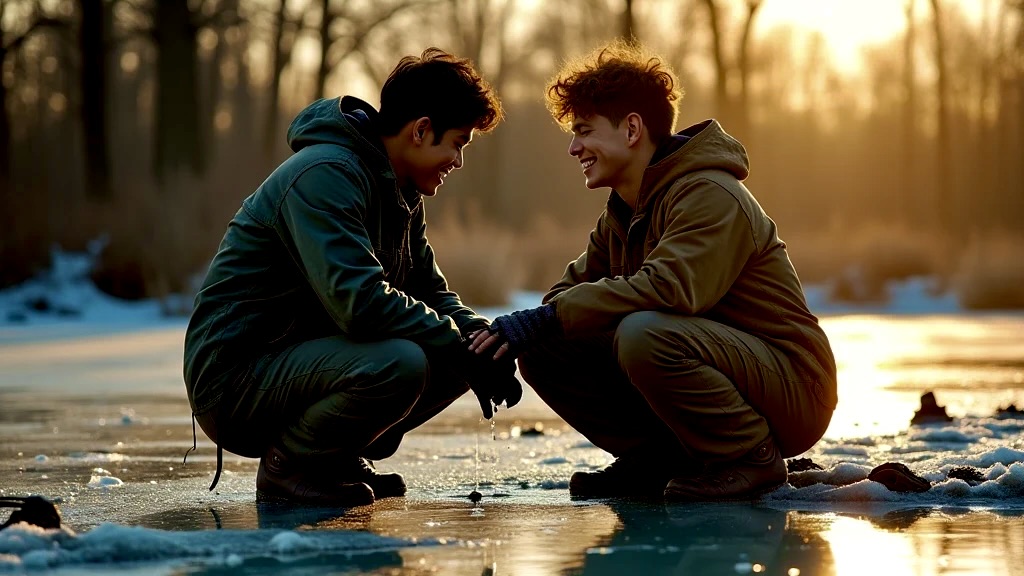
Leo and Gabe attempt one last ice fishing trip as the world melts and their future looms dangerously close.
The sled hit a patch of exposed mud and screeched. It was a violent, plastic-on-rock sound that set Leo’s teeth on edge. He adjusted his grip on the nylon rope, the cord cutting into his palm through his thin gloves. Behind him, Gabe was carrying the heavy power auger like it was a prop in a movie, slung over his shoulder, his face already slick with sweat. It was fifty-four degrees. They were wearing heavy Carhartt bibs and thermal layers because the calendar said it was winter, but the air said they were idiots.
“The trail’s gone,” Gabe said. He stopped to wipe his forehead with his sleeve. He looked ridiculous in the bright orange beanie, a neon beacon against the budding grey-green of the trees. “It’s just soup now.”
Leo didn’t look back. He kept his eyes on the shoreline of Miller’s Pond. The lake was small, a bruised thumbprint in the middle of a valley that was rapidly turning into a swamp. The ice didn’t look white anymore. It was a dull, saturated grey, the color of a wet sidewalk. “We’re here now. I’m not dragging this shit back up the hill without at least one hole in the ice.”
“We’re gonna fall through,” Gabe said, though he kept walking. He sounded like he didn’t particularly mind the idea. Falling through the ice into four feet of water seemed like a reasonable alternative to thinking about the next three months.
They reached the edge where the land turned into a slurry of dead cattails and slush. Leo stepped out first. The ice groaned. It wasn’t the sharp, healthy crack of mid-January. It was a deep, hollow sigh. The ice was honeycombed, full of air and water, losing its structural integrity by the minute. He felt the surface give slightly under his boot, a terrifying, spongy sensation. He shifted his weight. It held.
“It’s fine,” Leo lied. “The center’s still thick.”
“Famous last words,” Gabe muttered. He followed, his heavier frame making the ice complain even louder. They shuffled toward the middle of the pond, dragging the gear. The sun was an aggressive yellow bruise in the sky, beating down on them. Leo felt a bead of sweat crawl down his spine. It felt like a bug. He wanted to strip down to his T-shirt, but the ritual required the gear. If they weren’t dressed for the tundra, they were just two guys standing in a puddle.
They reached what they collectively agreed was the ‘deep’ spot—maybe ten feet. Gabe set the auger down. The metal bit clinked against the ice. He looked at Leo, his eyes squinting against the glare. “You want the honors? Or is your arm still sore from being a benchwarmer?”
“Shut up,” Leo said, reaching for the handle. He clicked the starter. The engine coughed, spat a cloud of blue smoke that smelled like gasoline and nostalgia, and then roared to life. The vibration traveled through Leo’s arms, rattling his collarbone. He pressed the blade into the ice.
Usually, the auger threw up dry, white chips like frozen glitter. Today, it sprayed grey slush. It was like drilling through a giant margarita. The blade sank fast. Too fast. Within seconds, a geyser of dark water erupted, flooding the surface around their boots. Leo killed the engine. The silence that followed was heavy, filled only by the sound of their own rhythmic breathing.
“Well,” Gabe said, staring at the hole. “It’s wet.”
“It’s a lake, Gabe. It’s supposed to be wet.”
Leo set up the buckets. They sat down, six feet apart, facing the hole. The water in the hole was dark and murky, swirling with bits of weed and silt. Leo rigged his line with a wax worm. His fingers felt clumsy. He looked at Gabe, who was staring off at the treeline, his rod tip hovering over the water. Gabe’s jaw was set in that way it got when he was scrolling through his emails.
“You hear back from the housing office?” Leo asked. He tried to make it sound casual, like he was asking about the weather.
“Yeah,” Gabe said. He didn’t look over. “Thunder Bay. West Campus. It’s a literal closet. I looked it up on Street View. There’s a dumpster right outside the window.”
“Classic,” Leo said. “At least you’ll have a view.”
“Of trash. Appropriate.” Gabe finally looked at him. “What about you? You still doing the Winnipeg thing?”
“Deposit’s in. I start orientation in August.”
“August,” Gabe repeated. The word hung there, melting like the ice. August was a death sentence. August was the end of the world.
Leo looked down at his flasher—the sonar device that was supposed to show him if there were fish below. The screen was a chaotic mess of red and green lines. The warm water was messing with the signal. Or maybe there was just too much junk in the pond. “I don’t think there’s anything down there,” he whispered.
“There’s always something,” Gabe said. “They’re just sluggish. Too much sun. They’re confused. They think it’s spring, but they’re still stuck under this.” He tapped the ice with his boot.
“It is spring,” Leo said.
“Technically.”
They sat in silence for twenty minutes. The ice continued to shift. Every few minutes, a loud boom would echo from the shoreline as the ice expanded and contracted. It sounded like distant artillery. In January, that sound was comforting—it meant the ice was growing. Now, it sounded like a warning. Leo watched a small stream of water flow from a higher point on the ice directly into their hole. It was a closed loop of decay.
“Remember that time we came out here in tenth grade?” Gabe asked suddenly. He was leaning back on his bucket, dangerously close to tipping. “The blizzard? Your dad’s truck got stuck in the drift?”
“We almost died,” Leo said. “I think my toes are still numb from that.”
“It was better then,” Gabe said. He wasn’t smiling. “At least it was cold. This middle-ground shit? It’s exhausting. Just melt or stay frozen. Don’t do both.”
Leo felt a sharp tug on his line. His heart skipped. It wasn’t a fish—it was too heavy, too dead. He reeled it in slowly. A clump of rotting lily pads broke the surface, dripping with black slime. He shook them off the hook, the smell of sulfur and old pond hitting his nose. “Gross.”
“Your big catch,” Gabe joked, but his voice lacked the usual bite. He reached into his pocket and pulled out his phone. He stared at the screen for a second, his face illuminated by the blue light, making him look pale and ghostly in the daylight. He put it back without checking anything.
“You okay?” Leo asked.
“I’m great. I’m sitting on a melting popsicle in the middle of a swamp. Life is peak.”
Leo shifted his bucket closer. The ice groaned, a long, low protest. He didn’t stop until his knee was inches from Gabe’s. He could feel the heat radiating off the other boy’s heavy bibs. Gabe didn’t move away. He didn't look up, either. He just stared at the hole.
“We could just go,” Leo said. “We don’t have to do this.”
“We’re doing it,” Gabe insisted. “One last time. It’s the tradition.”
“Traditions are for people who have futures,” Leo said. He didn’t know why he said it. It sounded more dramatic than he intended. It sounded like a line from one of the shows his sister watched. He felt an immediate spike of embarrassment, a hot flush creeping up his neck.
Gabe finally looked at him. His eyes were dark, shadowed by the brim of his hat. “That’s dark, Leo. Even for you.”
“You know what I mean. Everything’s changing. We’re going to be different people in six months. We’ll be 'Thunder Bay Gabe' and 'Winnipeg Leo.' We’ll have different coffee shops and different shitty roommates.”
“I’ll still be a prick,” Gabe said. “That’s a constant.”
“True.”
Leo reached out and steadying himself, he placed a hand on the ice between them. It was wet. The water was pooling around his glove. “Do you think we’ll actually talk? Or is this like the summer after middle school where we didn't speak for two months because you got obsessed with that one girl?”
“She was a lifesaver, Leo. Literally. She worked at the pool.”
“She ignored you for ten weeks.”
“Detail,” Gabe waved his hand. He looked back at the hole. “I’ll call you. I’ll text. I’ll send you memes of trash cans in Thunder Bay.”
“Okay.”
“I’m serious,” Gabe said. He turned his body toward Leo. The movement caused a small crack to spiderweb out from under his bucket. Neither of them looked down. “I’m not… I’m not good at the long-distance thing. With anyone. But you’re not 'anyone.'”
Leo’s pulse thudded in his ears. It was a heavy, rhythmic sound that drowned out the melting lake. He looked at Gabe’s mouth, then back at the hole. The air felt too thick. He felt like he was breathing in water. “Gabe.”
“Yeah?”
“The ice is really thin.”
“I know.”
“No, like… look.” Leo pointed. A circular fracture had formed around both of their buckets. They were effectively on their own island now, separated from the main sheet by a hairline fracture that was rapidly widening as the water seeped in.
They both stared at it. It was absurd. It was the physical manifestation of their conversation. If they moved too fast, the island would sink. If they stayed still, it would melt.
“If we fall in, I’m saving the auger first,” Gabe said. His voice was shaky, but he was trying to smirk. It was a bleak, desperate expression.
“The auger is seventy pounds, Gabe. You’ll drown.”
“Worth it. Do you know how much that thing costs?”
Leo felt a sudden, sharp laugh bubble up in his chest. It was the kind of laugh that came from pure stress. “We’re so stupid. We are literally the dumbest people in this county.”
“Probably the state,” Gabe added. He started to laugh too. It was a quiet, jagged sound.
They sat there, laughing at the precariousness of their situation, at the fact that they were twenty years old and about to be dumped into a freezing pond because they couldn't figure out how to say they’d miss each other. The ice groaned again, louder this time. A chunk of the edge broke off and bobbed in the water like a grey marshmallow.
“Leo,” Gabe said, his laughter dying down. He reached out and grabbed Leo’s forearm. His grip was tight, desperate. “I don’t want to go.”
“Me neither.”
“I mean… I don’t want to go to Thunder Bay without you.”
Leo looked at Gabe’s hand on his arm. The orange fabric of the glove against the dark brown of his sleeve. It felt like a tether. “We’ll figure it out. We’ll visit. It’s just a plane ride.”
“Planes are expensive. And I’m going to be a broke student.”
“I’ll drive. I’ll buy a shitty car and drive fourteen hours.”
“You hate driving.”
“I’ll hate it for you,” Leo said.
He looked up and met Gabe’s eyes. There was a moment there—a clear, sharp window where the irony dropped away. No jokes, no skepticism, no digital-native detachment. Just two kids on a sinking piece of ice. Gabe leaned in. It was a slow, tentative movement, the physical equivalent of a question mark.
Leo held his breath. He could see the individual eyelashes on Gabe’s lids, the small scar on his lip from a hockey game three years ago. The world felt very small. Just the two of them and the dark water.
Then, the ice gave way.
It wasn't a dramatic crash. It was a soft, squelching collapse. The island they were sitting on tilted sharply to the left. Leo’s bucket slid sideways, and he went down, his legs plunging into the frigid water. Gabe followed, a tangle of limbs and orange fabric.
“Shit!” Leo gasped. The cold hit him like a physical blow, a thousand needles piercing his skin. He scrambled for purchase, his hands sliding over the slick, honeycombed surface.
He felt a hand grab his collar and haul him upward. Gabe was standing in waist-deep water, his face twisted in a grimace of pure shock. The water was shallow enough to stand, but the mud at the bottom was like quicksand, sucking at their boots.
“I got you,” Gabe panted. He pulled Leo toward the more stable ice near the shore. They moved like zombies, heavy and dripping, their gear abandoned. The sled was floating away, the power auger partially submerged.
They reached the muddy bank and collapsed onto the dead grass. Leo was shivering violently, his teeth chattering so hard it hurt. The warm spring air now felt like a cruel joke against his soaked skin.
“You okay?” Gabe asked. He was dripping, his neon hat gone, his hair matted to his forehead. He looked pathetic. He looked beautiful.
“Cold,” Leo managed to say. “So cold.”
Gabe moved closer, wrapping his arms around Leo. It wasn't a romantic embrace; it was a survival tactic, but Leo didn't care. He pressed his face into Gabe’s wet shoulder, smelling the gasoline and the pond and the scent that was just Gabe.
“We’re idiots,” Gabe whispered into his ear.
“The biggest,” Leo agreed.
They sat there for a long time as the sun began to dip behind the trees, turning the melting pond into a sheet of liquid gold. The school year was almost over. The ice was gone. The water was cold, but the sun was finally, actually warm.
Leo pulled back just enough to look at Gabe. The ambiguity of the future was still there, a vast, terrifying ocean, but for a second, the ground felt solid again.
“We should go,” Leo said. “Before we get pneumonia.”
“Yeah,” Gabe said, but he didn't let go. He reached out and wiped a smudge of mud from Leo’s cheek. His thumb lingered there for a second too long to be an accident. “Let’s go.”
They stood up together, their boots squelching with every step as they headed back toward the truck, leaving their gear to sink into the mud, two figures moving through the long shadows of the ending season.
“As they reached the truck, Gabe didn't reach for his keys; instead, he reached for Leo’s hand, his grip tighter than the ice had ever been.”


