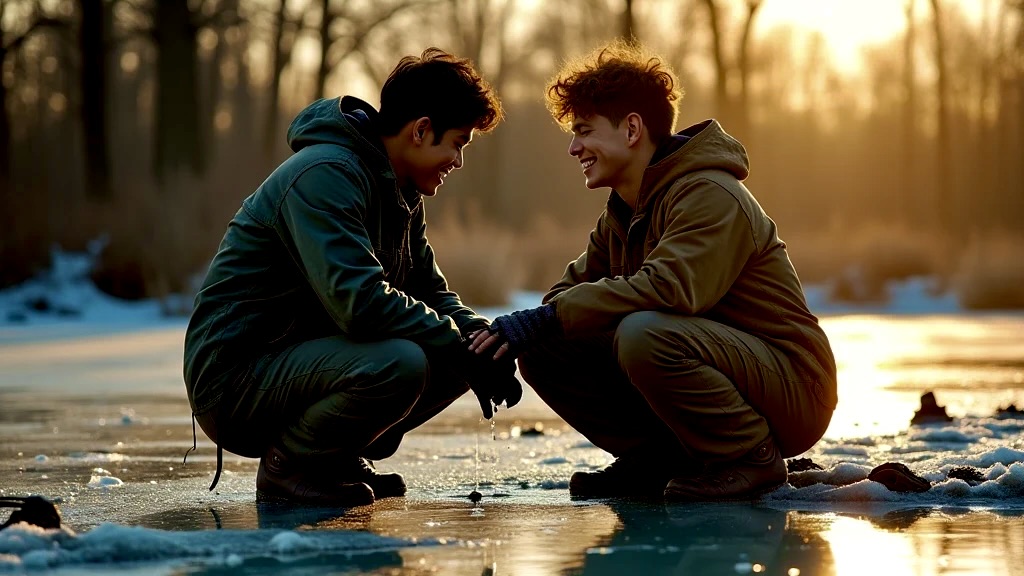
The story follows two young men, Leo and Gabe, as they embark on a final, ill-advised ice fishing trip in the transition between winter and spring. The ice on Miller’s Pond is rapidly decaying, serving as a metaphor for their own lives as they face impending separation and the end of their youth. Despite the obvious danger, they persist in the ritual, using the gear and the activity as a shield against the anxiety of their upcoming departures to different cities. Their attempt to fish culminates in the ice breaking beneath them, forcing them into the freezing, murky water. After narrowly escaping the pond, they retreat to the safety of the shore, finding a moment of fragile, intimate connection amidst the wreckage of their equipment and their plans.
The central theme of the narrative is the desperate, often destructive human need to cling to tradition when facing an inevitable transition. By choosing to fish on a pond that is quite literally melting, Leo and Gabe perform a ritual that has lost its foundation. The ice acts as a powerful symbol for the transitional period of young adulthood, representing a state of being that is neither fully solidified nor completely dissolved. This "middle-ground" existence is presented as an agonizing state of suspension where the characters must choose between the comfort of the past and the uncertainty of an independent future.
Another core theme is the failure of language to express profound emotional shifts. Throughout the narrative, the characters use sarcasm, cynical humor, and technical discussions about fishing gear to avoid addressing the grief of their separation. Their inability to speak directly about their bond until the moment of crisis highlights the difficulty of navigating intimacy in a culture that often demands a detached, ironic persona. The ice breaking is not merely a physical accident; it is a necessary collapse that strips away their defensive facades, forcing them to confront the reality of their feelings for one another.
Leo serves as the primary lens through which the reader experiences the tension between nostalgia and forward motion. He is acutely aware of the absurdity of their situation, yet he feels a compulsive need to see the task through to its end. This drive suggests a struggle with control; he attempts to impose order on a deteriorating environment because he cannot control the trajectory of his own life. His internal state is marked by a quiet, simmering anxiety that he hides behind a mask of pragmatism and occasional dry wit.
As the story progresses, Leo’s vulnerability surfaces. He is the one who initiates the deeper conversation about their future, signaling a desire for closure and honesty. His physical reactions—the hot flush of embarrassment and the thudding pulse—reveal his deep-seated fear of losing his connection to Gabe. By the end of the chapter, Leo moves from a position of detached observation to one of active emotional engagement, choosing to prioritize his relationship over the performative requirements of their friendship.
Gabe embodies the defensive use of cynicism as a survival mechanism against emotional pain. His insistence on carrying the power auger and his obsession with the cost of the equipment are displacement activities designed to distract him from the impending move to Thunder Bay. He projects a sense of bravado, yet his behavior—such as checking his phone and staring into the treeline—betrays a profound sense of displacement and lack of purpose. He is terrified of the change, viewing his future as a "death sentence" and a descent into obscurity.
Despite his prickly exterior, Gabe is the character who ultimately bridges the gap between them. His physical reach toward Leo on the ice is a desperate, uncharacteristic act of grounding. He uses the threat of the freezing water to force an ultimatum, whether consciously or not, that demands a response from Leo. His transition from mocking the situation to admitting he does not want to leave without his companion marks a significant emotional arc. He sheds his "prick" persona to reveal a person who is deeply reliant on the anchor of his friendship.
The narrative voice is visceral and grounded, utilizing sensory details to heighten the sense of physical danger and emotional decay. The author employs sharp, evocative imagery, such as the ice being described as a "bruised thumbprint" or a "wet sidewalk," to create a landscape that feels inherently hostile. The pacing is deliberate, mirroring the slow, suspenseful creep of the ice as it gives way. This methodical build-up creates a sense of inevitable dread that keeps the reader tethered to the precariousness of the protagonists' situation.
The tone shifts effectively from the cold, mechanical irony of the opening to the raw, intimate warmth of the conclusion. By focusing on the interplay between the "aggressive yellow" sun and the "cold, murky" water, the author underscores the internal conflicts of the characters. The dialogue is particularly effective in its realism, capturing the specific, shorthand rhythm of male friendship while leaving significant emotional weight in the spaces between words. The final scene, where the pond is transformed into liquid gold, provides a poignant contrast to the earlier decay, suggesting that while their old life has melted, a new, albeit uncertain, light has emerged.


