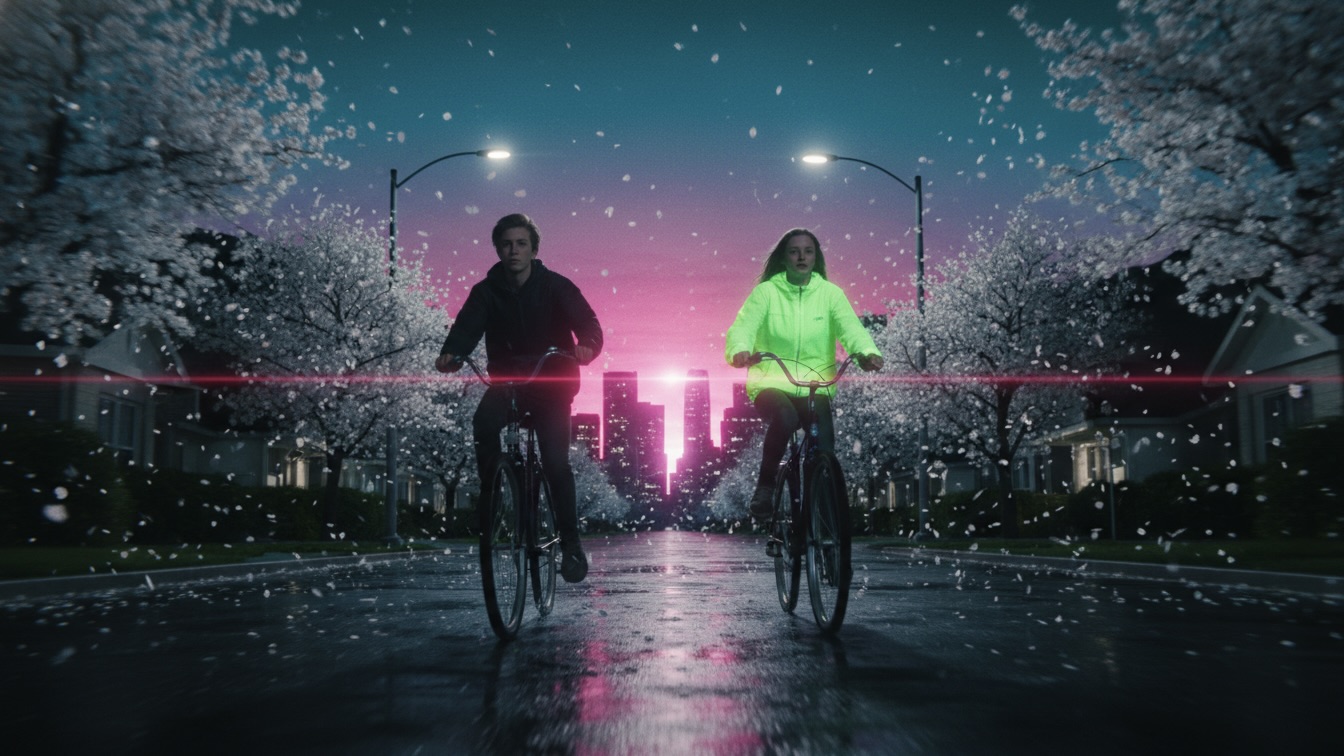
Stan and Sophie break into a vintage shop at midnight to find a film canister containing his parents' secrets.
Stan sat on the edge of his bed, the springs groaning under a weight that wasn't just his body. In his hand, he held a receipt. It was thermal paper, the kind that turns black if you leave it in a hot car, but this one had been tucked inside the inner pocket of his father’s old corduroy jacket for thirty years. The ink was a ghost, a pale grey whisper that read: RED CANISTER - HOLD. There was a date from 1976 and the name of a shop that shouldn't exist anymore: The Velvet Bin. To Stan, this wasn't just trash. It was a glitch in the timeline. His parents were currently arguing in the kitchen about the price of organic eggs, their lives a series of predictable loops. But this receipt suggested a version of them that existed before the loops began. It suggested a movie he hadn't seen yet.
He checked his phone. 11:34 PM. The screen glowed with a clinical, blue light that made his eyes ache. He swiped to Sophie’s contact. He didn't call. Nobody calls. He sent a photo of the receipt with a single caption: "The lore is real. We're going."
Three minutes later, a pebble hit his window. It wasn't a romantic tap. It was a sharp, aggressive thud that sounded like property damage. He looked down to see Sophie standing by her bike, her neon green windbreaker catching the yellow hum of the streetlights. She looked tired, her eyes rimmed with the faint redness of someone who had spent the last six hours staring at a laptop screen, but she was smiling that sharp, crooked smile that usually meant Stan was about to get them both in trouble.
"This is peak mid-life crisis behavior, Stan," she said when he climbed down the porch. "And you’re seventeen. It’s statistically impossible."
"It’s not a crisis. It’s a quest," Stan said, swinging his leg over his own bike. The metal was cold. The spring air felt like wet silk against his face, heavy with the smell of cut grass and the damp, metallic scent of the suburbs after a light rain. "My dad’s jacket has been in the attic since forever. I found this receipt in the lining. It’s for a film canister. A red one. From the year they met."
Sophie kicked up her kickstand. "So we’re breaking into a thrift store for some old photos? That is so delulu. Truly iconic, but deeply unhinged."
"The shop is still there, Soph. I checked. It’s on the edge of the industrial district. They probably still have it. Who picks up a 'Red Canister' in 2026?"
They pedaled out of the driveway, the sound of their tires on the wet asphalt a rhythmic, splashing hiss. The suburbs were quiet, but it was a fake quiet. Behind every darkened window, Stan imagined the hum of servers and the blue glow of televisions. Everything felt digitized, recorded, and filed away. He wanted something that wasn't on a cloud. He wanted the physical grain of a 1970s afternoon.
As they rode, the streetlights became more sparse. The neon signs of the strip malls flickered with a strange, unpredictable logic. A pink donut sign blinked in a rhythm that felt like a heartbeat. The world felt glitchy, like the frame rate was dropping. Stan felt a knot in his stomach, a physical weight that he couldn't quite name. It wasn't just the fear of getting caught. It was the fear that they would get there and find nothing. That the 'Red Canister' was just a dry cleaning tag or a forgotten deposit for a coat his father never liked.
"Why do you care so much?" Sophie asked, her voice cutting through the wind. She wasn't looking at him; she was focused on a pothole filled with oily water. "About the photos?"
Stan shifted gears. The chain rattled. "Because they look like they’re waiting for something in the old photos I have. In the digital ones, they just look tired. I want to see what they were waiting for."
Sophie didn't answer for a long time. They turned onto a gravel road where the trees grew thick and the blossoms of the cherry trees looked like white static against the dark sky. "You're looking for main character energy, Stan," she finally said. "You think if you find the 'secret' to their story, your own life will suddenly start having a plot."
"Does it have one now?" Stan asked.
"We’re biking to a crime scene at midnight in the rain," Sophie said. "I think that counts as a plot point."
They reached The Velvet Bin twenty minutes later. It was a low-slung brick building tucked between a closed car wash and a plumbing supply warehouse. The front window was filled with a chaotic display of mannequin heads wearing cracked leather flight helmets and a stack of televisions from the nineties. A faded sign in the window read: CLOSED SINCE THE FUTURE BEGAN. It was a joke, or maybe a warning.
Stan led the way to the back. The alley smelled of old grease and wet cardboard. He found the window he’d scouted on Google Earth—a small, hopper-style window near the roofline. It was slightly ajar, the latch rusted into a permanent state of indecision. He boosted Sophie up first. She was light, her sneakers leaving muddy marks on his shoulders.
"If I die in a pile of mothballs, I’m haunting your Spotify wrapped," she whispered, her legs disappearing into the dark opening.
Stan followed, his jacket catching on the frame. He dropped onto a pile of something soft and dusty. The air inside the shop was thick and stagnant. It tasted like time. He turned on his phone's flashlight, the beam cutting a narrow path through the gloom. They were in the clothing section. Thousands of polyester shirts hung from metal racks, their patterns loud even in the dark—sickly greens, burnt oranges, and browns that looked like dried blood.
"Over there," Stan whispered, pointing toward a glass counter at the front of the shop.
They moved through the racks. The fabric brushed against their arms, a thousand phantom touches from people who had long since grown old or moved away. Stan felt a sudden, sharp pang of vertigo. The store felt too big, the ceiling disappearing into a black void. He felt small, a tiny point of light in a sea of forgotten things.
"Stan," Sophie said, her voice barely a breath. "Look."
Behind the counter, on a shelf labeled 'UNCLAIMED MEMORIES,' sat a row of small metal boxes. And there, in the center, was a canister painted a chipped, vibrant red. It looked out of place, like a splash of fresh blood on a dusty floor.
Stan reached for it, his fingers trembling. His pulse was a dull thud in his fingertips. He could feel the cold metal, the weight of the film inside. This was it. The evidence. The physical proof of a moment that hadn't been compressed into a JPEG.
Suddenly, the floorboards creaked at the far end of the store. A heavy, rhythmic sound. Thump. Thump. Thump.
"Hide," Stan hissed.
They dove into a rack of oversized faux-fur coats. The smell of cedar and old perfume enveloped them. Stan was pressed against Sophie, her heart beating against his arm. Through the gap in the coats, he saw a beam of light much stronger than his own. It swept across the room, illuminating the dust motes like a swarm of golden insects.
Guard Franklin walked into the light. He was a man in his sixties, his uniform shirt strained at the buttons, a single earbud hanging from his left ear. He didn't look like a threat; he looked like a man who was deeply confused by his own existence. He stopped in front of the counter, his flashlight landing directly on the spot where the red canister had been a second ago.
"I know you're in here," Franklin said. His voice was gravelly, tired. "I saw the bikes. You kids are low-key unhinged. You know that? It's midnight. Go home and watch Netflix like normal people."
Sophie squeezed Stan's hand. Her palm was sweaty. Stan felt a sudden urge to laugh, a hysterical bubble rising in his chest. The absurdity of the moment—the fur coats, the red canister, the guard talking like a TikTok comment—it was all too much.
"We just want the canister," Stan whispered, though he knew Franklin couldn't hear him.
"I'm calling the cops in five minutes," Franklin announced to the empty room. He sighed, leaning against the counter. "This job is a fever dream. I swear. Every spring, you kids get some idea in your heads. Last year it was the vintage typewriters. Year before that, it was the polaroids. Just... why?"
Stan looked at Sophie. Her eyes were wide, reflecting the faint light from the guard's flashlight. In that moment, he didn't care about his parents' first date. He didn't care about the 1970s. He cared about the way Sophie was looking at him—not like he was a background character, but like he was the only thing in the room that mattered.
"I'm scared," Stan whispered, his voice so low it was almost internal.
"Of the guard?" Sophie breathed.
"Of the future. Of it just being... more of this. Screens and loops. I don't want to be a digital ghost."
Sophie moved closer, her forehead resting against his shoulder. "You're not a ghost, Stan. You're a felon. There's a difference."
Franklin turned his back to check the front door. This was it. The window of opportunity.
"Run," Stan said.
They burst from the coats like a pair of startled birds. Stan grabbed the red canister from the counter as they sprinted past. Franklin yelled, a surprised, strangled sound, his flashlight swinging wildly.
"Hey! Stop! You're actually being so extra right now!" Franklin shouted, his heavy boots thumping on the wood as he gave chase.
They didn't stop. They scrambled over the crates, Stan boosting Sophie back up to the high window. He felt a hand brush his ankle just as he hauled himself up. He kicked out, hitting something soft, and then he was through, tumbling onto the wet gravel of the alleyway.
Sophie was already on her bike, her legs moving before her feet were even on the pedals. "Go! Stan, go!"
They tore down the gravel road, the wind screaming in their ears. Behind them, the lights of the industrial district blurred into a long, neon smear. The rain started to come down harder, a sudden spring downpour that turned the world into a smudge of grey and silver. Stan reached into his pocket, his hand closing around the cold, hard cylinder of the red canister. He had it. He had the glitch.
They didn't stop until they reached the park, huddling under the concrete pavilion as the storm broke overhead. They were soaked, their hair plastered to their foreheads, their lungs burning from the cold air.
Sophie started to laugh. It was a loud, genuine sound that echoed off the concrete. "We are so cooked. Franklin definitely saw your face."
"He was too busy trying to remember what year it was," Stan panted, pulling the canister out.
He looked at the red metal. It was beautiful in its simplicity. No buttons, no screens, no updates. Just a secret held in a box. He went to twist the cap, his heart hammering a frantic rhythm against his ribs.
"Wait," Sophie said, her hand stopping his. "Are you sure you want to know?"
Stan paused. The rain drummed on the metal roof above them. If he opened it, the mystery was over. The movie would end. But if he didn't, the story could stay exactly as it was in his head—perfect, vibrant, and real.
He looked at Sophie. The neon light from a distant billboard turned the rain on her cheeks into tiny, glowing sparks. She wasn't a character in a movie. She was right here.
He twisted the lid. It gave way with a dry, metallic screech.
Inside, there was no film.
Stan’s heart dropped. He tipped the canister over into his palm. A small, folded piece of paper fell out, followed by a single, heavy silver ring with a blue stone.
He unfolded the paper. It wasn't a receipt. It wasn't a secret. It was a note, written in his father’s messy, teenage scrawl: "If you're reading this, you probably broke in. I knew you couldn't resist a good mystery, Stan."
Stan froze, the paper trembling in his hand.
“Stan froze, the paper trembling in his hand as he realized the mystery had been a trap set decades in advance.”


