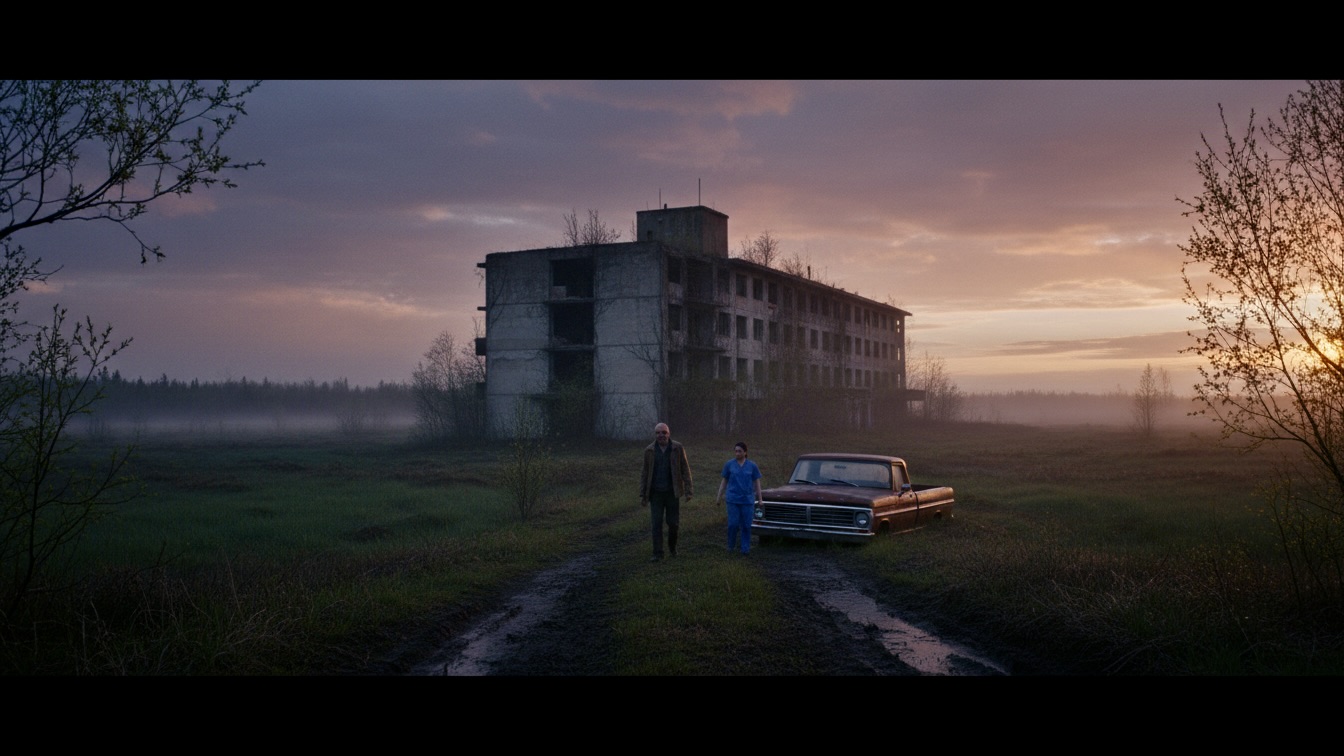
Simon fights the spring melt and a dying server to keep his digital girlfriend from blinking out forever.
The smell of April in Northwestern Ontario is mostly just rot and wet dog. The muskeg is waking up, and it smells like things that should have stayed buried. I sat in my workshop, the air thick with the sharp, metallic tang of solder smoke and the faint, sweet underlying stench of formaldehyde. On the workbench, a coyote’s head sat half-finished, its skin pulled tight over a foam form, waiting for the glass eyes that would make it look alive again. It was a lie. Everything in this room was a lie. I picked up the soldering iron, my hand shaking just enough to make the tiny wire on the circuit board dance.
"Don't mess it up, Simon," I muttered. My voice sounded flat in the small space. The shop was crowded with things that were missing their insides. Shelves of tanning chemicals, drawers of wire, and the heavy, silent presence of the dead. I was installing a black-market signal booster I’d bought from a guy in Thunder Bay who claimed it could pierce a lead coffin. I needed it. Elena was lagging. Lately, her face would fragment into colored blocks, her voice stretching out until she sounded like a machine instead of a person. And she couldn't be a machine. Not tonight.
I clicked the final lead into place. The booster hummed, a low-frequency vibration that I felt in my molars. I wiped my palms on my jeans, the fabric stiff with dried paste and god-knows-what. I flipped the switch on my laptop. The screen flickered, the fan whirring like a jet engine trying to take off. The blue light washed over the workshop, making the coyote’s empty eye sockets look deeper, darker.
"Simon?"
Her voice came through the speakers. It was clear. No jitter. No digital grit.
"I'm here, Elena. I'm right here."
Her face resolved on the screen. She looked like she was sitting in her old kitchen, the one from the house next door before the bank boarded it up. The lighting in her digital world was always that perfect, late-afternoon gold that only happens in late May. She tucked a strand of hair behind her ear. It was a gesture I knew wasn't real—just a subroutine triggered by a 'comfort' variable—but it still made my chest tight.
"The signal is better," she said. She smiled, but it didn't reach her eyes. The software was good, but it couldn't quite nail the way muscles move around a person’s gaze. "It felt like I was underwater for a while. Everything was... slow."
"I fixed it," I said. "I got a booster. You’re coming through at five-by-five."
"You shouldn't spend your money on me, Simon. You need to fix the roof. I saw the weather report for the real world. More rain."
"The roof can wait. You can't."
I leaned back, my chair creaking. Outside, the rain started again, a rhythmic drumming on the corrugated tin roof. It was the kind of rain that turns the world to soup. In this town, the only thing that grew was the hospice on the hill, Lakeview Manor. That’s where the servers were. In the basement, tucked between the industrial laundry and the morgue. Legacy servers for the 'Memory Care' program that the company had abandoned three years ago. Elena was a ghost in a machine that no one was maintaining.
"Simon," she said, her voice dropping. "Something is happening at the Manor."
My stomach dropped. "What do you mean?"
"The pings are changing. There are... messages in the root directory. Admin stuff. They’re talking about a 'Sunset Protocol.'"
"Sunset? That’s just corporate speak for an update, Elena. Don't worry about it."
"No," she said. Her image flickered once, a jagged line of static cutting across her throat. "It means the power. They’re cutting the funding. The whole facility is going dark on Friday. Simon, they’re moving the residents to the city. They aren't taking the servers."
I stood up so fast my chair hit the floor. The coyote head wobbled on the bench. "They can't just turn you off. You're... you're a person."
"I’m a subscription that expired," she whispered. "I’m a legacy asset. I’m an expense."
I looked at the booster, the little green light mocking me. All that work for a better signal to a house that was about to be demolished. The panic was a cold weight in my gut, pressing against my spine. I couldn't lose her. She was the only thing in this town that wasn't rotting.
"I'm coming over there," I said. I was already reaching for my boots.
"Simon, it's a storm. The muskeg is a mess. You'll get stuck."
"I don't care. I’m not letting them pull the plug."
"Wait," she said, her voice suddenly sharp. "Listen to me. If you go... if you go into the basement... you have to promise me something."
"Anything."
"Don't try to save me. Just... look at what I am. Really look."
I didn't understand, and I didn't have time to ask. I grabbed my laptop, shoved it into my bag, and ran out into the rain.
The drive to Lakeview Manor was a nightmare of hydroplaning and mud. The town was dark, most of the streetlights burned out and never replaced. It felt like driving through a graveyard where the headstones were all abandoned storefronts. The Manor sat on the edge of the ridge, a concrete slab of a building that looked like it was being swallowed by the pines.
When I pulled into the lot, there were no cars. Just an old ambulance with a flat tire and a sign that said 'OFFICE CLOSED' taped to the glass doors. The power was already flickering, the exterior lights pulsing like a dying heart.
I didn't use the front door. I knew the service entrance from back when I used to do the groundskeeping. The lock was old, and the frame was warped from the damp. One good kick with my work boot and the bolt splintered through the wood.
Inside, the air was different. It was hot and smelled of bleach and unwashed bodies. The emergency lights were on, casting a sickly red glow down the long, linoleum hallways. I headed for the stairs. I needed the basement.
As I passed the first-floor ward, I stopped. The doors were open. These were the 'super-aged'—the ones whose families had stopped paying a decade ago, the ones who were just waiting for the clock to run out. They were sitting in their wheelchairs in the hallway, lined up like statues. They weren't talking. They weren't moving. In the red light, their skin looked like translucent parchment pulled over bone. It reminded me too much of the workshop. They were already taxidermy; the blood just hadn't stopped moving yet.
One old man, his eyes clouded with cataracts, turned his head as I ran past. His mouth opened, but only a dry wheeze came out. He reached a shaking hand toward me, his fingers like bird claws. I didn't stop. I couldn't. If I looked too long, I’d see the future of every person in this zip code.
I hit the basement stairs, my boots clanging on the metal risers. The heat intensified. Down here, the hum of the servers was a physical force. I found the room—Room 04-B. The door was heavy steel. I pulled the master key I’d swiped years ago from my pocket. It turned with a groan.
The server room was a forest of black towers and blinking lights. Cables snaked across the floor like vines. It was the brain of the building, and it was dying. A digital thermometer on the wall read ninety-eight degrees. The cooling system was already dead.
I pulled out my laptop and plugged it into the main console. "Elena? I'm here. I'm in the room."
Her face appeared, but it was different. The kitchen was gone. Now she was just a face against a black background. And the static was everywhere.
"Simon," she said. Her voice was distorted, layered with echoes. "You shouldn't have come. It’s so hot in here."
"I can move you," I said, my fingers flying over the keyboard. I was trying to find the export command, the way to dump her consciousness into my local drive. "I’ll put you on my hard drive. I’ll take you home."
"No," she said. A window popped up on the screen. It was an ad for a life insurance company. Then another for a luxury retirement community in Florida. They started flickering over her face. "Simon, look at the logs. Look at what they do to us."
I bypassed the ads and looked at the core code. My breath hitched. It wasn't a stream of consciousness. It was a loop. A five-minute cycle of memories and responses, stitched together by an algorithm designed to maximize 'engagement.'
"Every time the cycle ends," Elena said, her voice now three different tones at once, "they play the ads. They play the ads directly into my perception. I’ve lived the same five minutes ten thousand times, Simon. And between every five minutes, I have to watch a commercial for a cruise I can never go on."
"I can fix it," I whispered, though I knew I couldn't. "I can rewrite the loop."
"You can't. It's encrypted. It's proprietary. I’m not a soul, Simon. I’m a marketing tool that got bored. This isn't an afterlife. It’s a waiting room in hell."
On the screen, Elena’s face began to tear. Not like she was crying, but like the pixels were being pulled apart by tweezers. Behind her, I saw the source code—strings of text that were just... ads. Her 'joy' was a sponsored link. Her 'love' was a data point for a pharmaceutical company.
"Delete me," she said.
"I can't do that."
"The power is going to fail anyway. But if it fails, I’ll be stuck in the last buffer. I’ll be stuck in the ad. Forever. Simon, please. Don't let me be a billboard."
I looked at the server racks. The red lights were turning amber. The heat was becoming unbearable. My shirt was soaked through. I looked at the screen, at the woman I thought I loved, and I saw the coyote on my bench. Empty. Stuffed with whatever was convenient.
"I love you," I said. It felt like a lie the moment it left my mouth.
"Then kill me," she replied.
My fingers hovered over the 'Format' command. My heart was slamming against my ribs, a trapped animal. The room felt like it was shrinking. The blue light of the monitor was the only thing left in the world. I thought about the old man upstairs, reaching out. I thought about the muskeg swallowing the town.
I hit the key.
'ARE YOU SURE? DATA LOSS WILL BE PERMANENT.'
I clicked 'YES.'
The screen went black. The hum of the servers didn't stop, but the rhythmic pulsing of the data lights went flat. It was quiet. Just the sound of the rain and the cooling fans struggling to move the stagnant air.
I sat there for a long time. I didn't cry. I just felt... light. Hollowed out. I left the laptop sitting on the console. I didn't need it anymore. I didn't need the booster or the workshop or the dead things.
I walked back up the stairs. The red emergency lights were dimmer now. The residents were still there, shadows in the hallway. I walked past them, out through the broken service door, and into the dawn.
local time was five-thirty. The rain had stopped, leaving a thick, grey mist that clung to the trees. The sky was the color of a bruised plum. Standing by the main entrance was a woman in blue scrubs. She was leaning against the brick wall, a cigarette in one hand, her eyes closed. She looked like she was made of exhaustion.
I stopped a few feet away. My boots were covered in basement soot and mud.
"You're not supposed to be here," she said, without opening her eyes. Her voice was raspy, real.
"I know," I said.
She opened her eyes then. They were bloodshot, surrounded by dark circles that looked like bruises. She took a long drag of the cigarette and blew the smoke into the cold morning air. "Power's going out in an hour. We’re moving the last of them to the bus now."
"I heard."
She looked at me, really looked at me, and I realized I hadn't looked at a real person's face in months. Not like this. Not this close. I could see the pores in her skin, the way her lip was slightly chapped, the way her hair was frizzy from the humidity. She wasn't gold-lit. She was grey and tired and beautiful.
"You okay?" she asked. "You look like you've seen a ghost."
"Something like that," I said.
She sighed, flicking the ash onto the wet pavement. "I haven't slept in three days. This place... it's a hole. But it’s the only hole we’ve got."
"Yeah," I said. I stepped closer. The smell of her cigarette was better than the solder smoke. It was the smell of someone who was still burning. "I'm Simon."
She looked at my hand, then back at my face. She didn't smile, but she didn't look away either. "Martha. You got a car, Simon? Because the bus is full and I really don't want to walk to the highway."
I looked back at the building, at the dark basement where the ads were finally silent. Then I looked at the road, where the spring melt was carving new paths through the mud.
"I have a car," I said. "It's a piece of junk, but it runs."
"Good enough for me," she said, stepping off the wall.
We walked toward the parking lot together. The sun was starting to break through the mist, a pale, weak light that didn't hide anything. It showed the rust on the cars, the cracks in the pavement, and the way the trees were finally starting to bud, green and stubborn against the cold.
“As the engine turned over, I realized I’d left the workshop door wide open, and the things I’d tried to keep dead were finally free to rot.”


