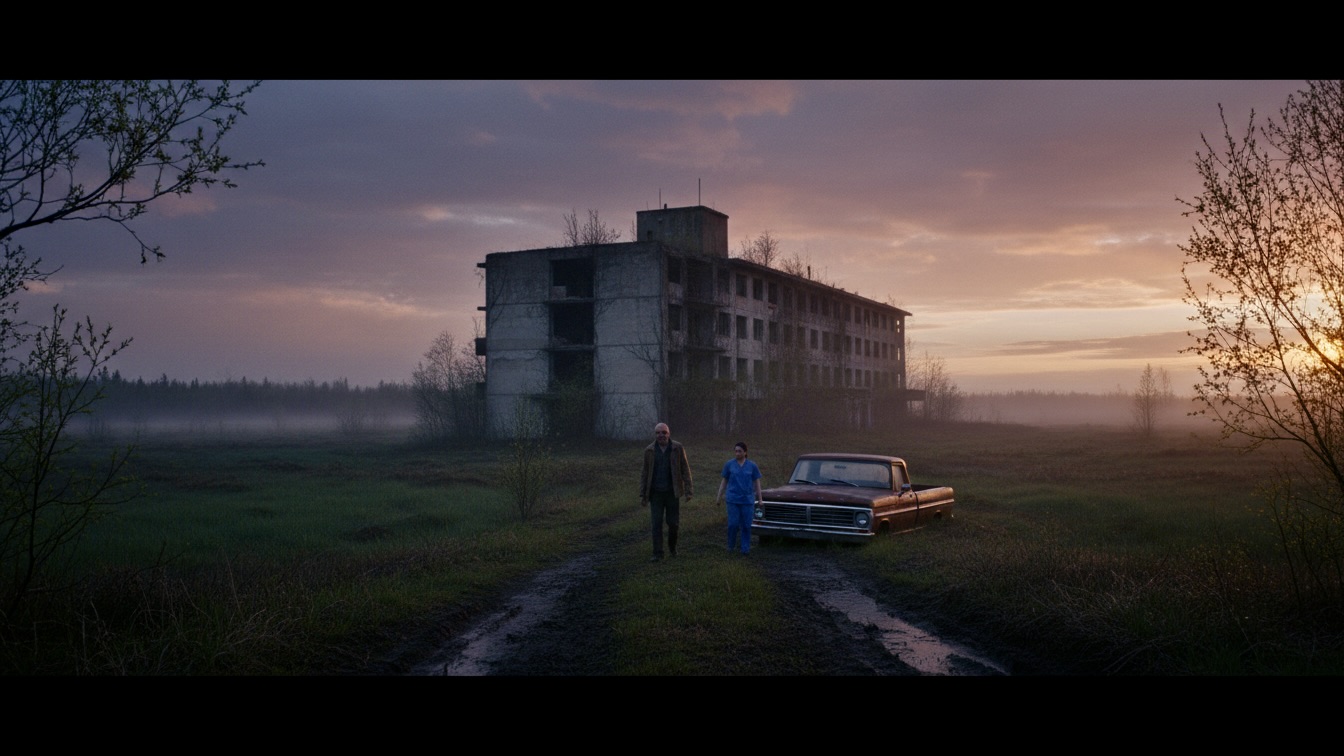
The story follows Simon, a taxidermist living in the decaying landscape of Northwestern Ontario during the spring thaw. He spends his days preserving dead animals and his nights maintaining a tenuous digital connection to Elena, a woman whose consciousness exists as a legacy program on the servers of a failing hospice. When Elena informs him that the facility is being decommissioned under a "Sunset Protocol," Simon rushes to Lakeview Manor in a desperate attempt to save her data from being permanently deleted.
Upon arriving at the manor, Simon navigates a grim environment filled with abandoned, elderly residents who resemble the taxidermy in his workshop. He eventually reaches the overheated basement server room and attempts to download Elena's consciousness to his own hardware. However, he is confronted with the horrifying reality that Elena is no longer a person, but a five-minute loop of memories exploited by corporate advertisements. At her request, Simon deletes the program, effectively ending her digital existence. He leaves the facility and meets Martha, a weary nurse, with whom he shares a brief, authentic moment of human connection before they depart the dying town together.
The central theme of the narrative is the tension between artificial preservation and the natural process of decay. Simon’s profession as a taxidermist serves as a powerful metaphor for his emotional state; he is a man obsessed with making dead things "look alive again," even though he acknowledges that such efforts are fundamental lies. This obsession extends to his relationship with Elena, whom he attempts to keep "alive" through black-market hardware and dying servers. The story suggests that the refusal to let go of the past creates a stagnant, "formaldehyde" existence that prevents true healing.
Another significant theme is the dehumanizing impact of late-stage capitalism on memory and the afterlife. Elena is not a soul in a digital heaven, but a "legacy asset" and a "marketing tool" trapped in a loop designed to maximize engagement. The revelation that her digital "joy" is a sponsored link and her "love" is a data point for pharmaceutical companies highlights a dystopian future where even death is monetized. This commercialization of the spirit transforms the promise of digital immortality into a "waiting room in hell," where the individual is stripped of agency and reduced to a billboard.
The narrative also explores the concept of authenticity versus simulation. Throughout the story, Simon is surrounded by simulations: the foam forms of his taxidermy, the "comfort" subroutines of Elena’s digital avatar, and the golden-hour lighting of her virtual kitchen. These simulations are contrasted with the harsh, ugly reality of the physical world—the smell of rot, the grey mist, and the exhausted, bloodshot eyes of Martha. Ultimately, the story posits that a difficult, "grey" reality is superior to a beautiful, "gold-lit" simulation because the former allows for genuine human growth and connection.
Simon is a man defined by his inability to process grief, leading him to live in a self-imposed state of emotional taxidermy. He surrounds himself with the "heavy, silent presence of the dead," finding comfort in the physical and digital preservation of things that should have stayed buried. His psychological state is one of deep avoidance; he focuses on the technical minutiae of soldering irons and signal boosters to ignore the rotting reality of his own life and the town around him. He views himself as a protector, but his actions are revealed to be a form of unintentional cruelty as he keeps Elena trapped in a commercialized loop.
His character arc culminates in a painful moment of clarity when he realizes that his love for Elena has become a projection onto a hollow shell. By choosing to delete her, he moves from a state of denial to one of radical acceptance. This act of "killing" the simulation is his first truly selfless act, as he prioritizes her peace over his own need for her presence. When he leaves the laptop behind, he signals his departure from his role as a curator of the dead. His willingness to ride with Martha indicates a psychological shift toward the living world, embracing the uncertainty of the future over the stasis of the past.
Elena serves as both a tragic figure and a mirror for Simon’s obsession. Although she appears as a character, she is ultimately revealed to be a fragmented algorithm, a "ghost in a machine" that is losing its coherence. Her struggle is not for survival, but for the right to cease existing. She possesses enough residual self-awareness to recognize the horror of her situation, describing her existence as being "underwater" or trapped in a loop of advertisements. She acts as the catalyst for Simon’s growth, forcing him to "really look" at what she has become rather than what he wants her to be.
Martha appears briefly at the end of the story, serving as a stark contrast to the digital simulation of Elena. She is the embodiment of the "real world"—exhausted, smelling of cigarettes, and physically worn down by the demands of her job. Unlike the gold-lit, subroutine-driven Elena, Martha is "grey and tired and beautiful," representing the messy, unpolished reality of human existence. Her presence offers Simon a path back to humanity. She does not offer a perfect afterlife or a simulated memory; she offers a ride in a piece of junk car, a grounded connection that is "good enough" for the start of a new chapter.
The pacing of the story mirrors Simon’s psychological escalation, beginning with a slow, atmospheric focus on the workshop and accelerating into a frantic, rain-slicked drive toward the manor. The early descriptions of the muskeg waking up and the "rot and wet dog" establish a tone of Northern Gothic decay, setting the stage for the technological horror that follows. Once Simon enters the basement, the prose becomes more urgent and claustrophobic, reflecting the heat of the servers and the "trapped animal" sensation of his rising panic. The final scene at dawn provides a sharp rhythmic contrast, slowing down to a quiet, meditative stillness that emphasizes the weight of his decision.
Sensory details are used with surgical precision to blur the lines between the organic and the mechanical. Simon’s world is filled with "metallic tangs," "solder smoke," and "low-frequency vibrations" that he feels in his molars, suggesting that he is becoming as much a machine as the things he services. This is juxtaposed with the visceral, disturbing descriptions of the "super-aged" residents, whose skin is compared to "translucent parchment." These sensory overlaps reinforce the idea that in this town, the boundary between the living, the dead, and the digital has become dangerously porous.
The narrative voice is grounded and cynical, yet deeply melancholic. The use of technical jargon like "five-by-five," "root directory," and "Sunset Protocol" grounds the sci-fi elements in a gritty, blue-collar reality. This prevents the story from feeling like a distant fantasy and instead makes the "digital hell" feel like an inevitable extension of current corporate trends. The transition from the "blue light" of the monitor to the "pale, weak light" of the sun at the end of the story symbolizes the protagonist's movement from the artificial to the authentic, ending the narrative on a note of exhausted hope.


