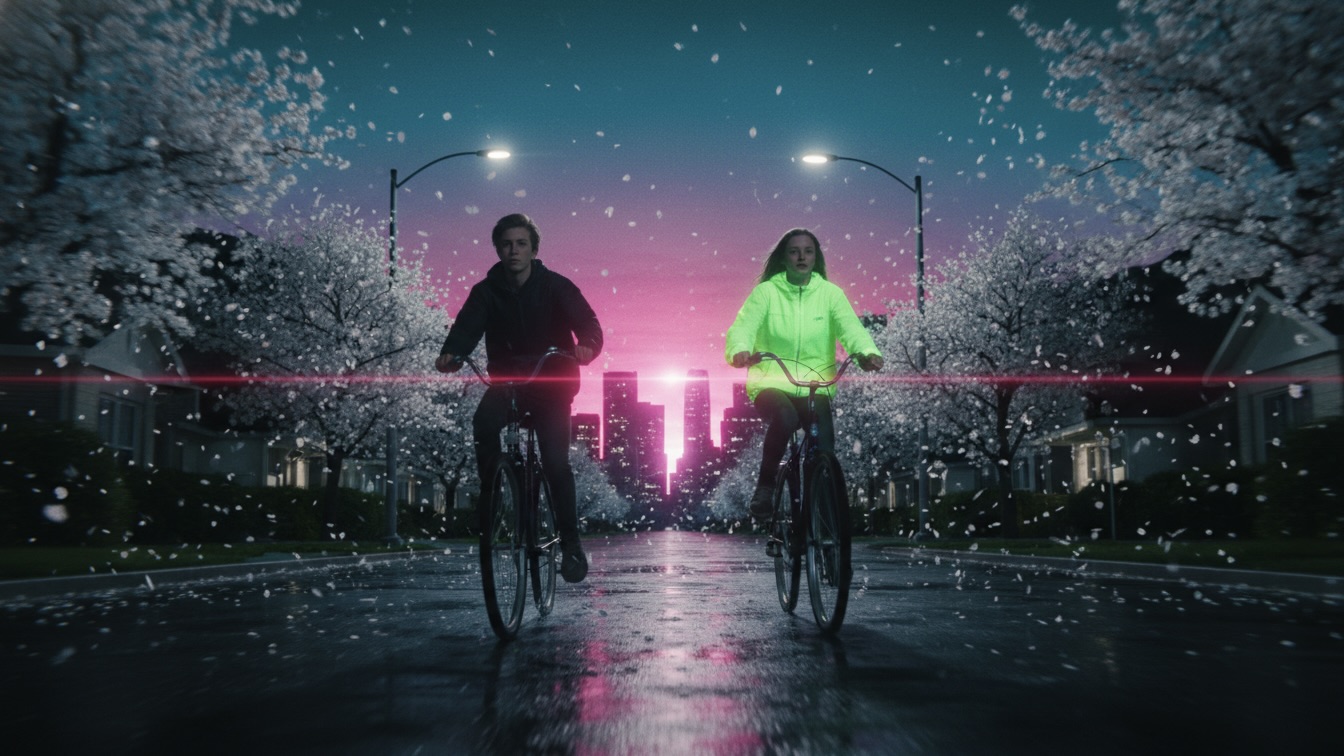
Stan is a seventeen-year-old boy who discovers a thirty-year-old receipt tucked into the lining of his father’s old corduroy jacket. The receipt, dated 1976, is for a "red canister" held at a shop called The Velvet Bin. Feeling trapped in a world of digital loops and predictable routines, Stan views this physical artifact as a gateway to a more authentic, cinematic past. He recruits his friend Sophie to join him on a late-night mission to retrieve the item, hoping to find a secret that will give his own life a sense of narrative purpose.
The two teenagers bike through a rainy, suburban landscape that Stan perceives as glitchy and artificial. They reach the industrial district and break into the dusty, relic-filled thrift store through a high window. Inside, they find the red canister sitting on a shelf labeled for unclaimed memories. Their mission is nearly thwarted by a security guard named Franklin, who discovers their presence but expresses a weary, modern frustration with their antics. After a narrow escape, Stan opens the canister in a park, expecting to find old film. Instead, he discovers a ring and a note from his father, revealing that the entire mystery was a carefully laid trap designed for a son who could not resist a good story.
The primary theme of the story is the conflict between the physical and the digital worlds. Stan perceives his modern life as a series of "clinical blue" screens and "digital ghosts," where everything is compressed and filed away in a cloud. He craves the tactile reality of the past, symbolized by the "physical grain" of 1970s film and the smell of old cedar. This hunger for the tangible suggests a psychological need to connect with a reality that feels permanent rather than fleeting and pixelated.
Another central theme is the search for "main character energy" and narrative identity. Stan feels like a background character in a world of repetitive loops, and he seeks a "quest" to validate his existence. Sophie identifies this as a desire for a "plot," highlighting the modern struggle to feel significant in a hyper-recorded society. The red canister represents the hope that there is a hidden, vibrant layer to reality that has not yet been flattened by the mundane demands of adulthood.
The story also explores the concept of generational echoes and the continuity of the human spirit. Stan believes his parents are "tired" and "predictable," yet the ending reveals that his father was once exactly like him. The note in the canister bridges the gap between the 1970s and 2026, suggesting that the desire for mystery and rebellion is a hereditary trait. This revelation reframes the father not as a digital ghost, but as a co-conspirator in Stan's search for meaning.
Stan is a protagonist defined by his deep existential dissatisfaction and his longing for a life that feels like a movie. He is highly sensitive to his environment, perceiving the suburbs as a "fake quiet" and his parents' lives as stagnant loops. This perspective drives him to seek out the red canister as a way to "glitch" the timeline and find a version of his family that was once full of anticipation. He is not merely looking for photos; he is looking for a reason to believe that his own future is not doomed to be a series of "predictable loops."
Psychologically, Stan exhibits a classic adolescent search for identity, though it is filtered through a contemporary lens of digital fatigue. He is fearful of becoming a "digital ghost," a fear that manifests as a physical knot in his stomach. His decision to break into a store is an act of rebellion against the sanitized, safe world he inhabits. By choosing a physical quest over a digital distraction, he attempts to reclaim a sense of agency and weight in his own life.
By the end of the chapter, Stan’s internal conflict shifts from a search for external secrets to a realization of internal connection. When he opens the canister and finds his father’s note, his perception of his father is fundamentally altered. He realizes that the "main character energy" he was hunting for was something his father had already anticipated and perhaps even shared. This discovery forces him to see his parents as individuals with their own histories of mystery and mischief, rather than just tired figures in a kitchen.
Sophie serves as the pragmatic yet adventurous foil to Stan’s brooding idealism. She is sharp-witted and uses modern slang as a shield, mocking Stan’s "mid-life crisis" while simultaneously participating in his "unhinged" behavior. Her role is to ground the narrative, providing a cynical perspective that highlights the absurdity of their mission. Despite her sarcasm, her willingness to bike through the rain and break into a building reveals a deep loyalty to Stan and a shared desire for excitement.
Her psychology is marked by a keen observational sense; she is the one who points out that Stan is looking for a "plot" for his life. She understands the performative nature of their generation, yet she is not immune to the thrill of a real-world stakes. When she is hiding in the fur coats, her physical proximity to Stan and her shared fear create a moment of genuine connection. This connection is more real to her than the "lore" they are chasing, suggesting she values human relationships over historical artifacts.
In the final scene, Sophie acts as the voice of caution and reflection. She asks Stan if he is sure he wants to know the truth, recognizing that the mystery itself might be more valuable than the answer. Her laughter after the escape signals a release of tension and an appreciation for the "felony" they committed together. For Sophie, the value of the night is not in the canister’s contents, but in the shared experience of being "extra" in a world that often feels mundane.
The narrative voice of the story is characterized by a blend of atmospheric, literary prose and sharp, contemporary dialogue. The author uses sensory details to create a vivid contrast between the sterile present and the dusty, textured past. Descriptions like "wet silk" air and "clinical, blue light" establish a mood that is both nostalgic and anxious. These details allow the reader to feel Stan’s sensory overload and his specific repulsion toward the digital landscape.
The pacing of the chapter is carefully managed, moving from a slow, contemplative opening to a high-stakes heist. The tension builds as the teenagers move through the "chaotic display" of the shop, with the author using the setting to evoke a sense of vertigo and timelessness. The arrival of Guard Franklin introduces a sudden shift in tone, as his modern way of speaking clashes with the ancient atmosphere of the thrift store. This juxtaposition serves to remind the reader that even the "past" is being guarded by the present.
The author employs the "Red Canister" as a powerful narrative MacGuffin that ultimately subverts the reader's expectations. The use of modern slang like "delulu," "peak," and "cooked" anchors the story in a specific cultural moment, making Stan’s desire for the 1970s feel more poignant. The final image of the rain turning into "tiny, glowing sparks" on Sophie’s cheeks provides a cinematic conclusion. This stylistic choice emphasizes that the beauty Stan was looking for in the past was actually present in his current reality all along.


