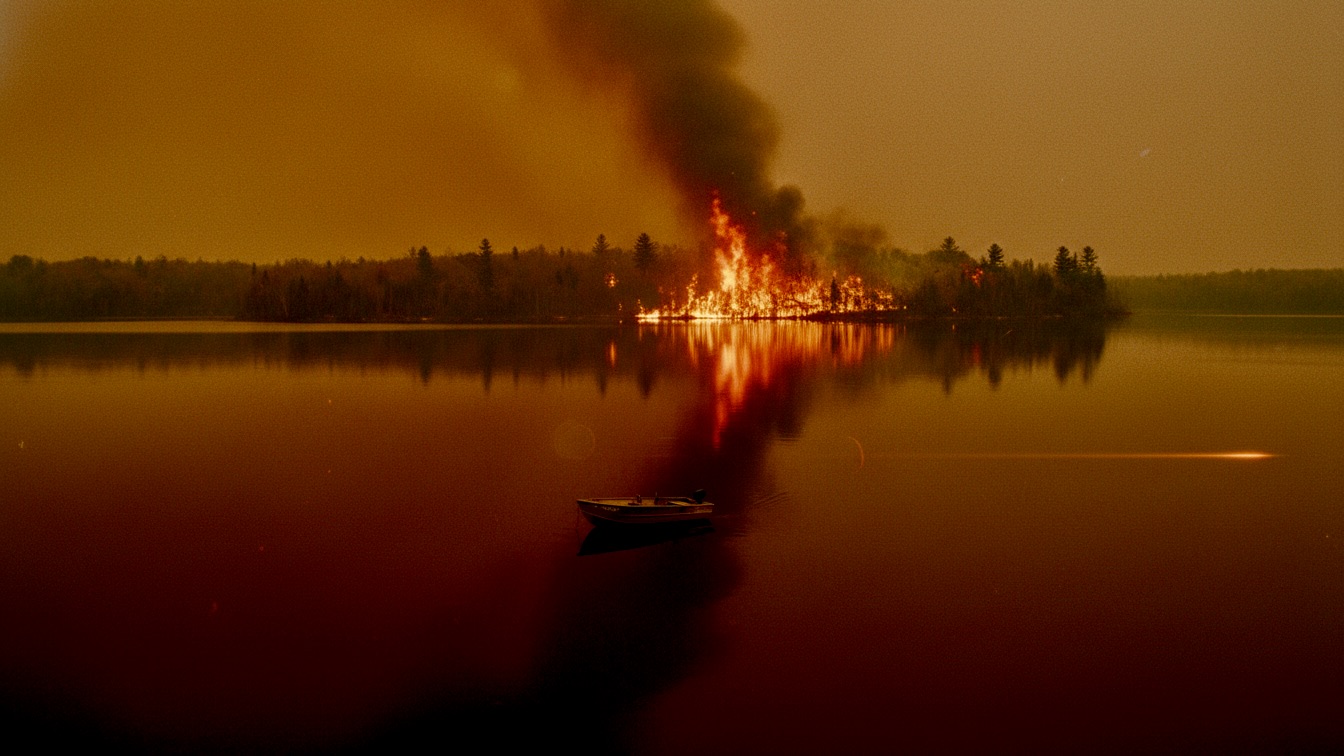
Sadie finds her mother's residential school records while Northwestern Ontario burns, choosing to stream her final stand online.
The heat is a physical weight. It pushes against the cabin walls, demanding entry. Outside, the sky has abandoned blue. It is a thick, sick orange—the color of a rusted blade. I can smell the spruce needles cooking before they even catch. I have three bars of signal on a satellite phone that is mostly luck and battery acid. I am not leaving. The evacuation siren on the mainland stopped an hour ago. Now, there is only the sound of the wind, which isn't wind at all. It is the fire breathing. It is the sound of a thousand freight trains moving through the canopy.
I look around the kitchen. It is a room defined by what is gone. The heavy cast-iron skillet is missing; my mother took that when she fled to the city three years ago. The wall calendar stopped in April, its pages curled and yellowed. There is a clean rectangle on the wood where the radio used to sit. Everything useful is gone. I am left with the debris of a life that didn't stick. My boots are caked in dried mud from the spring thaw, which felt like a century ago but was only last week. The lake is low. The dock is a skeleton of grey wood bleached by a sun that hasn't been seen in three days.
I drop to my knees in the center of the room. The third plank from the woodstove is loose. I know this because my father used to trip on it every night before he stopped coming home. I wedge a butter knife into the gap and pry. The wood groans. It sounds like a bone breaking. Beneath the dust and the dead spiders, there is a bundle wrapped in heavy plastic. It is cold. I pull it out and the smell of old paper hits me—damp, sour, and ancient. This is what Ida kept. This is the secret that made her stare at the lake for hours without blinking.
I unwrap the plastic. Inside are records. Official government headers. St. Jude’s Residential School. I see her name: Ida Linklater. Student Number 442. There are marks for 'Conduct' and 'Industry.' There are notes in the margins written in a precise, cruel hand. 'Subject is resistant to instruction. Refuses to abandon native tongue.' My heart hits my ribs like a trapped bird. The fire is crowning on the mainland now. I can see the flames leaping from the tops of the trees, a wall of neon red against the smoke. But I can't stop reading. I see the medical reports. The 'treatments' for a cough that wasn't a cough. The system that tried to delete her is sitting in my hands while the world tries to delete me.
I stand up. My legs feel like they belong to someone else. I grab the satellite phone. The screen is cracked, a spiderweb of light across the glass. I hit the stream button. I don’t check my hair. I don’t check the lighting. The lighting is the end of the world. Within ten seconds, the viewer count jumps to four hundred. Within a minute, it’s five thousand. They are watching from Toronto, from Vancouver, from apartments where the air is still breathable. I hold the records up to the camera lens.
"You must witness this," I say. My voice is steady, which surprises me. "You sold our future for a pipeline, and you tried to bury our past under these floorboards. My mother was a number to you. I am just a statistic in an evacuation report. But I am still here. The fire is three miles away and I am holding the proof of what you did."
The chat is a blur. 'Get out of there,' 'Is this real?', 'Someone call the RCMP.' I ignore them. I am talking to the ghosts. "The spring was supposed to be a time of growth. Look at the trees. They are torches. You told us the climate was a debate. It isn't a debate when you can't breathe. It’s a funeral."
I hear a roar. Not the fire. A mechanical scream. I look out the window. A yellow helicopter is banked hard over the bay. It’s a bird of prey looking for a place to land. The smoke is so thick the rotors are carving visible swirls in the air. My phone pings. A private message on the stream. 'This is Captain Ben. I am in the air above you. You need to get to the rocky point on the south side. The dock is a death trap.'
I don't reply. I grab the records and shove them into my jacket. I run for the door. The heat hits me like a wall of lead. I scramble toward my small aluminum boat, the 'Ida B.' I yank the starter cord. It slips. I yank again. Nothing. The engine is a cold lump of metal. The air is too thin, too full of ash for combustion. I look at the mainland. The fire has reached the shore. It’s jumping the water. Embers the size of my fist are raining down. One lands on the seat of the boat and melts the vinyl. I have to swim. No, the water is too cold, and the smoke will choke me before I reach the point.
"Captain Ben, do you copy?" I shout into the phone. The stream is still live. Ten thousand people are watching me fail to start a motor.
"I see you, Sadie," a voice crackles through the speaker. It is deep, formal, and strained. "The visibility is zero. I am flying by instruments and your GPS signal. You must move toward the clearing. The fire is moving at sixty kilometers an hour. It has no mercy."
"The engine is dead!" I scream. "The atmosphere is a graveyard!"
"Listen to me," Ben says. "The rocky cave on the point. It is your only sanctuary. I am coming down, but I cannot hover long. The heat will melt the seals on my hydraulics. Move!"
I run. I don't look back at the cabin. The place where I grew up is already a ghost. I scramble over the lichen-covered rocks. My lungs are on fire. I reach the cave—a shallow slit in the granite. The helicopter is low now, the downdraft clearing a temporary circle in the smoke. The pilot is a shadow behind the glass. He sets the skids down on the uneven rock. The machine is shaking. It wants to shake itself apart.
I dive toward the door. A hand reaches out and hauls me in. The interior of the helicopter smells like jet fuel and sweat. The pilot, Captain Ben, looks at me. He is older, his face etched with a fatigue that goes deeper than sleep. He is wearing a flight suit that looks like it’s seen three wars.
"Your presence here is a triumph of will over wisdom," Ben says. He doesn't look at me; his eyes are locked on the gauges. "We cannot fly out. The ceiling has dropped to the ground. We are grounded until the front passes."
"You defied the order?" I ask, clutching the records to my chest.
"The order was a suggestion made by men in air-conditioned offices," he replies. "I saw your stream. I saw the papers. I have spent twenty years flying over this province watching it turn to ash. I decided today was not the day for another disappearance."
We sit in the vibrating belly of the machine as the fire roars over the cave entrance. The world outside is a solid wall of flame. The helicopter rocks as the wind shears against the granite. We are in a tomb of our own making.
"My mother never told me," I whisper, the records heavy in my lap. "She just went quiet. I thought she hated the island. I didn't know she was hiding from the dirt it was built on."
"We all hide in different ways," Ben says. He leans back, his hands finally leaving the controls. "I hide in the sky. But there is nowhere left to fly to. The horizon is gone."
We sit in silence as the heat rises. The stream is still active, the phone propped against a flight bag. The world is watching us wait to die. I look at the lens. "If you are listening," I say to the digital void, "don't look away. This is what the end looks like. It’s not a bang. It’s a girl in a cave holding a pile of lies."
The fire continues its feast outside, the sound of the forest dying a rhythmic, terrible thrum against the stone.
“As the temperature inside the cave begins to spike, the satellite phone screen flickers and displays a final, haunting message from an unknown sender.”


