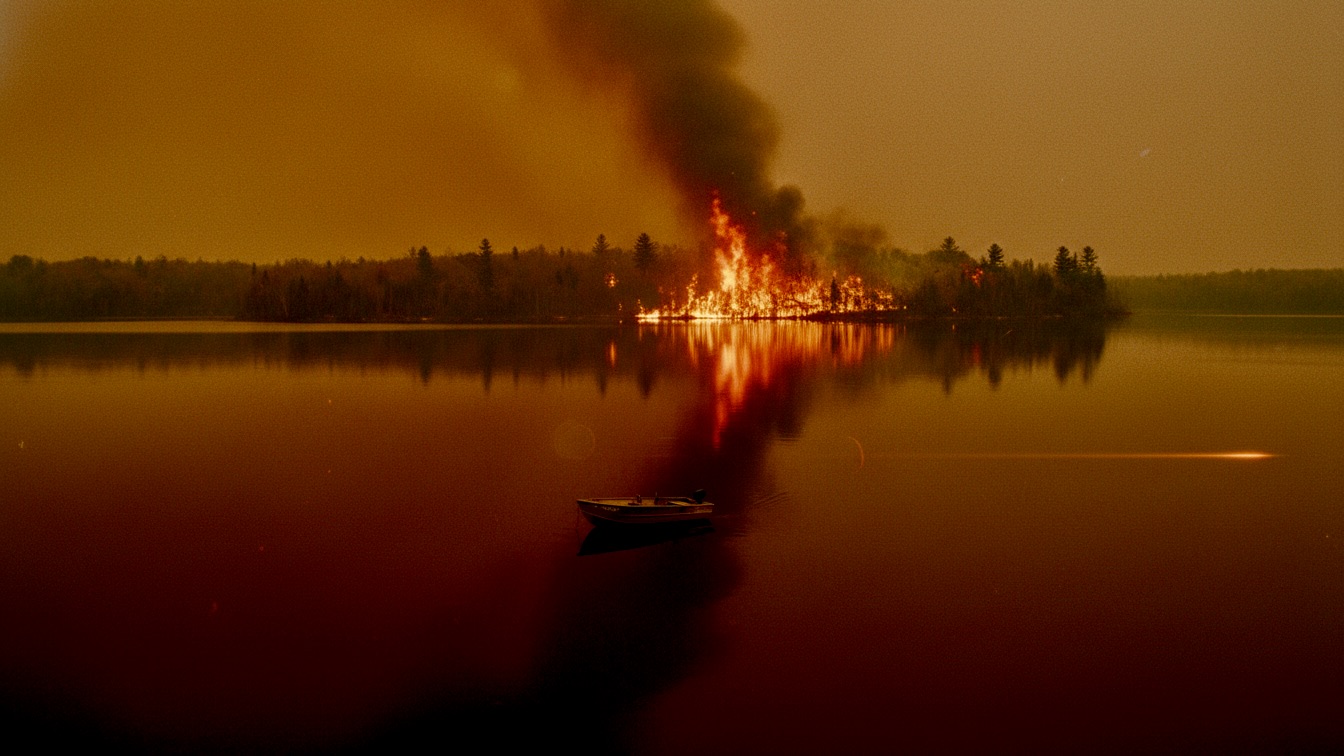
Sadie remains in her family’s isolated cabin as a catastrophic wildfire turns the sky into a thick, suffocating orange. While the evacuation siren fades on the mainland, she unearths a hidden bundle beneath the floorboards containing her mother’s residential school records. These documents reveal the systemic abuse and attempted erasure of Ida Linklater’s identity, providing a haunting context for the family’s fractured history. As the fire leaps across the water, Sadie initiates a livestream to expose these records to a global audience, linking the destruction of the land to the historical destruction of her people. Captain Ben, a helicopter pilot moved by her broadcast, defies orders to rescue her from the shore. They end up trapped in a granite cave, grounded by the smoke and heat, as Sadie continues to broadcast their final moments to the world.
The narrative explores the profound theme of intergenerational trauma and the "layered erasure" of Indigenous identity. The residential school records represent a past that was literally buried beneath the floorboards, mirroring how the state attempted to bury the "native tongue" and humanity of children like Ida. Sadie’s discovery suggests that such secrets are not static; they are volatile elements that eventually demand to be seen. The fire outside serves as a physical manifestation of this suppressed history, a destructive force that cannot be ignored or debated away. By holding the records while the forest burns, Sadie illustrates that the "funeral" of the environment is inextricably linked to the "funeral" of cultural heritage.
Furthermore, the story examines the disconnect between digital witness and physical reality. Sadie’s livestream attracts thousands of viewers from cities where the air is still breathable, creating a sharp contrast between those who experience the end of the world and those who watch it on a screen. The "digital void" becomes a repository for a truth that the physical world tried to delete. This theme highlights the irony of modern connectivity, where a person can be globally visible yet entirely alone and unprotected. The fire is described as a "feast," suggesting an insatiable consumption that mirrors the way the public consumes tragic content without the power or will to intervene.
Sadie is a protagonist driven by a psychological need for "witness" in the face of total annihilation. She is no longer content to be a "statistic in an evacuation report," reflecting a deep-seated rebellion against the anonymity imposed on her mother. Her decision to stay and read the records as the fire crowns on the mainland indicates that her search for identity outweighs her instinct for self-preservation. She experiences the heat not just as a weather event, but as a "physical weight" of the past finally catching up to her. By the end of the chapter, she has transitioned from a victim of circumstance to a self-appointed historian of the apocalypse. Her steadiness in the cave suggests she has found a grim clarity by finally understanding the "dirt" her life was built on.
Captain Ben embodies a state of "moral exhaustion" born from twenty years of witnessing environmental decay. He is a man who has traded his "wisdom" for a final act of "will," choosing to rescue a single voice over following the safety protocols of an indifferent system. His fatigue is existential, as he recognizes that there is "nowhere left to fly to" because the horizon itself has been consumed. Ben serves as a bridge between the "men in air-conditioned offices" and the reality of the burning forest, ultimately choosing to stand with the latter. His presence provides a stoic, grounded counterpoint to Sadie’s urgent activism, yet he shares her realization that they are both in a "tomb of their own making." He represents the segment of the older generation that has finally stopped hiding in the sky and accepted the ground-level truth.
The narrative voice is characterized by "visceral personification," where the environment is treated as a predatory, sentient entity. The fire is described as "breathing" and having "no mercy," while the sky is the color of a "rusted blade." These metaphors move the story beyond a simple disaster tale and into the realm of a psychological thriller where the world itself is the antagonist. The sensory details are oppressive, focusing on the smell of "cooking" needles and the "mechanical scream" of the helicopter. This creates a claustrophobic atmosphere that effectively mirrors the protagonist's internal state of being trapped by both fire and history.
The pacing of the chapter utilizes "staccato urgency" to reflect the escalating danger of the wildfire. Short, declarative sentences like "I am not leaving" and "The engine is dead" punctuate the more lyrical descriptions of the landscape. This creates a rhythmic tension that mimics a racing pulse, forcing the reader to experience the compression of time as the fire approaches. The transition from the quiet, dusty discovery of the records to the roaring chaos of the rescue is handled with a seamless intensity. This stylistic choice ensures that the political and historical revelations carry the same life-or-death weight as the encroaching flames.


