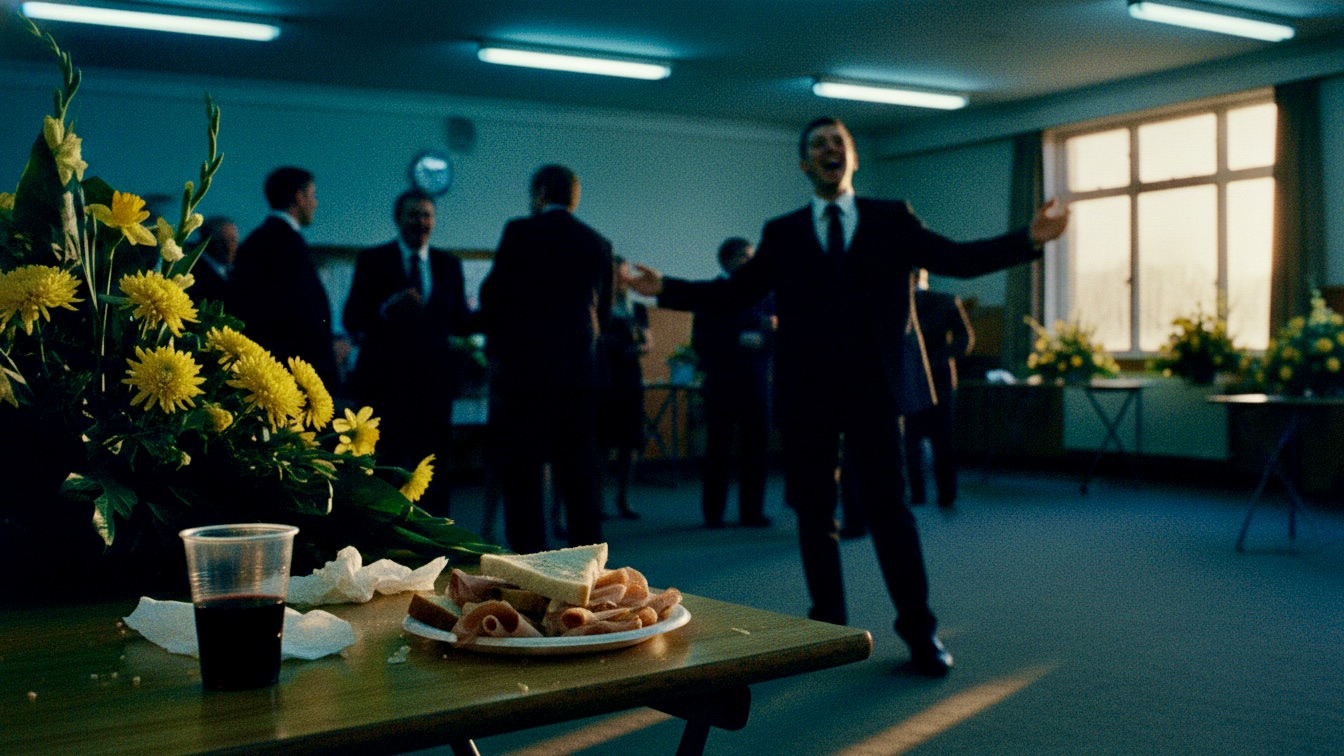
A funeral for a flower lover turns into a drunken, pollen-choked mess in the bright spring sun.
The casket was crooked. It wasn't a lot, maybe three degrees to the left, but enough to make my neck itch. Mrs. Thompson would have hated it. She was a woman of right angles and sharp shears. Now she was sitting in a box that looked like it had been dropped by a tired delivery guy. The sun was doing that thing it does in April where it tries too hard. It was too bright, too yellow, and it made the sweat under my collar feel like a slow-moving insect. My nose was already starting to run. It wasn't grief. It was the lilies. Hundreds of them. They were aggressive. Their scent was thick enough to chew on, a heavy, sweet smell that reminded me of rotting fruit and old perfume. I looked at Sarah. She was wearing sunglasses that took up half her face. Her shoulders were shaking, but I knew she wasn't crying. She was trying not to sneeze.
"Bless you," I whispered before she even did it.
"Shut up," she hissed back. Her voice was a wet rasp. "My eyes are vibrating, Pete. Why so many flowers? It’s a hate crime against my sinuses."
"She loved them," I said. I looked at the priest. He was sweating through his vestments. He looked like he wanted a beer. He was talking about 'the garden of the soul' or some other junk. I stopped listening. I focused on a small green caterpillar crawling up the side of the mahogany box. It was making better time than the sermon. The air was full of floating white bits—poplar fluff, maybe, or just the general debris of a world waking up when someone had just gone to sleep. It felt disrespectful, how loud the birds were. They were screaming in the trees behind the cemetery, probably fighting over worms or territory, completely oblivious to the fact that the woman who used to put out the good suet was currently being lowered into a hole.
Uncle Dave was three rows ahead of us. He was already swaying. Dave didn't wait for wakes. Dave brought the wake with him in a silver flask that caught the sun and blinded me every time he took a pull. He smelled like a distillery had exploded in a laundromat. The service dragged on. The priest's voice was a low drone, like a lawnmower three houses down. I thought about Mrs. Thompson. She used to catch me stealing her snapdragons when I was six. She didn't yell. She just made me help her weed the beds until my knees were black with dirt. She said plants were the only things that didn't lie to you. If they were dying, they looked like it. They didn't put on a suit and pretend they were fine.
Finally, the dirt hit the lid. Thud. Thud. Thud. It’s a final sound. No way to mistake it for anything else. People started moving, a slow, shuffling mass of black wool and polyester. We headed to the community center. It was a brick box with bad lighting and a carpet that had seen too many spilled juices. The transition from the bright, mocking spring light to the fluorescent hum of the hall was jarring. It made everyone look gray.
"Drinks," Sarah said, her hand gripping my elbow. "Now. Before I start peeling my own skin off."
The bar was a folding table at the back. It was stocked with the kind of wine that comes in jugs and beer that tastes like pennies. Danny was there, Mrs. Thompson’s grand-nephew or something. He was twenty-two and wearing a suit that was clearly a rental. He looked like he was vibrating. He had a plastic cup in each hand.
"This is mid, right?" Danny said, nodding toward the buffet. "The vibe is tragic. Like, actually tragic."
"It’s a funeral, Danny," I said. I took a cup of the red wine. It was cold, which was its only redeeming quality.
"Nah, I mean the food," he said. "Look at those sandwiches. They’re curling at the edges. It’s giving hostage situation. And the pollen out there? Bruh. I’m cooked. My throat is like, sandpaper."
"Go eat a crusty sandwich, Danny," Sarah said. She took a long gulp of her wine and sighed. "I can feel my brain cells quitting. This is going to be a long one."
By four o'clock, the atmosphere had shifted. The initial hush of mourning had been replaced by the loud, desperate chatter of people who had realized they were still alive. The 'Bleak Smirk' had set in. Uncle Dave was at the center of a circle, telling a story about the time Mrs. Thompson accidentally joined a protest because she thought they were handing out free mulch. He was gesturing wildly, his tie tucked into his shirt pocket for some reason.
"She had the sign!" Dave roared, slopping beer onto his shoes. "'Down with the System!' She thought it was a brand of organic fertilizer! She stayed there for three hours because the leader had nice dahlias!"
Everyone laughed. It was that sharp, jagged laughter that happens when everyone is a little bit too stressed and a little bit too drunk. I looked around. Mrs. Thompson’s bridge club was huddled in the corner, drinking gin out of tea cups. They looked like a gang of highly organized owls. They were staring at the younger generation with a mix of pity and judgment.
I felt a weird pressure in my chest. It wasn't a heart attack, though with the amount of fried ham I’d eaten, it wasn't out of the question. It was just the weight of it all. The spring blooming outside, the dead woman in the ground, the cheap wine in my hand. It was all so ridiculous. We spend all this time trying to be dignified, and then we end up in a basement with sticky floors, talking about mulch.
Sarah nudged me. "Check out Aunt Linda."
Linda was currently trying to explain TikTok to a confused octogenarian. "No, see, you just swipe. Like you're brushing away a fly. And then it’s a different person dancing. It’s a whole thing. It’s how we process the void now."
The octogenarian just nodded, looking like she wanted to go back to her gin.
"I think I'm hit," I said to Sarah. "The wine is starting to taste like actual grapes. That’s a bad sign."
"Stay in the fight, Pete," she said. Her eyes were bloodshot from the allergies, making her look like a very stylish demon. "We haven't even gotten to the part where they play her favorite hymns on that out-of-tune piano. I want to see Danny try to sing along. He doesn't know the words to anything written before 2020."
I looked over at the piano. It was a battered upright in the corner, covered in dusty trophies from the local bowling league. There were more flowers on it. More lilies. My nose twitched. I felt a sneeze building, a massive, tectonic shift in my sinuses. I tried to suppress it. I pinched my nose. I looked at the ceiling. I thought about ice.
It didn't work. The sneeze came out like a gunshot. It was so loud the room actually went silent for a second. Uncle Dave stopped mid-sentence. The bridge club turned as one.
"Bless you," Danny said from across the room. "That was a whole mood."
"Thanks," I muttered, wiping my eyes.
I walked over to the window. Outside, the world was aggressively green. The lawn of the community center was overgrown, sprinkled with dandelions that looked like dropped gold coins. A neighbor was washing his car down the street, the spray from his hose catching the light and creating a tiny, fleeting rainbow. It was beautiful and stupid.
Mrs. Thompson had spent her whole life trying to control the dirt. She’d fought the weeds, pruned the roses, chased the squirrels. And in the end, the dirt won. It always does. But as I watched the rainbow in the neighbor’s driveway, I thought maybe that wasn't the point. Maybe the point was the fight. The sheer, stubborn absurdity of planting something beautiful in a world that just wanted to turn it back into compost.
I turned back to the room. Uncle Dave was now attempting to do a magic trick with a cocktail napkin. It wasn't working. He just looked like he was attacking a piece of paper. Sarah was laughing, a real, unforced sound that cut through the hum of the fluorescent lights.
"Hey," a voice said.
It was Leanna. She’d been Mrs. Thompson’s neighbor for years. She was holding a plate of those curling sandwiches. "You okay, Pete? You look like you're contemplating the heat death of the universe."
"Just the allergies," I said. "And the wine."
"It’s terrible, isn't it?" She took a bite of a sandwich and winced. "I think this ham was sliced during the Nixon administration. But she would have loved this. All of us here, making fools of ourselves."
"You think?"
"Oh, definitely. She used to say that a funeral without a little bit of a mess was just a rehearsal for being boring. She liked the mess."
I looked at the mess. I saw the spilled beer, the mismatched chairs, the people I only saw when someone died. I saw the way the spring light was fading into a soft, bruised purple outside the windows. It was okay. It was more than okay. It was the only way it could be.
"To the mess," I said, raising my plastic cup.
"To the mess," Leanna echoed.
We stood there for a while, watching the chaos. Danny had found a Bluetooth speaker and was trying to convince the priest that a certain lo-fi hip-hop track was 'basically a psalm.' The priest was actually listening, his head tilted to the side, looking thoughtful.
I felt a sudden, sharp pang of something that wasn't just gas. It was a realization. Mrs. Thompson wasn't in that box anymore than she was in the peonies. She was in the way we were all leaning on each other, even if we were leaning because we were too drunk to stand up straight. She was in the laughter that shouldn't be there and the bright, relentless spring that didn't care about our grief.
I saw Sarah head toward the piano. She sat down and ran her fingers over the keys. They were yellowed, like old teeth. She hit a chord. It was horribly out of tune, a sour, clashing sound that made everyone wince.
"Alright everyone!" she shouted. "Mrs. T’s favorite. 'All Things Bright and Beautiful.' And if you don't sing, you’re not getting any of the good scotch I hid under the table."
A cheer went up. A ragged, drunken, wonderful cheer.
I joined in. My voice was terrible, and I didn't know half the verses, but I sang anyway. I sang about the flowers and the birds and the 'creatures great and small.' I sang until my throat felt raw and my eyes were watering again.
As the song wound down into a series of mismatched notes and giggles, Uncle Dave stumbled over to me. He put a heavy, trembling arm around my shoulders.
"She was a good egg, Pete," he wheezed. "A real... a real prime specimen."
"She was, Dave."
"I ever tell you about the time she tried to fix her own roof?"
"No, Dave. Tell me."
I settled in. The sun was almost gone now, the long shadows of the trees stretching across the lawn like fingers. The room felt warmer, the smell of the lilies finally fading into the background, replaced by the scent of people and old wood and life.
And then the door at the back of the hall creaked open. A man I didn't recognize stood there. He was drenched in sweat, holding a massive, overflowing bouquet of peonies—the very flowers Mrs. Thompson had spent fifty years perfecting. He looked frantic, his eyes darting around the room until they landed on the empty space where the guest book sat.
"I'm late," he panted, his voice cracking. "I'm so sorry. I had to get the specific ones. The ones from the south side of the hill."
Everyone stopped. We all stared at him. He wasn't family. He wasn't a neighbor I knew. He was just a man with a lot of flowers and a look on his face that suggested the world was currently ending.
He walked to the center of the room and set the peonies down on the snack table, right next to the curling ham sandwiches. The smell hit us instantly—fresh, sharp, and unmistakably alive.
"She told me to bring these," he said, looking at no one in particular. "She said if I didn't bring them to the party, she’d haunt my vegetable garden until the end of time."
He looked around, confused. "Is... is there any wine left?"
I handed him my cup. He took it and drained it in one go.
"Who are you?" Sarah asked, standing up from the piano.
The man wiped his mouth with the back of his hand. He looked at the flowers, then back at us. A small, strange smile touched his lips.
"I'm the guy who’s been buying her seeds for twenty years," he said. "And I think there's something you all need to see in the back of her garden shed."
The room went quiet again. The humor, the booze, the lightness—it all seemed to evaporate in an instant, replaced by a sudden, sharp curiosity that felt like a cold breeze.
"What's in the shed?" I asked.
He reached into his pocket and pulled out a heavy brass key, the kind that looked like it belonged to a different century. He held it up, the metal gleaming in the dim light of the community center.
"She called it her 'Spring Surprise'," he said. "And trust me, you're going to want to be sober for this."
I looked at Sarah. She looked at me. Uncle Dave let go of my shoulder, his face suddenly pale.
We all looked at the key. It felt like the air in the room had suddenly become very thin. The funeral was over, the wake was winding down, but something else—something Mrs. Thompson had planned with the same precision she used on her rosebushes—was just beginning to bloom.
“He held up the heavy brass key, his eyes wide with a secret that made the drunken laughter of the room die instantly.”


