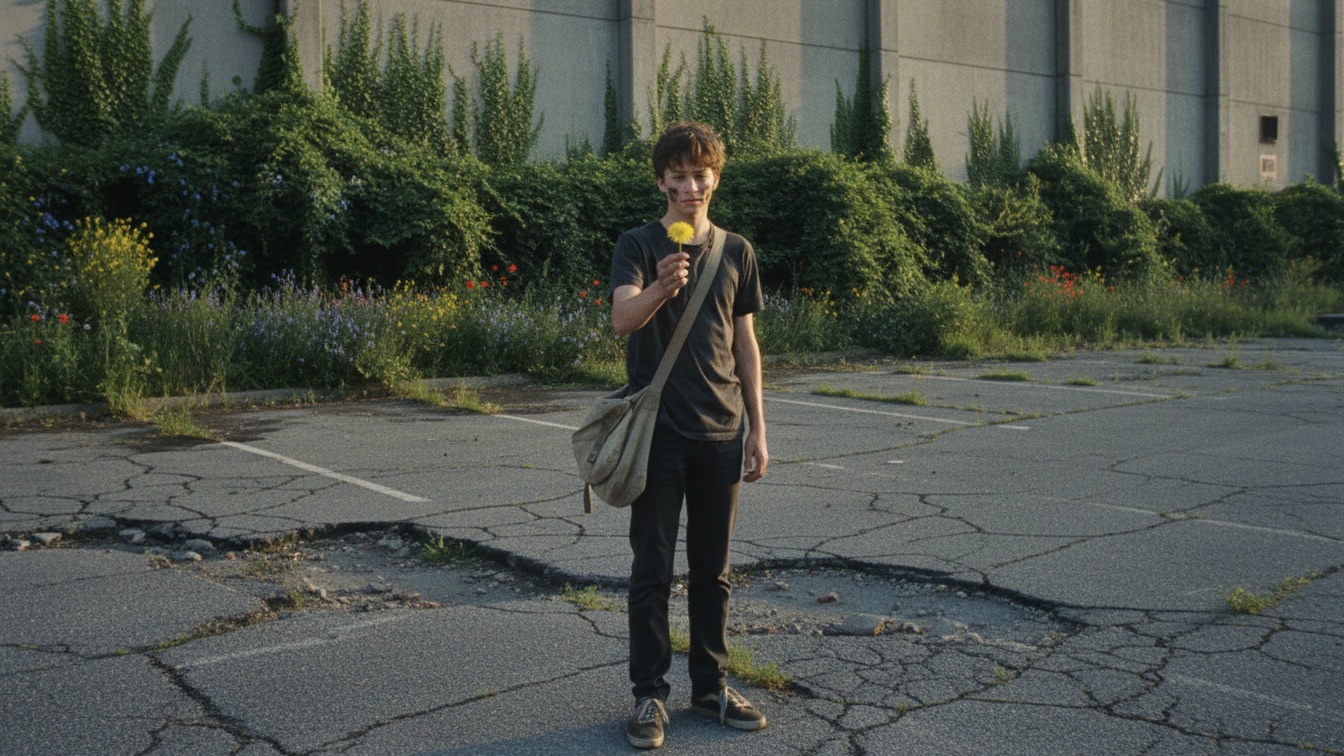
A delivery courier discovers a glitch in the city's mapping software that transforms concrete ruins into botanical battlegrounds.
The bike frame vibrates against my thighs. Every crack in the asphalt is a data point I can feel in my teeth. My phone, mounted to the handlebars with a cheap plastic clip that rattles constantly, screams at me. Another delivery. Six dollars. Two miles. The math never adds up, but the algorithm doesn't care about math. It cares about movement. Keep the dot moving. Don't let the dot stop.
I’m seventeen and I feel like a piece of legacy hardware. My knees click. My back is a tight wire. The air in the Industrial District tastes like burnt rubber and old grease. It’s Spring, supposedly. Somewhere out there, trees are doing their thing. Here, the only green is the flickering neon of a 'Open' sign at a 24-hour depot.
I pull into the Logistics Hub 42. It’s a graveyard of shipping containers and grey gravel. The GPS pings. 'Arrived,' it says. I look around. There is no one here. Just a massive, empty slab of reinforced concrete that looks like it was poured by someone who hated the concept of beauty. I check the app. The pin is pulsing in the middle of a dead zone behind a rusted fence.
I hop the curb. The tires crunch over debris. And then I see it. It’s a crack. A long, jagged lightning bolt in the concrete where the earth decided it was done being buried. In the center of that crack, surrounded by grey dust and cigarette butts, is a flower. It’s small. Bright yellow. It looks like a solar flare caught in a tailspin. It’s a Common Tansy, maybe. Or a weirdly aggressive dandelion. It doesn't matter. It’s the only thing in this three-mile radius that isn't trying to sell me something or track my location.
I pull out my phone. My thumb hovers over the 'Complete Delivery' button, but instead, I open the camera. I take a photo. The contrast is insane. The yellow is so loud against the grey. I open 'Under-Net,' a niche forum for people who still think the internet can be used for something other than scrolling through ads. I post the photo. No caption. Just the coordinates.
"Sam, you are idling. The efficiency rating is dropping. Move, Sam, move."
I talk to the app now. It helps. "I am not idling, you digital tyrant. I am witnessing a miracle of biological persistence. Observe the specimen. It has bypassed your structural integrity."
I pedal away, but something feels different. The oxygen feels heavier. No, that’s wrong. It feels lighter. Like a weight I didn't know I was carrying just snapped.
Two hours later, my phone explodes. Not literally, though the battery is getting hot enough to cook an egg. The forum post has gone nuclear. People are mapping the coordinates. Someone named Carmen D. replies: 'The glitch is real. The hub’s geo-fencing is broken. The cameras don't cover the cracks. We can use this.'
I meet Carmen behind a coffee shop that charges nine dollars for a latte. She’s eighteen, hair dyed a color that doesn't exist in nature, and she’s holding a tablet like it’s a holy relic. She doesn't say hi. She just turns the screen toward me.
"Sam, look at the architecture of their failure," Carmen says. Her voice is deep, practiced. It’s the voice of someone who spent their childhood watching video essays on urban decay. "The mapping software they use for the courier fleet has a blind spot. It ignores non-commercial zones within commercial sectors. To the system, these cracks are invisible. They are null-space."
"It’s just a flower, Carmen," I say, though my heart is thumping against my ribs. "I just thought it looked cool."
"It is not merely a flower," she declares, her eyes wide and unblinking. "It is a breach. If we use the courier API, we can create a secondary layer. An encrypted channel. We won't deliver packages. We will deliver the future. We shall call it Petal Punk. We will drop native seeds into every null-space the algorithm ignores. We will glitch the grey until it turns green."
I look at my bike. The chain is rusty. The seat is torn. "How do we even start?"
"We start by reclaiming the dirt," she says. "I have synthesized a seed-bomb mixture that can survive in high-alkaline concrete. We need the couriers. We need the people who see the cracks every day."
Within a week, Petal Punk is a thing. It’s small at first. Just me, Carmen, and a few other riders who are tired of being dots on a map. We carry small pouches of 'glitch-matter'—clay balls packed with wildflower seeds, compost, and a bit of moisture-retaining gel. Every time the app sends us to an industrial wasteland or a corporate parking lot, we find a crack. We drop the bomb. We log the coordinates in Carmen’s encrypted app.
The map starts to change. On my screen, the city isn't just a grid of streets anymore. It’s a series of potential blooms. I feel a strange sense of clarity. The claustrophobia of the gig economy—the feeling of being trapped in a loop of endless, meaningless tasks—starts to lift. I’m not just a delivery boy. I’m a gardener in a war zone.
By the third week of Spring, the glitches start to show. At the Logistics Hub 42, the single yellow flower is now a cluster. Bluebells are pushing through the vents of an abandoned data center. Red poppies are lining the perimeter of the regional bank’s private helipad. It’s beautiful. It’s messy. It’s unmanaged.
Then, it goes viral. A drone pilot captures footage of a 'bleeding' industrial park—a sea of grey concrete suddenly interrupted by a massive, vibrant 'X' made of wildflowers. The 'X' marks the spot where the system failed. Social media eats it up. #PetalPunk trends. Kids in other cities start asking for the API. The movement isn't a secret anymore.
I’m riding through the downtown core when I see the first counter-move. A white van with no markings is parked near the old textile mill. Two guys in hazmat suits are spraying a thick, blue liquid over a patch of morning glories that had just started to climb the fence. The smell is sharp, chemical. It’s the smell of order being restored.
I stop my bike. My hands are shaking. "Stop!" I yell. "That’s native flora! You’re poisoning the water table!"
One of the men turns. His mask makes him look like an insect. "This is unauthorized biological growth, kid. It’s a tripping hazard and a violation of corporate aesthetic standards. Move along."
"The aesthetic of a tomb?" I shout back. "You are murdering the only living thing in this district!"
I take a video. I upload it instantly to the Petal Punk main-feed. Within minutes, the comments are a firestorm. 'They are killing the Spring,' someone writes. 'The Grey is scared of a flower,' says another.
That night, Carmen calls me. Her voice is tight with adrenaline. "Sam, they’ve escalated. The city council just passed an emergency ordinance. Any 'non-sanctioned botanical activity' is now a felony. They’re calling us 'eco-terrorists.'"
"Eco-terrorists for planting flowers?" I ask. I’m sitting on my floor, surrounded by seed pouches. "The irony is physically painful."
"It’s not about the flowers, Sam," she says. "It’s about control. We proved that their map is incomplete. We proved that we can use their own tools to subvert them. Tomorrow is the Spring Equinox. They’re planning a sweep of the industrial zones. They’re going to bleach everything."
"Then we don't give them the chance," I say. A new feeling is settling in. It’s not anxiety. It’s a cold, hard resolve. "We call for a Spring Breakout. Not just the couriers. Everyone."
Morning comes with a pale, clear light. The air is crisp. I meet Carmen at the edge of the central plaza. There are hundreds of people there. Teenagers in hoodies, office workers who ditched their ties, even a few elderly people carrying bags of potting soil.
Officer Wilson is there, too. He’s standing by his cruiser, arms crossed. He’s the guy who usually gives me tickets for 'reckless cycling.' He looks at the crowd, then at me.
"Sam," Wilson says, stepping forward. His voice is formal, the way the police are taught to speak when they’re trying to prevent a riot. "I must advise you that this assembly has not been granted a permit. The distribution of unregulated biological material is a violation of city code 402."
I look him in the eye. I feel like I’m standing on a stage. "Officer Wilson, look around you. The city is a desert of our own making. We are not here to protest. We are here to irrigate. Will you arrest a thousand people for holding a handful of seeds?"
Wilson looks at the crowd. He looks at a young girl holding a small pot of lavender. He looks back at me. He doesn't move. He doesn't reach for his zip-ties. "The logistics of such an operation would be... complicated," he says, his voice softening just a fraction. "However, the corporate entities will not be as hesitant as the municipal guard."
"Let them come," Carmen says, stepping up beside me. "We have already seeded the clouds. The rain is coming, and it will be green."
We march. It’s not a fast march. We stop at every vacant lot. We stop at every cracked sidewalk. We dig. We plant. We don't just drop seeds anymore; we plant saplings. Oak, maple, birch. We are building a forest in the middle of a graveyard.
The sound of the city changes. The roar of the traffic is still there, but there’s a new rhythm—the sound of shovels hitting dirt, the sound of people laughing, the sound of a thousand conversations that aren't about the price of gas or the latest notification.
By noon, we reach the headquarters of 'Omni-Logistics,' the company that runs the delivery app. The plaza in front of their glass tower is a masterpiece of sterile architecture. Pure grey stone. Not a single blade of grass.
"This is the heart of the void," Carmen whispers.
We don't wait for a signal. Everyone moves at once. We pull up the loose paving stones. We pour in the soil. We plant a massive weeping willow right in the center of their entrance. It’s theatrical. It’s absurd. It’s the most beautiful thing I’ve ever seen.
Security guards come out, but they stop at the edge of the glass. They see the cameras. They see the thousands of people. They see the flowers. They don't know what to do. How do you fight a garden? You can’t shoot a daisy. You can’t pepper-spray a forest.
As the sun starts to set, the city looks different. The light catches the new leaves, the bright petals, the dark, rich earth. The claustrophobia is gone. I can breathe. The oxygen is sudden and sharp. I feel like I’ve finally woken up from a long, grey sleep.
I sit on the edge of a newly planted planter, watching the people. Carmen sits next to me, her hands covered in dirt.
"We did it," I say.
"We started it," she corrects. She looks up at the Omni-Logistics tower. The lights are coming on inside. "But Sam, look at the windows. They aren't going to let this stand. They are already recalculating."
I look up. On the top floor, I can see the blue glow of monitors. The algorithm is still running. It’s analyzing the 'glitch.' It’s looking for a way to monetize the green or kill it. The fight isn't over. It’s just moved to a different terrain.
I reach into my pocket and find one last seed bomb. It’s small, round, and full of potential. I look at the dark glass of the corporate tower.
"Let them recalculate," I say. "You can't patch out the truth. The world wants to grow. We are just the ones who remembered how to let it."
But as the shadows lengthen over the new forest, I see a fleet of black drones rising from the roof of the tower, their red lights blinking like eyes in the dark.
“But as the shadows lengthen over the new forest, I see a fleet of black drones rising from the roof of the tower, their red lights blinking like eyes in the dark.”


