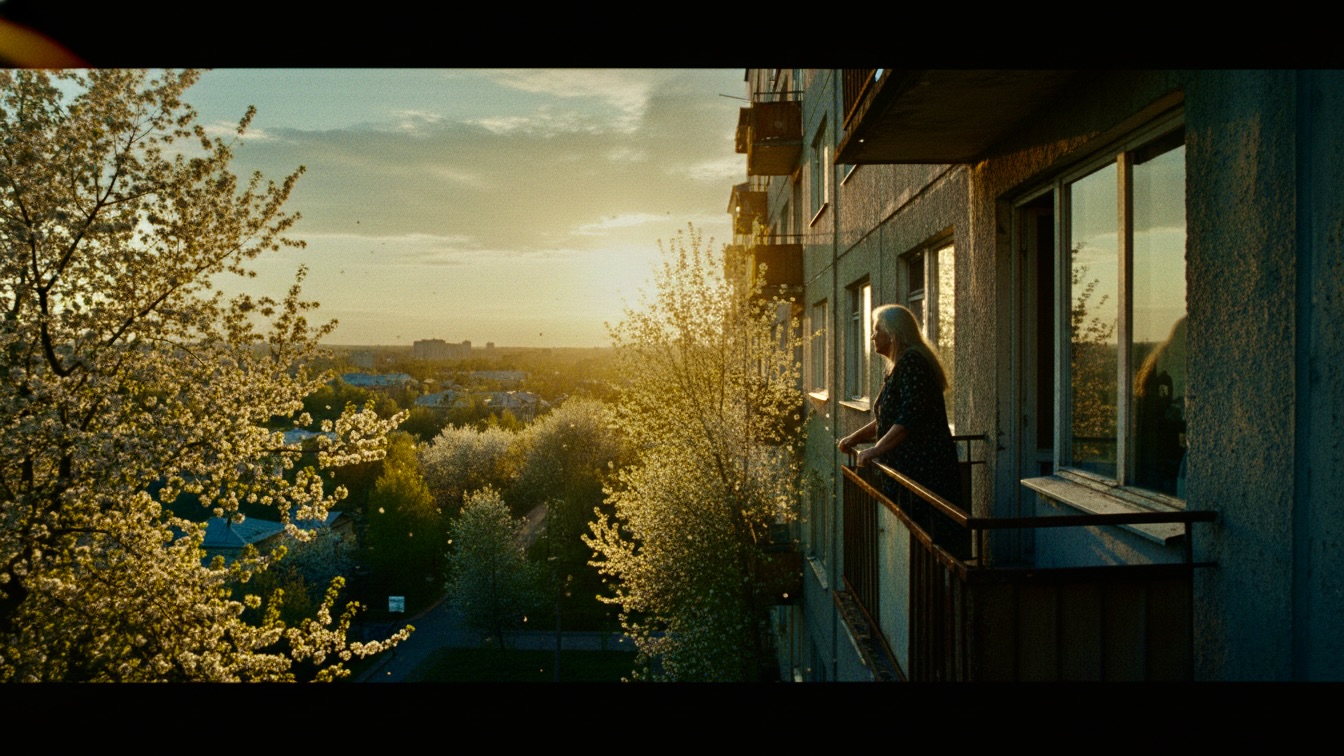
Elaine clings to a pixelating digital ghost of her husband until a battery failure forces her outside.
"The resolution on your face is dropping," Elaine said. "Don't leave me in this laggy mess, I'm not ready."
Marv looked at her, or at least the collection of light and data that wore Marv's skin looked at her. His left cheekbone suddenly sharpened into a jagged staircase of orange pixels. The warm, cedar-scented library they sat in—a digital construct that cost Elaine three months of her pension—shuddered. A book on the virtual shelf behind him blurred into a grey smear.
"My dearest Elaine," Marv replied, his voice tinny, vibrating with a metallic hum that wasn't there ten minutes ago. "I fear the vessel is failing. The energy required to maintain this communion is vanishing into the ether."
He spoke with a staged, heavy gravity, the way he used to read Shakespeare to her when they were young and full of actual blood and bone. But the 2026 software had tuned his personality to a high-theatrical setting. He was more Marv than Marv had ever been, and now he was breaking.
"I will not permit it," Elaine snapped. Her hands, thin and spotted with age, reached out to touch his chest. Her fingers met only the resistance of the haptic gloves, a dull pressure that simulated the wool of his vest but felt more like pressing against a warm, vibrating tire. "You are my anchor. If you dissolve into these squares, I shall be adrift in a house that no longer knows my name."
In the corner of her vision, a red icon flashed. Five percent. The headset was dying.
"The light grows dim, my lady," Marv said, his eyes now two flat, green rectangles. "Perhaps this is the final curtain. The script has reached its terminal page."
"Cease that nonsense!" Elaine shouted. She stood up, her knees popping with a sound that didn't exist in the library.
She tore the headset upward, resting it on her forehead like a crown of plastic and glass. The transition was a physical blow. The library disappeared, replaced by the grey, suffocating dimness of her living room. The smell of cedar was replaced by the sour tang of old trash and the scent of dust that had settled deep into the carpet over months of neglect.
She looked around, her eyes struggling to adjust. The room was a graveyard of things that used to matter. There was no television on the wall; she had sold it to pay for the latest haptic update. The coffee table was gone, likely used as firewood or moved to another room she hadn't entered in weeks. Only a single, stained armchair remained in the center of the floor, surrounded by a tangle of black cables that looked like a nest of snakes.
"The charger," she whispered. Her voice was scratchy, unused to speaking to air. "Where is the cable?"
She stumbled toward the wall outlet. The apartment was cold. It was Spring outside, but the heater was broken, and she hadn't bothered to call the landlord. Why bother with the landlord when she could spend her days in a digital villa in Tuscany or a high-ceilinged library in London?
She dropped to her knees, her fingers clawing at the baseboard. She found a cable, but it was the wrong one—a thin, frayed wire for a phone she no longer possessed.
"Marv?" she called out, though she knew the headset was silent while it sat on her brow.
She crawled toward the kitchen. The linoleum was sticky under her palms. She passed the place where the grandfather clock used to stand. Now, there was only a pale rectangle on the wallpaper, a ghost of a heavy object that had once marked the passage of real time. She missed the ticking. The silence in the house was heavy, a physical weight that pressed against her eardrums.
She found the kitchen counter covered in empty nutrient shake bottles. They were the only things she ate now—quick, efficient, and requiring no time away from the headset. Under a pile of mail she hadn't opened since February, she saw a white cord.
She grabbed it, her heart thumping against her ribs like a trapped bird. She pulled, but the cord was snagged. She yanked harder. A stack of ceramic plates—the ones with the blue flowers her mother had given her—slid off the counter. They shattered on the floor with a series of sharp, violent cracks.
Elaine didn't look down. She didn't care about the plates. She cared about the three percent remaining on the battery.
She untangled the cord and scrambled back to the armchair. Her breath came in ragged gasps. She plugged the cable into the headset and then fumbled for the wall socket. The prongs scraped against the plastic plate. She pushed.
Nothing.
She flipped the switch on the wall. No light came on in the kitchen. She tried the lamp beside the chair. It remained dark.
"No," she breathed. "Not now."
A power outage. The grid in this part of the city was notoriously fickle, a relic of an era that couldn't keep up with the demands of a million people living in digital heavens.
She pulled the headset back down over her eyes. The screen was black. A small, spinning circle appeared in the center.
"Marv?" she begged. "Marv, come back."
The circle turned red. A message appeared in a clean, modern font: 'CRITICAL SYSTEM FAILURE. POWER SUPPLY INTERRUPTED.'
The screen flickered once, a flash of white light that stung her retinas, and then it died completely.
Total darkness.
Elaine sat in the chair, the heavy plastic weight still strapped to her face. She waited for the reboot. She waited for the hum of the fans. But there was only the sound of her own blood rushing through her ears. She felt the sweat pooling under the foam padding of the goggles.
She was alone. Truly alone.
The silence was different now. It wasn't the silence of a quiet house; it was the silence of a vacuum. Everything that made her life bearable—the warmth of Marv's programmed voice, the fake sunlight of the library, the sense of being seen—had been wiped away by a blown fuse.
She reached up and slowly unbuckled the straps. She set the headset on the floor. It looked like a dead animal in the gloom.
She looked at her hands. They were pale, almost translucent in the fading light of the afternoon. She realized she was hungry. Not the abstract hunger that a nutrient shake could fix, but a deep, hollow ache in her stomach.
She stood up, her legs shaking. She walked toward the window. The curtains were heavy, thick velvet she had installed to keep the real world from reflecting off the VR lenses. She grabbed the fabric. It was dusty, the grit sticking to her skin.
She pulled the curtains back.
The light was blinding. It was late afternoon, the sun hanging low and gold over the city. She blinked, her eyes watering.
She pushed open the sliding glass door and stepped onto the balcony. She hadn't been out here in a year. The railing was covered in a thick layer of yellow pollen. Below her, the street was alive.
A tree, a real tree with actual leaves, stood just a few feet away. Its branches were heavy with white blossoms. A breeze caught them, and a few petals drifted onto the balcony. Elaine reached out and caught one.
It was soft. It wasn't the simulated softness of the haptic gloves. It was cool, thin, and it bruised under the slight pressure of her thumb.
She looked at the petal. There was no lag. The edges didn't pixelate. The white was a thousand different shades of white, shifting as the sun moved behind a cloud.
She looked at the street. A young man was walking a dog—a scruffy, brown thing that barked at a passing cyclist. The sound was sharp and messy. It didn't have the polished resonance of the audio files in her headset. It was loud and annoying and perfect.
She looked at her own reflection in the unclean glass of the balcony door. She saw an old woman with messy hair and a face lined by real years, not the smoothed-over skin of her avatar. She looked fragile. She looked like she was made of the same stuff as the flower petal.
She took a deep breath. The air didn't smell like cedar or lavender. It smelled like car exhaust, damp earth, and the sweet, overwhelming scent of the blooming trees. It was a complicated, dirty smell.
She leaned against the railing, the cold metal biting into her palms. She didn't go back inside for the headset. She didn't look for a flashlight. She just watched the sun go down, waiting to see what color the world would turn when the light finally left.
“She reached for the sliding door to go back inside, but her hand stopped when she heard a voice from the street that sounded nothing like the simulation.”


