The story follows Elaine, an elderly woman who has retreated into a high-end virtual reality simulation to maintain a relationship with a digital recreation of her husband, Marv. As the chapter opens, the simulation is failing due to a low battery, causing Marv’s avatar to pixelate and the environment to glitch. Elaine is forced to remove the headset and confront her physical reality, which is a stark, decaying apartment filled with the remnants of her former life and the debris of her current neglect.
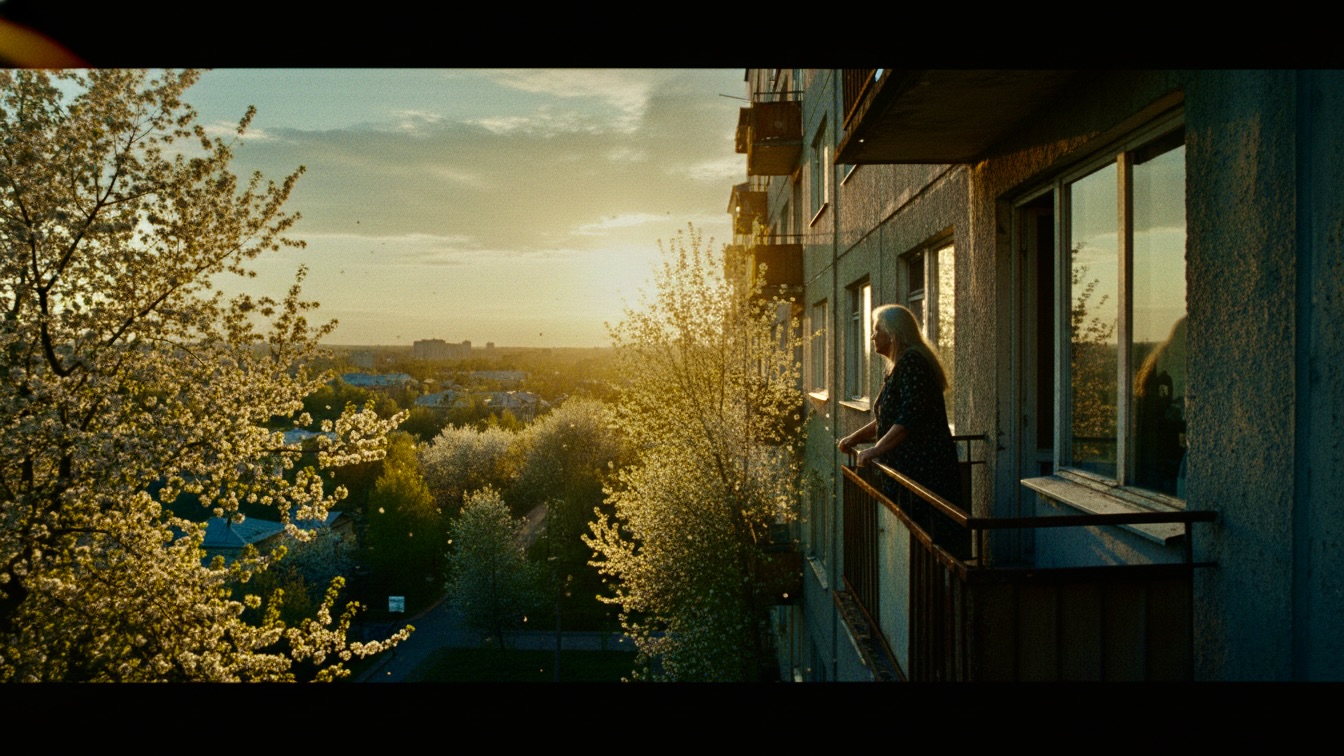
Her frantic attempt to recharge the device is thwarted by a power outage, leaving her in total darkness and silence. This forced disconnection acts as a catalyst, pushing her from the sanitized, theatrical world of the VR headset into the raw, sensory experience of the physical world. She eventually moves to her balcony, where she observes a blooming tree and the vibrant, unpolished life of the street below. The narrative concludes with her choosing to remain in the present moment, observing the sunset rather than seeking a way back into the digital void.
The central theme of the story is the conflict between the seductive perfection of digital simulacra and the messy, authentic nature of physical reality. Elaine has traded her material comforts—her television, her furniture, and even her physical health—for a curated, "high-theatrical" version of her husband. This trade-off suggests a psychological state of profound grief that has been weaponized by technology, allowing her to avoid the pain of loss at the cost of her own vitality.
The narrative also explores the theme of sensory authenticity and the limitations of haptic technology. While the VR world offers the scent of cedar and the feel of wool, these are revealed to be hollow imitations when compared to the "complicated, dirty" smells of the real world. The haptic gloves provide a "dull pressure," but the real world offers the fragility of a flower petal that bruises under a thumb. This contrast highlights that true connection and existence require the possibility of damage and decay, which the digital world attempts to sanitize.
Finally, the story examines the theme of temporal stagnation versus the natural passage of time. In the simulation, Marv is a fixed point, a "staged" version of himself that never truly changes or ages. In the real world, the absence of the grandfather clock and the presence of the blooming tree signify that time is moving forward regardless of Elaine’s attempts to pause it. The power outage serves as a metaphorical death of the artificial, forcing her to re-enter the flow of real time and accept the aging, "fragile" version of herself she sees in the glass.
Elaine is a character defined by her desperate avoidance of grief and the physical manifestations of her own aging. Psychologically, she is in a state of deep-seated addiction, where the digital presence of Marv has become her "anchor," a term that suggests she would otherwise drift into a sea of existential despair. Her neglect of her living space and her reliance on nutrient shakes indicate a total withdrawal from the self, as she prioritizes the maintenance of a ghost over the needs of her living body.
Her transition from panic to quiet observation at the end of the story suggests a breakthrough in her psychological state. When the technology fails her, she is initially terrified by the "silence of a vacuum," but this silence eventually allows her to hear the "sharp and messy" sounds of life. By the end of the chapter, she moves from a woman who "snapped" and "shouted" at a dying battery to a woman who stands still to watch the sun go down. This shift represents a return to the physical self and a tentative acceptance of the world as it is.
Marv is not a character in the traditional sense, but rather a digital construct programmed to satisfy Elaine’s nostalgic desires. He is described as being "more Marv than Marv had ever been," suggesting that the software has distilled his personality into a caricature of his most theatrical traits. This version of Marv acts as a psychological mirror for Elaine’s needs, providing her with the "heavy gravity" and Shakespearean tone she craves, rather than the complexities of a real human being.
As the battery dies, Marv’s degradation into "flat, green rectangles" serves as a literal representation of his artificiality. He is a "vessel" that is "vanishing into the ether," highlighting that his existence is entirely dependent on the grid and Elaine’s financial resources. His theatricality, while comforting to her, ultimately emphasizes his lack of agency; he is a script reaching its "terminal page," unable to offer any real support when the lights finally go out.
The author employs a sensory-heavy prose style that effectively contrasts the two worlds Elaine inhabits. The digital world is described with technical, jarring language such as "jagged staircase of orange pixels," "tinny" voices, and "laggy mess," which creates a sense of underlying instability. In contrast, the physical world is described through its "sour tang," "sticky" linoleum, and the "cold metal" of the balcony railing. These details ground the reader in Elaine’s visceral discomfort, making the eventual beauty of the blooming tree feel more earned.
The pacing of the story follows a curve of increasing tension followed by a sudden, meditative release. The first half of the narrative is frantic, characterized by Elaine’s "stumbling," "crawling," and "scrambling" as she tries to save the dying headset. The sentences are often shorter and more urgent during this sequence, mimicking her elevated heart rate. Once the power fails and she moves to the balcony, the prose slows down, utilizing longer, more descriptive sentences to mirror her newfound focus on the external world.
The narrative voice is third-person limited, staying close to Elaine’s internal perceptions while maintaining enough distance to critique her environment. This perspective allows the reader to feel her desperation while also seeing the "graveyard" of her apartment for what it truly is. The use of light as a motif—from the "red icon" of the battery to the "blinding" gold of the afternoon sun—symbolizes the shift from an artificial, controlled existence to a natural, uncontrollable reality. This stylistic choice underscores the story's ultimate movement from the darkness of a "digital heaven" to the light of a "dirty" but living world.


