Format: Short Film / Anthology Episode | Est. Length: 10-12 minutes
Imagine a near-future anthology series titled The Null-Space, where every episode explores a different "glitch" in a hyper-optimized, corporate-controlled urban landscape. This episode serves as the catalyst for a grassroots rebellion, showing how small acts of biological defiance can disrupt the rigid algorithms governing human life and transform a sterile metropolis into a living ecosystem.
The series as a whole follows the "Under-Net," a hidden digital layer where citizens share coordinates of systemic failures. While other episodes might focus on data leaks or infrastructure hacks, "Guerilla Petals" focuses on the "biological hack"—the realization that nature is the only thing the corporate algorithm cannot fully predict or monetize.
A weary teenage courier discovers a single, vibrant flower growing through a crack in a desolate industrial hub, triggering a realization that the city’s digital map is incomplete. This small "glitch" in the concrete becomes the spark for a city-wide movement to reclaim the earth from the algorithm.
In a city ruled by a delivery algorithm, a teenage courier discovers a biological blind spot in the corporate grid. He teams up with a radical coder to launch a "Petal Punk" rebellion, transforming industrial wastelands into wildflower battlegrounds.
The primary theme is the conflict between organic chaos and algorithmic order, highlighting the human need for beauty in a world optimized solely for efficiency. It explores the concept of "biophilia" as a form of political resistance, suggesting that the natural world is the ultimate counter-culture to a sterile, data-driven existence.
The episode also touches on the alienation of the gig economy and the reclamation of agency. By turning their tools of surveillance and delivery into instruments of ecological restoration, the characters find meaning in a system designed to strip them of their humanity.
For Sam, the stakes involve his livelihood and legal freedom, as his defiance risks his "efficiency rating" and eventually leads to felony charges under new emergency ordinances. On a larger scale, the survival of the city’s remaining biodiversity is at risk as corporate entities deploy chemical "restoration" to maintain their aesthetic of control. If the movement fails, the city will remain a "desert of our own making," a sterile tomb where even the cracks in the pavement are bleached of life.
The external conflict pits the "Petal Punk" couriers against Omni-Logistics and municipal authorities who view unregulated nature as a "tripping hazard" and a breach of corporate aesthetic standards. Internally, Sam struggles with the transition from a passive "piece of legacy hardware" to an active revolutionary, grappling with the fear of consequences versus the necessity of the cause. The ultimate antagonist is the "Algorithm" itself—an invisible, unfeeling force that seeks to patch out the "glitch" of biological persistence.
Sam is a seventeen-year-old delivery rider trapped in the "gig economy" of a grey, industrial district where every movement is tracked by a relentless app. While making a delivery to a desolate logistics hub, he finds a Common Tansy growing through a crack in the concrete—a "null-space" ignored by the city’s mapping software. He shares the coordinates on a niche forum, catching the attention of Carmen, a tech-savvy activist who realizes these cracks are blind spots in corporate surveillance. Together, they mobilize a fleet of couriers to "glitch the grey" by planting seed bombs in these invisible zones, creating a secondary, encrypted layer of the city.
The movement, dubbed "Petal Punk," goes viral after a drone captures footage of a massive wildflower "X" marking a systemic failure in an industrial park. The city retaliates by declaring "non-sanctioned botanical activity" a felony and deploying hazmat teams to bleach the growth. In response, Sam and Carmen lead a massive public "Spring Breakout," where hundreds of citizens converge on the Omni-Logistics headquarters to plant a forest in the center of their sterile plaza. The episode ends with a bittersweet victory; while the people have woken up, the corporate tower responds by launching a fleet of predatory drones to "recalculate" the landscape.
Sam: A cynical, physically exhausted seventeen-year-old who views himself as "legacy hardware" until the discovery of the flower awakens his sense of agency. His psychological arc moves from passive compliance with the algorithm to a state of "cold, hard resolve" as he leads a public planting demonstration. By the end, he is no longer just a delivery boy but a "gardener in a war zone," ready to defend the life he helped plant.
Carmen: An eighteen-year-old radical intellectual with a deep understanding of urban architecture and digital surveillance. She serves as the strategist of the movement, evolving from a theoretical activist who watches video essays to a field leader who isn't afraid to challenge corporate giants directly. Her arc is defined by the transition from seeing the "cracks" as mere data points to seeing them as the foundation for a new world.
Officer Wilson: A municipal guard who represents the "human" side of the enforcement machine. Initially Sam's antagonist, his psychological state shifts from rigid adherence to city code to a moment of hesitant empathy when faced with a crowd of people holding flowers. He serves as a mirror for the audience, questioning whether the logistics of order are worth the death of the spring.
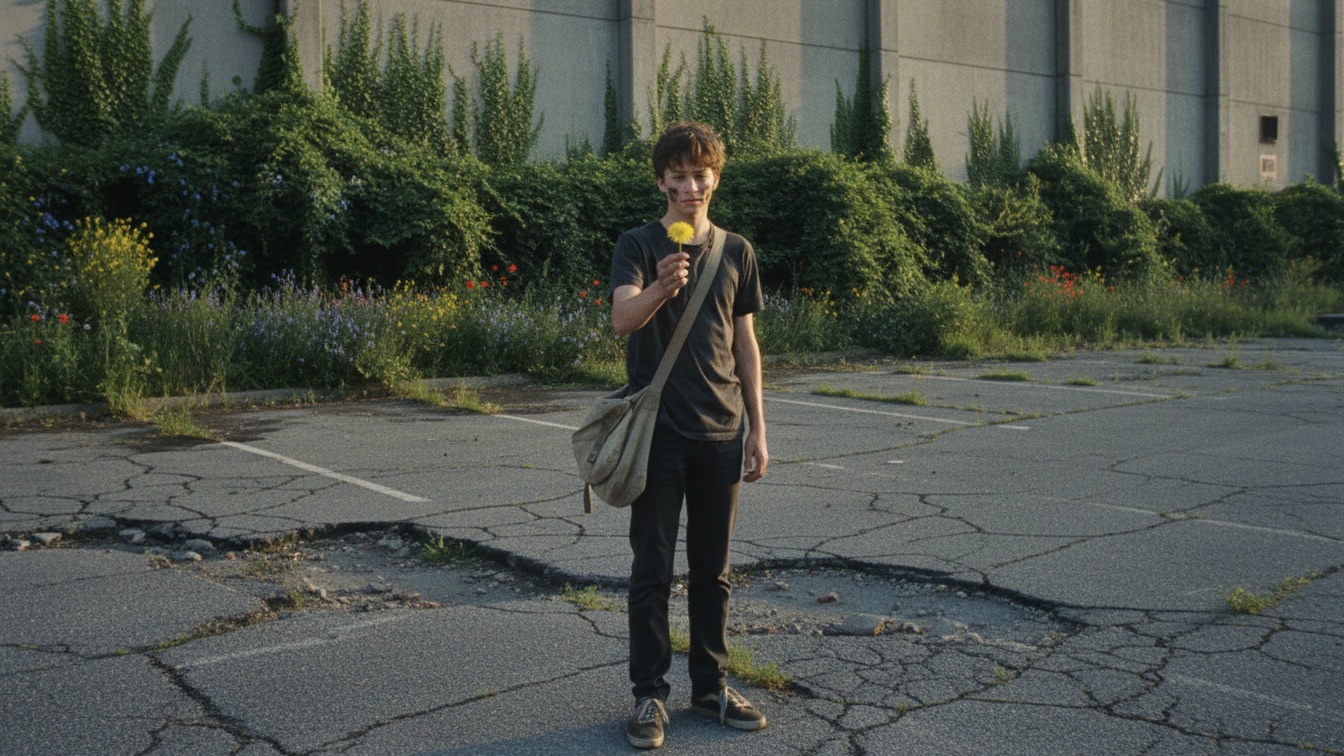
The Discovery: Sam navigates a brutalist industrial landscape, his teeth rattling from the vibrations of his bike as the "Omni-Logistics" app barks orders at him. He arrives at a dead zone behind a rusted fence and discovers a bright yellow flower thriving in a concrete crack, choosing to photograph it rather than complete his delivery. This moment of "idling" marks his first act of defiance against the digital tyrant controlling his movements and sets the "Under-Net" in motion.
The Alliance: Sam meets Carmen behind an overpriced coffee shop, where she reveals that the city’s mapping software ignores non-commercial "null-spaces" within industrial sectors. They develop "glitch-matter" seed bombs and recruit other weary couriers to begin a covert re-greening project across the city’s blind spots. The map on Sam's phone transforms from a grid of tasks into a constellation of potential blooms, shifting his perspective from worker to gardener.
The Escalation: As wildflowers begin to "bleed" through industrial parks and viral drone footage captures the movement, the city council and Omni-Logistics retaliate with chemical sprays and emergency ordinances. Sam witnesses men in hazmat suits poisoning a patch of morning glories, leading to a heated confrontation that he broadcasts to the Petal Punk network. This escalation forces the movement out of the shadows and into a full-scale public "Spring Breakout" at the corporate headquarters.
The Climax: Hundreds of citizens converge on the sterile Omni-Logistics plaza, physically tearing up paving stones to plant a massive weeping willow in front of the glass tower. Security guards are paralyzed by the optics of the situation, unable to use force against a crowd wielding flowers and saplings. Sam stands his ground against Officer Wilson, successfully arguing that the city is a desert in need of irrigation rather than a site of criminal assembly.
The Aftermath: As the sun sets over the newly planted urban forest, Sam and Carmen realize their victory is temporary as the corporate algorithm begins to "recalculate" its response. High above, a fleet of black drones with red lights rises from the Omni-Logistics roof, signaling a new, more high-tech phase of the conflict. Sam holds one final seed bomb, accepting that while the world wants to grow, the fight to let it do so has only just begun.
The episode begins with a sense of crushing claustrophobia and physical fatigue, mirroring the grey, suffocating atmosphere of the Industrial District. As the "Petal Punk" movement grows, the mood shifts toward adrenaline-fueled hope and a sense of communal purpose. The finale offers a cathartic release of "sudden and sharp" oxygen, followed by a chilling cliffhanger that replaces the initial exhaustion with a vigilant, defiant resolve.
If expanded, the season would follow the "Petal Punk" movement as it spreads to other cities, forcing "Omni-Logistics" to evolve its surveillance into biological warfare. The conflict would escalate from simple seed-bombing to the creation of "bio-hacked" plants designed to disrupt digital signals or provide food in urban deserts.
The overarching narrative would explore the radicalization of the working class through environmentalism, eventually leading to a global "Null-Space" network. The season finale would see the protagonists attempting to "re-wild" the central server hubs that power the global algorithm, effectively turning the internet back into a decentralized, organic "wood wide web."
The visual style utilizes a high-contrast color palette, shifting from desaturated, "sickly" greys and teals in the industrial zones to hyper-saturated yellows, greens, and purples where the flowers bloom. Handheld, shaky-cam work during the delivery sequences should contrast with stable, wide, and "breathable" shots once the gardens take root, emphasizing the change in Sam's mental state.
The tone is "Grounded Solarpunk," blending the gritty realism of a gig-economy drama with the vibrant, rebellious energy of a heist film. Tonal comparables include the urban isolation of Mr. Robot mixed with the defiant, youthful optimism of The Florida Project.
The target audience is Gen Z and Millennials (ages 16-35) who resonate with themes of the gig economy, environmental activism, and digital alienation. It is designed for streaming platforms that favor "solarpunk" or "cyberpunk" aesthetics with a grounded, social-justice-oriented narrative, appealing to viewers who enjoy stories about subverting technology for the greater good.
The pacing is "accelerated-organic," starting with the frantic, staccato rhythm of a courier's workday before slowing down during the moments of botanical discovery. The middle act builds momentum through a montage of successful "glitches," culminating in a high-tension, slow-motion march toward the corporate headquarters. The 10-12 minute runtime ensures a tight, punchy narrative that prioritizes visual storytelling over heavy dialogue.
The production will require a mix of practical "seed bomb" props and high-end CGI to depict the rapid, "glitch-like" growth of the wildflowers in the industrial zones. Finding a location with brutalist architecture or an abandoned shipping hub will be essential to establish the "Grey" aesthetic before the floral transformation begins.
The final scene involving the drone fleet should use practical lighting (red LEDs) to create an ominous, predatory atmosphere against the natural greenery. Coordination with a botanical consultant will ensure that the plants depicted are actually "native flora" appropriate for an urban environment, reinforcing the story's message of biological authenticity.


