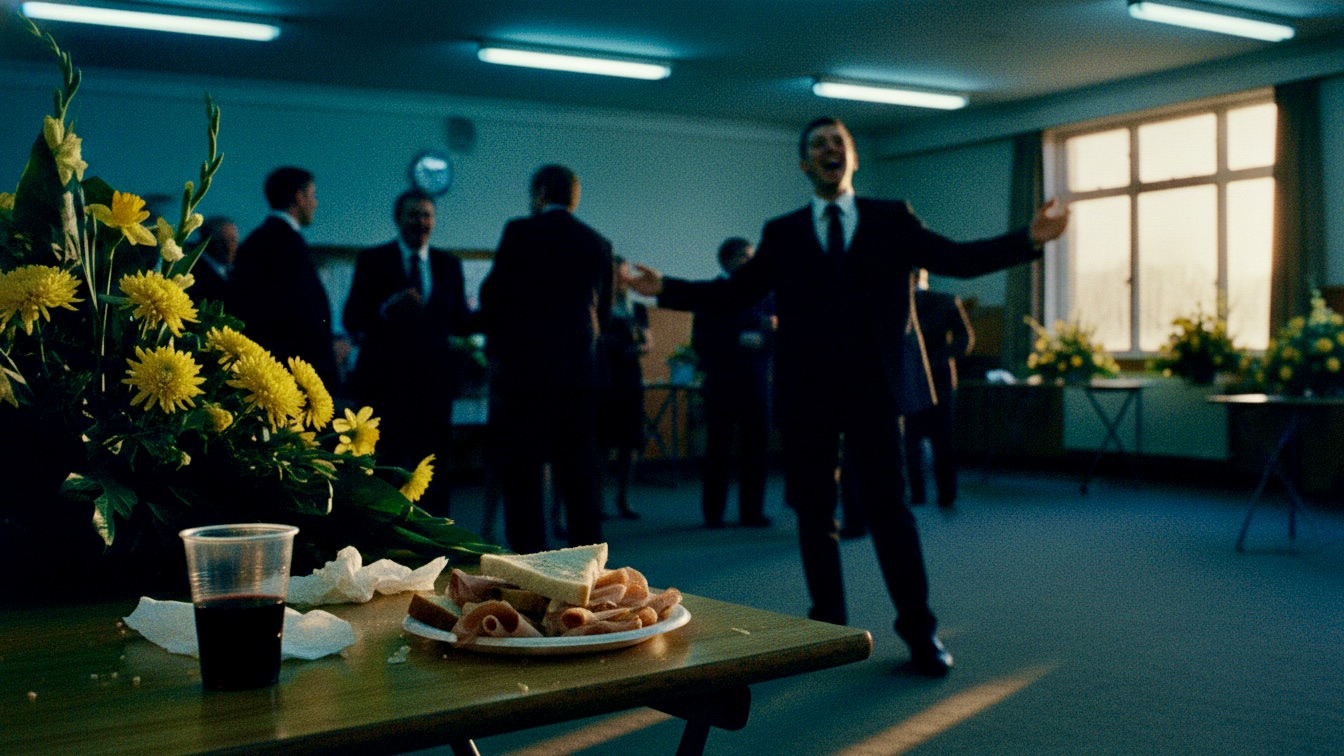
The chapter follows Pete as he attends the funeral and subsequent wake of Mrs. Thompson, a woman he remembers for her sharp, no-nonsense nature and her love of gardening. Throughout the service, Pete struggles with the physical discomfort of aggressive floral scents and the mocking brightness of the spring weather. The narrative shifts to a community center wake where the initial solemnity dissolves into a chaotic, alcohol-fueled gathering of family and friends. As the evening progresses, Pete begins to find peace in the absurdity of the situation, eventually realizing that the community’s shared, messy grief is a fitting tribute to the deceased. The chapter concludes with the mysterious arrival of an unknown man who introduces a final, enigmatic request from Mrs. Thompson involving a brass key and a secret hidden in her garden shed.
The central theme of the narrative is the inherent absurdity of human rituals when contrasted with the relentless, indifferent progression of nature. Mrs. Thompson, a woman defined by right angles and rigid control, is buried on a day that is aggressively alive, filled with pollen, screaming birds, and chaotic spring growth. This juxtaposition highlights the futility of trying to impose order on a world that ultimately demands organic decay and renewal. The narrative suggests that grief is not a tidy, dignified process but a messy, fragmented experience that is best navigated through shared laughter and the collective endurance of those left behind.
Another profound theme is the concept of the legacy of the living. While the casket represents the finality of death, the characters find Mrs. Thompson’s true essence in their interactions with one another and in the strange, lingering tasks she left behind. The transition from the stiff, formal atmosphere of the cemetery to the drunken chaos of the community center illustrates the human need to move toward life. By the end of the chapter, the "mess" of the wake is transformed into a sacred space, validating the idea that the connections forged between the living are the only true monuments to the dead.
Pete serves as the grounded, observant lens through which the reader experiences the funeral. He is clearly struggling with a disconnect between his internal stoicism and the chaotic emotional displays of those around him. His preoccupation with physical sensations, such as his itching neck and his impending sneeze, reveals a man who uses sensory details to avoid confronting the deeper, more painful reality of loss. He is deeply cynical, yet he possesses a hidden well of empathy that allows him to eventually embrace the "mess" of the wake as a meaningful experience.
Sarah acts as a sharp-witted foil to Pete, utilizing sarcasm and irritation as a defense mechanism against her own grief. Her insistence on alcohol and her sensory overload from the pollen suggest a character who is barely holding her composure together. Despite her outward harshness, she is the one who initiates the communal singing, revealing that she understands the necessity of performing grief in a way that feels authentic rather than pious. She represents the volatile, reactive side of mourning, providing the emotional friction that keeps the narrative moving forward.
Although she never speaks, Mrs. Thompson is the most influential presence in the chapter. She is characterized as a woman of extreme discipline who viewed plants as the only honest entities because they never pretended to be anything other than what they were. Her influence is felt in every detail, from the way she forced young Pete to weed her garden to the mysterious, planned finality of her secret in the garden shed. She is a woman who clearly refused to let even her own death be a boring or predictable affair, orchestrating her final act with the same precision she applied to her flowerbeds.
The narrative voice is visceral and immediate, relying heavily on sensory imagery to convey the suffocating atmosphere of the funeral. The author employs sharp, evocative metaphors, such as comparing the scent of lilies to rotting fruit or describing the community center as a brick box, to ground the reader in Pete’s subjective experience. This focus on the physical—the sweat, the pollen, the cold wine, and the out-of-tune piano—prevents the story from becoming sentimental or overly abstract. The tone is consistently dry and observant, balancing the inherent sadness of the event with a dark, observational humor that feels earned.
The pacing of the chapter is carefully structured to mirror the progression of the day, starting with the slow, agonizing crawl of the funeral service and accelerating into the frantic energy of the wake. The transition from the bright, mocking light of the cemetery to the artificial, gray hum of the community center highlights the jarring shift in the characters' internal states. By using short, punchy sentences during moments of high tension and longer, more reflective sentences during moments of realization, the author maintains a rhythm that feels both natural and intentional. The final cliffhanger effectively pivots the narrative from a character study into a mystery, ensuring that the reader remains invested in the legacy of the deceased.


