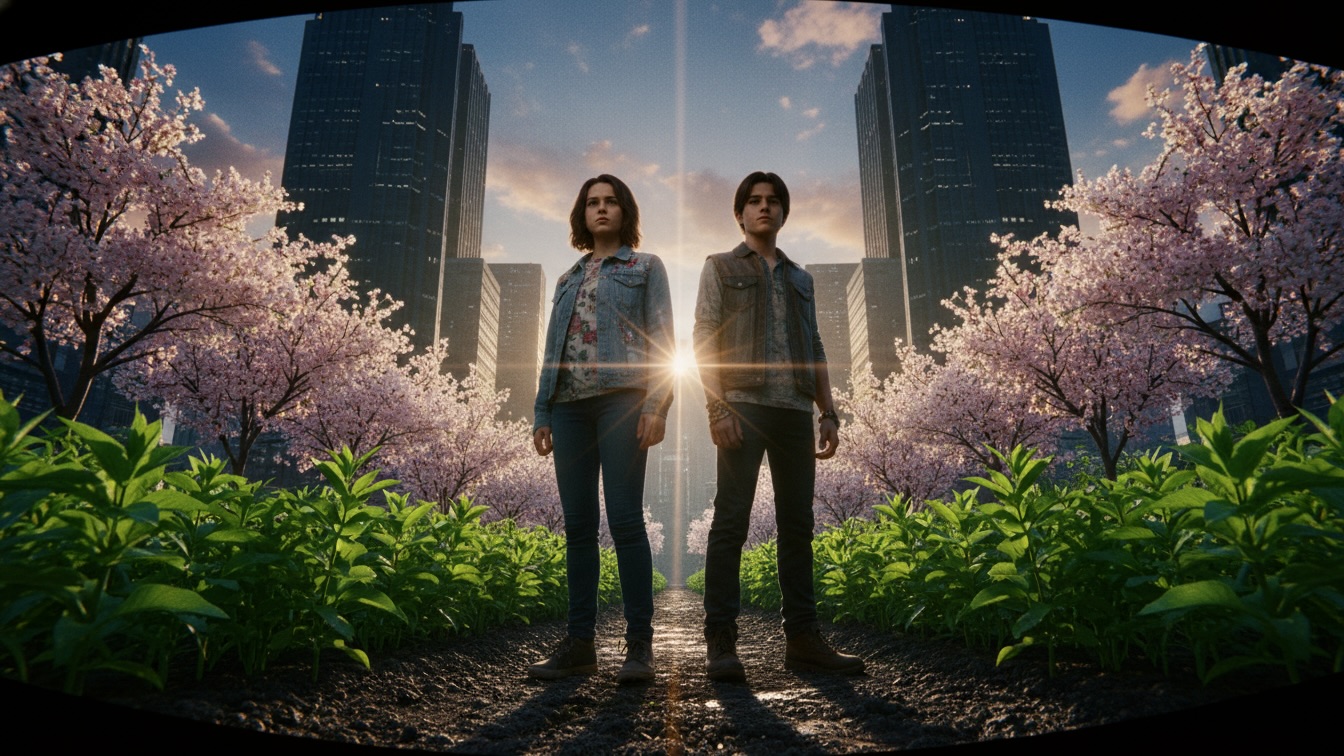
Riley and Leo fight for a patch of dirt as the world tries to pave over the last hope.
The air in the city is heavy. I was leaning against the chain-link fence of the East Side Community Garden, watching a black SUV idle across the street. The driver’s side window was tinted so dark it looked like a hole in reality. My phone buzzed in my pocket—another notification about the 'Smart City' initiative. The Apex Group wanted this lot. They wanted to turn this patch of dirt into a 'hub for innovation,' which is just corporate-speak for a glass box where no one can breathe.
"You’re doing the thing again," Leo said. He didn't look up from his spade. He was knee-deep in a pile of soil that smelled like actual life, which was a weird contrast to the smell of the bus station two blocks over. "The doom-stare. It’s not a good look for the brand, Riley."
"The brand is currently being evicted," I said, shoving my phone deeper into my hoodie. "Did you see the SUV? They’ve been there for twenty minutes. Just watching us. It’s giving 'main character about to get snatched' energy."
Leo finally looked up. He wiped a streak of mud across his forehead, leaving a dark smudge that made his eyes pop. "They’re just suits, Ry. Suits don't like dirt. We’re safe as long as we’re holding shovels. Now, grab the seed packets. If we don’t get these in the ground before the rain hits tonight, the whole season is cooked."
I looked at the small, crinkled paper envelopes in my hand. They didn't look like much. Just some dried-up bits of nature. "Milkweed," I muttered. "We’re literally putting our lives on the line for something called 'milkweed.' The branding on these plants is tragic."
"It’s functional," Leo said, standing up and stretching his back. I heard his spine pop. "Common Milkweed. Asclepias syriaca. It’s the only thing Monarch larvae can eat. No milkweed, no butterflies. No butterflies, and... well, the ecosystem loses another gear. Eventually, the whole machine stops."
I stepped into the plot. The soil was soft, yielding under my worn-out sneakers. The spring sun was actually doing its job for once, hitting the back of my neck with a heat that didn't feel like a fever. I knelt down, the dampness of the earth soaking through my jeans instantly. "Why is it called milkweed? Is it like, soy-based?"
Leo laughed, a short, sharp sound. "Break a leaf later and you’ll see. It’s got this white, sticky latex inside. It’s actually toxic to most things. That’s the hack. The Monarch caterpillars eat it, absorb the toxins, and then they taste like literal poison to birds. It’s their armor."
"So we’re planting biological weapons," I said, feeling a tiny spark of interest. "I can get behind that."
We started digging. The rhythm was supposed to be meditative, but I couldn't stop checking the SUV. Every time I looked, the engine was still humming, a low-frequency vibration that I could feel in my teeth. The city felt like it was closing in—the skyscrapers around the garden felt taller than they were yesterday, leaning over us like giants waiting for us to trip. Claustrophobia isn't just about small rooms; it’s about feeling like there’s no room left for anything that isn't made of steel.
"We need to clear the grass first," Leo directed, pointing at a stubborn patch of green. "Milkweed needs space. It’s a pioneer species. It goes where nothing else wants to grow. It’s a rebel plant."
"Relatable," I said. I jammed the trowel into the earth. I hit something hard. Not a rock. It sounded like metal. My heart did a quick double-time. "Uh, Leo?"
He leaned over, his brow furrowed. "What? Trash? This place used to be a garage in the nineties. Probably an old muffler."
I cleared the dirt away with my fingers. It wasn't a muffler. It was a metal box, small and rusted, but definitely intentional. I looked at the SUV. The brake lights flickered. Someone was watching. My stomach did a slow roll. "Leo, this doesn't look like garbage."
"Just pull it out," he said, though his voice had lost that casual edge. He reached down and helped me heave. The box came free with a wet, sucking sound. We sat back on our heels, staring at it. It was a heavy-duty Pelican case, the kind people use for expensive cameras or... things they don't want found.
"Is this a 'don't open it' moment or an 'open it immediately' moment?" I asked. My hands were shaking. The static in my head—the constant hum of anxiety I’d been carrying since the Apex Group started their buyouts—suddenly went silent. It was replaced by a sharp, cold clarity.
"It’s a garden project, Riley. We’re planting for the butterflies," Leo whispered, but he was already reaching for the latches. "The Monarchs are endangered. We’re doing a good thing. Good things don't involve buried tactical cases."
"Except they do. Everything is high stakes now. Even bugs."
He snapped the latches. They were surprisingly clean for being underground. He flipped the lid. Inside wasn't a bomb or money. It was a stack of legal documents and a hard drive. On top of the papers was a handwritten note: For when the concrete gets too thick. The seeds are the key.
I looked at Leo. He looked at me. Then we both looked at the milkweed packets.
"The 'seeds' are the key?" I said. "That’s a bit on the nose, isn't it?"
"Wait," Leo said, flipping through the papers. His eyes scanned the text at light speed. "These are land surveys. Riley, the garden isn't just a garden. This plot... the deed was never legally transferred to the city. It’s a private trust. Apex can't touch it. They’ve been faking the eviction notices."
I felt it then. The Sudden Oxygen. It was like a physical weight had been lifted off my chest. The skyscrapers didn't look like giants anymore; they just looked like buildings. The SUV across the street wasn't a predator; it was a desperate observer. They knew this was here. They were waiting for us to find it—or trying to scare us off before we did.
"We have to plant the seeds," I said. My voice was different. Stronger.
"Riley, we have a legal bombshell in our laps, and you want to garden?" Leo asked, though he was already grinning.
"No, you don't get it. If we plant these, and the Monarchs come, this becomes a protected habitat. It’s not just about the deed. It’s about making the land impossible to pave over. We’re not just gardening, Leo. We’re building a fortress."
We didn't wait. We worked with a frantic, focused energy. We dug the holes, exactly three inches deep. We placed the seeds—the little brown flakes of potential—into the dark earth. We covered them gently. Every movement felt like a middle finger to the glass boxes rising around us.
"We’re also going to make paper," I said, my mind racing. "Later in the fall. We take the stalks, harvest the fibers, and make paper that’s literally made of the thing that saved the garden. We can print the truth on it."
"You’re getting ahead of yourself," Leo said, but he was digging faster now. "First, we survive the spring. First, we make sure these things sprout."
I looked back at the SUV. The window rolled down just an inch. I saw a pair of sunglasses reflecting the sun. I didn't look away. I held up a seed packet like a trophy. I saw the window roll back up. The engine roared, and the vehicle peeled away, tires screeching against the asphalt.
"They’re gone," I said. I felt a laugh bubbling up in my throat. It wasn't a nervous laugh. It was real. "They’re actually gone."
"For now," Leo cautioned. He stood up, wiping his hands on his pants. He looked at the row of freshly turned earth. "Now we wait for the rain. And the Monarchs. Did you know they fly all the way from Mexico? Thousands of miles, just to find this specific weed."
"I get it," I said. I looked up at the sky. For the first time in months, it looked blue. Not 'city blue' which is basically grey, but actual, deep blue. "They’re looking for home. We just have to make sure it’s still here when they arrive."
We spent the next hour watering the beds. The water from the rusted spigot tasted like iron, but the plants didn't care. As the sun began to dip behind the skyline, casting long, orange shadows across our little sanctuary, I felt a strange sense of peace. The digital noise in my brain had faded to a dull hum.
"Hey," Leo said, pausing by the gate. "You think they’ll actually come? The butterflies?"
"They have to," I said. "We’re the only ones left with the poison they need."
We walked out of the garden, locking the gate behind us. The city was still loud, still crowded, and still trying to sell me things I didn't want, but it felt different. I felt like I had a secret. I felt like I was part of a resistance that didn't need guns or hackers—just some dirt and a very specific kind of weed.
As we reached the corner, a drop of rain hit my forehead. Then another. The sky was opening up, right on schedule.
"Perfect timing," Leo said, pulling his hood up. "The seeds are soaking. The revolution is hydrated."
I smiled, actually smiled, and for a second, I forgot about the Apex Group, the hard drive in Leo’s backpack, and the precariousness of being seventeen in a world that felt like it was ending. I was just a girl who had planted something.
But then I saw it.
Across the street, leaning against a lamp post where the SUV had been, was a woman in a grey suit. She wasn't looking at her phone. She was looking at the garden. And she was holding a gallon of industrial-strength herbicide.
“She unscrewed the cap of the herbicide and stepped toward our gate with a smile that didn't reach her eyes.”


