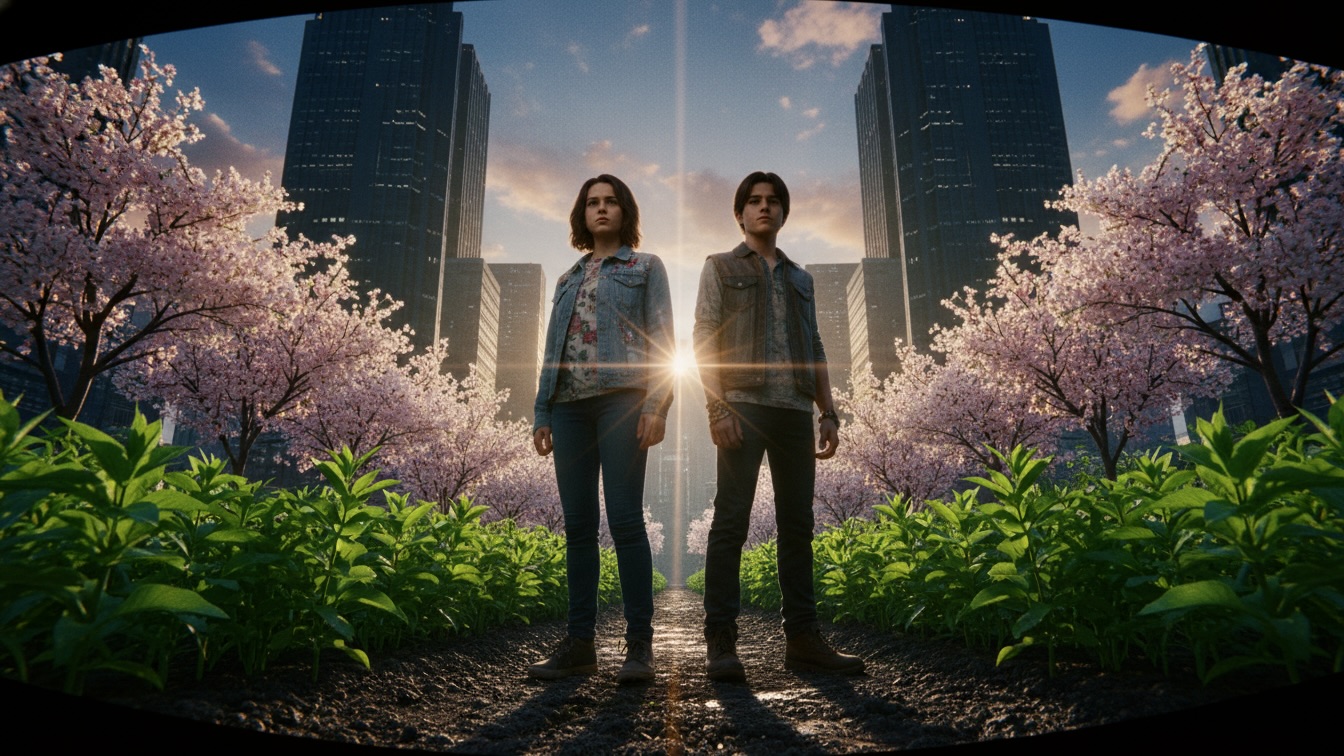
The narrative unfolds in the East Side Community Garden, a fragile sanctuary of soil amidst a looming urban landscape. Riley, a teenager consumed by the encroaching "Smart City" initiative, watches a suspicious black SUV while her friend Leo focuses on planting milkweed. Their mundane act of gardening takes a dramatic turn when Riley uncovers a buried Pelican case containing legal documents and a hard drive. These papers reveal that the Apex Group’s eviction notices are fraudulent, as the garden is actually a protected private trust.
Buoyed by this discovery, Riley and Leo plant the milkweed seeds with a newfound sense of purpose, viewing the plants as a biological fortress for both butterflies and their community. As they complete their work, the mysterious SUV departs, momentarily signaling a victory for the pair. However, the chapter concludes on a chilling note as they encounter a corporate operative armed with industrial-strength herbicide. This final image suggests that while the legal battle may be winnable, the physical survival of the garden remains under immediate threat.
The central theme of the story revolves around the concept of resistance through ecology. Riley and Leo are not using traditional methods of protest; instead, they are utilizing the inherent properties of the milkweed plant to create a "protected habitat" that corporate interests cannot legally pave over. This suggests that nature itself can be a form of armor against the sterile, glass-heavy expansion of modern urbanization. The milkweed’s "sticky white sap" and toxic properties serve as a metaphor for a resistance that is quiet, grounded, and inherently dangerous to those who try to consume or destroy it.
Another prominent theme is the psychological impact of urban claustrophobia and corporate surveillance. Riley perceives the skyscrapers as giants leaning over the garden, creating a sense of being trapped even in an open space. The "Smart City" initiative is presented not as a benefit to the citizens, but as a suffocating force that replaces "actual life" with "innovation hubs." The story highlights the tension between the organic, messy reality of the soil and the polished, deceptive world of corporate legalities and tinted windows.
The narrative also explores the idea of hope as a functional necessity rather than a vague sentiment. For Riley, the discovery of the legal documents provides what she calls "Sudden Oxygen," a physical relief from the crushing weight of her environment. The act of planting seeds becomes a middle finger to the corporate giants, transforming a small patch of dirt into a high-stakes battlefield. It illustrates how the preservation of a single species, like the Monarch butterfly, can become a focal point for reclaiming human agency in a world that feels increasingly automated and indifferent.
Riley is characterized by a deep-seated anxiety that manifests as a "doom-stare" and a constant awareness of her surroundings. She feels the weight of the city in her teeth, a sensory detail that underscores the physical toll of her psychological distress. Her initial cynicism regarding the "branding" of milkweed serves as a defense mechanism against the precariousness of her situation. She is a protagonist who feels small and hunted, yet she possesses a sharp intelligence that allows her to recognize the potential power in the legal documents they discover.
By the end of the chapter, Riley undergoes a significant internal shift from a state of paralysis to one of focused defiance. The "static" in her head is replaced by a cold clarity when she realizes that the land can be defended through both legal and biological means. Her decision to view the garden as a "fortress" reveals her need for security and her willingness to fight for a space that feels like home. She represents the struggle of a generation trying to find a foothold in a world that seems determined to pave over their future.
Leo serves as the grounding force in the narrative, acting as both a mentor and a calm counterpart to Riley’s heightened state of alert. He is literally and figuratively rooted in the earth, dismissing Riley’s fears as "main character energy" to keep her focused on the task at hand. His knowledge of botany provides the framework for their resistance, as he explains the tactical advantages of the milkweed’s toxicity. He is the one who understands that survival often requires a specific kind of "poison" to deter predators.
Despite his pragmatic exterior, Leo demonstrates a quiet passion for the ecosystem and the survival of the Monarchs. He is not just planting seeds; he is tending to a "machine" that he believes is worth saving. His reaction to the discovery of the Pelican case shows that he is capable of moving quickly when the situation demands it, though he remains more cautious than Riley. He provides the stability she needs to transition from a victim of her environment to an active participant in its defense.
The pacing of the story is expertly handled, beginning with a slow, atmospheric tension that gradually accelerates into a high-stakes discovery. The author uses the presence of the SUV as a ticking clock, creating a rhythmic sense of dread that punctuates the dialogue between Riley and Leo. When the metal box is found, the narrative shifts from contemplative to urgent, mirroring the characters' frantic energy as they plant the seeds. The final reveal of the woman with the herbicide provides a sharp, cinematic cliffhanger that effectively resets the tension for the next chapter.
The narrative voice is heavily influenced by Riley’s internal monologue, which is characterized by a blend of modern slang and vivid, sensory-driven metaphors. Phrases like "glass box where no one can breathe" and "main character about to get snatched energy" ground the story in a contemporary setting. This voice creates a strong sense of intimacy, allowing the reader to feel the "vibration" of the city and the "wet, sucking sound" of the earth alongside the protagonist. The contrast between her cynical inner thoughts and the earnest beauty of the garden creates a compelling tonal balance.
Sensory details are used to distinguish the two competing worlds of the story: the corporate and the organic. The city is described through "tinted" windows, "glass boxes," and "industrial-strength herbicide," creating an image of something sterile and artificial. In contrast, the garden is defined by the smell of "actual life," "sticky latex," and "dampness" soaking through jeans. These details reinforce the thematic conflict, making the struggle for the East Side Community Garden feel like a battle for the very senses themselves.


