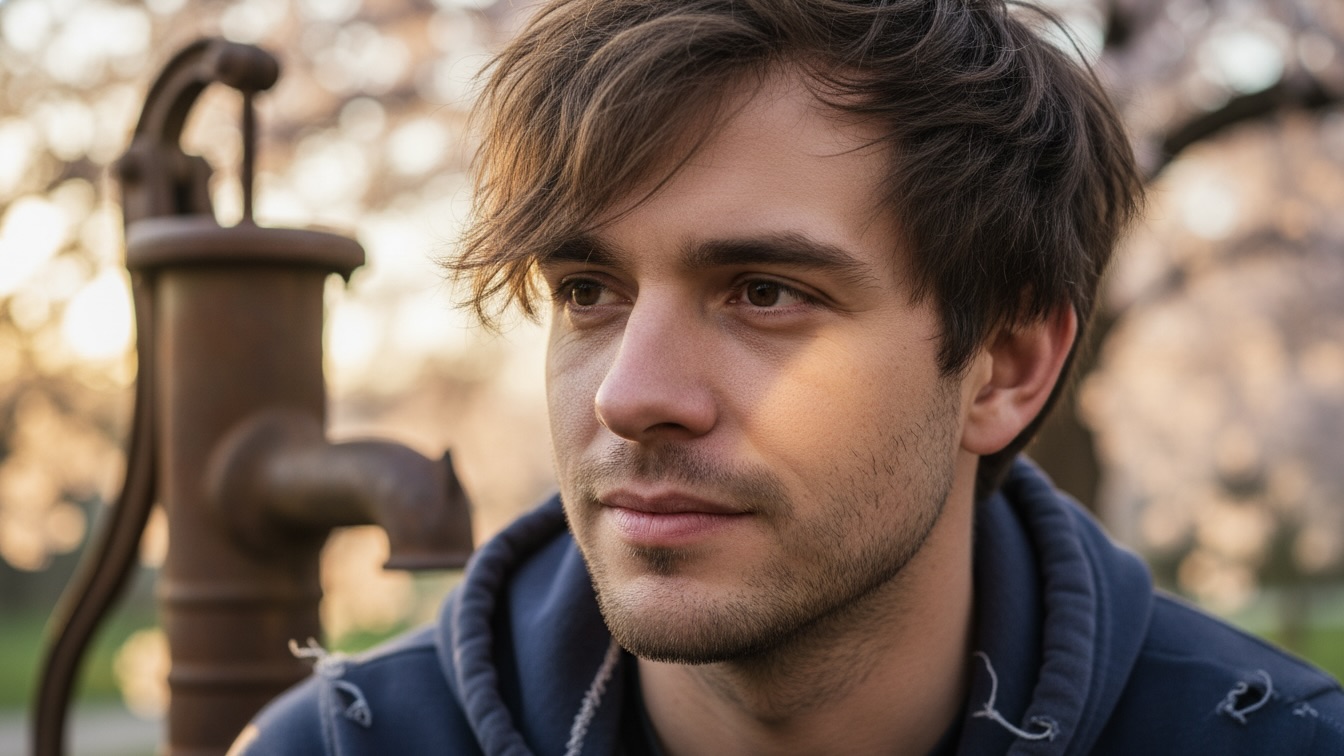
When a solar flare kills the grid, two strangers find reality more addictive than a high-cost dating algorithm.
The haptic band on Jay’s wrist buzzed. It was a sharp, annoying vibration that felt like a tiny insect trying to burrow into his skin. He didn’t need to look at the AR glasses sitting on his nose to know what it was. It was the SoulMatch bill. Another month. Another four hundred credits. Half his paycheck from the cloud-sorting facility gone to a server that promised him a soulmate but mostly just gave him ads for weighted blankets and antidepressants.
He stared at the floating interface. A red circle hovered in the corner of his vision. It told him he was ninety-eight percent compatible with a girl named Sarah who lived three blocks away. He had messaged Sarah three days ago. She hadn’t replied. The algorithm told him to send a ‘Spark’ for an extra ten credits. It was a scam. He knew it was a scam. The glasses were heavy. They made the bridge of his nose sore. He wanted to rip them off, but the world without the overlay was just gray concrete and peeling paint. The AR made the city look like a park. It turned the smog into a soft glow. Without them, he was just a twenty-year-old living in a box.
Then the sky changed. It wasn't a slow shift. It was a sudden, violent flash of white that felt like it was happening inside his skull. The AR display didn't just turn off; it screamed. A jagged line of static tore through his field of vision. The red compatibility circle expanded until it covered everything, then it shattered into a million digital shards. Jay stumbled back. His heel caught on a stack of empty soy-protein crates. He hit the floor hard. The hum of the city—the constant, low-frequency drone of millions of devices—stopped. The silence was louder than the noise had been. It was a heavy, physical weight. He pulled the glasses off. They were dead. The lenses were just cold glass. No icons. No notifications. No Sarah. He looked out the window. The streetlights were dark. The digital billboards that usually blasted neon colors into his room were black rectangles. The air felt different. It was less thick. It felt like oxygen was actually reaching his lungs for the first time in years.
He waited for the reboot. Ten minutes. Twenty. The grid didn't come back. He tried his faucet. Nothing. The smart-valve required a handshake with the central server to release the water. He was thirsty. The kind of thirst that makes the back of your throat feel like sandpaper. He remembered the old garden behind the complex. There was a manual pump there. A relic from the 1900s. It was kept there for ‘aesthetic purposes’ in the AR overlay, usually covered by a digital fountain. He grabbed a plastic bucket and headed into the stairwell. The emergency lights were dead. He had to feel his way down the concrete stairs. He could hear other people in the building. Doors opening. Voices that sounded small and scared. Without the digital buffer, everyone sounded raw.
He stepped outside. The sun was setting. It was a real sunset. No filters. The sky was a pale, bruised purple. It didn't look perfect. It looked messy. He walked toward the garden. The weeds were tall. In the AR, this place looked like a manicured lawn. In reality, it was a mess of dandelions and cracked dirt. He saw a figure standing by the iron pump. It was a girl. She was wearing a faded hoodie and had hair that looked like it hadn't seen a stylist in months. She didn't have the glowing skin the filters gave everyone. She had a small scar on her chin. She looked tired. She looked real. She was struggling with the handle of the pump. It was rusted shut. Jay stood there for a second. He felt a weird twitch in his thumb—the ghost of a gesture to swipe right on her. But there was no profile. No bio. No compatibility score.
“The mechanism is unyielding,” the girl said. She didn't look up. Her voice was steady, almost like she was reciting a line in a play. “It demands a strength I do not possess.”
Jay walked over. “It is merely oxidation,” he said. He felt his own voice change. Without the shorthand of text and emojis, he felt a strange urge to be precise. To be significant. “Allow me to apply the necessary leverage.”
He grabbed the iron handle. It was cold. It felt heavy. He pulled. Nothing. He braced his feet against the dirt and slammed his weight down. The metal groaned. It was a high, piercing sound that cut through the quiet of the dead city. He pumped again. A rhythmic clank-clank-clank began to echo. A stream of brown, muddy water spat out of the spout. Then, it cleared. It became a steady, crystal flow. The girl held her bucket under it. The sound of water hitting plastic was the loudest thing in the world.
“I am Tania,” she said. She looked him in the eyes. It was intense. In the world of AR, you never really looked at people’s eyes; you looked at the data tags hovering near their ears. “You have saved me from a very dry evening.”
“I am Jay,” he replied. He let go of the handle and wiped his hands on his jeans. “I didn't think anyone else knew this thing actually worked.”
“I didn't know,” Tania said. She took a sip of the water, then wiped her mouth. “I only hoped. The algorithm never mentioned the pump. It only showed me the fountain. The fountain was beautiful, but it was not functional.”
They sat down on the edge of a concrete planter. The spring air was cool. The smell of blooming jasmine was thick and sweet. It wasn't the artificial scent piped into the ventilation systems. It was heavy and a little bit rotting. It was better. They talked. They didn't talk about their jobs or their stats. They talked about the silence. Tania told him how she had spent the last hour trying to remember her mother’s phone number because it wasn't stored in her brain, only in the cloud. Jay told her about the four hundred credits he’d just spent on a dead service. They laughed. It wasn't a ‘LOL.’ It was a physical sound that shook their chests.
“The calculation was always wrong,” Tania said, her voice dropping to a theatrical whisper. “I have been matched with a dozen men this year. Each was a perfect mirror of my own interests. Each was a total void. The algorithm did not want us to find a partner. It wanted us to stay in the search. The search is where the revenue lives.”
Jay felt a chill that had nothing to do with the wind. “The subscription is a parasite. It feeds on the gap between us. If we are happy, the revenue stops. They curated our loneliness.”
They sat there for hours. The stars came out. Without the city lights, the sky was crowded. It was confusing. It was messy. It was the most beautiful thing Jay had ever seen. He didn't feel the need to take a picture of it. He just wanted to look. He felt the burden of the last three years—the constant pressure to be ‘matchable,’ the anxiety of the compatibility score—simply evaporate. It was sudden oxygen. He could breathe. He looked at Tania. He didn't need a red circle to tell him she was the right person to talk to. He just knew because he was still talking.
Suddenly, the city flinched. A streetlamp a block away flickered to life. Then another. A low hum began to vibrate through the ground. The grid was resetting. Jay felt a pang of genuine grief. He reached into his pocket and pulled out his AR glasses. They were vibrating. A tiny blue light was blinking. They were searching for a signal. Tania pulled her phone from her hoodie. It lit up her face with a harsh, artificial white light. The notifications started screaming. Pings. Whistles. Dings. The digital world was rushing back in, trying to claim them.
“It is returning,” Tania said. She looked at her screen. Her face went flat. The light washed out the warmth in her skin. “The ghost in the machine is hungry.”
Jay looked at his glasses. A notification popped up on the tiny lens: ‘Sarah sent you a Spark! See what she said for 5 credits!’ He felt a wave of disgust. It was so transparent. It was a trap. He looked at Tania. She was looking at her own screen, her thumb hovering over the glass.
“Don’t,” Jay said. His voice was sharp. “Don’t go back in.”
Tania looked up. The light from her phone made her eyes look like glass. “It is the only way to see, Jay. The world is dark without the overlay.”
“The world is right here,” Jay said. He stood up. He took his AR glasses. He felt the weight of them. Then, he dropped them onto the concrete. He raised his heavy leather boot and brought it down. The crunch of glass and plastic was incredibly satisfying. It was the sound of a contract being broken.
Tania stared at the broken tech. A slow smile spread across her face. She tapped her screen, her fingers moving with a speed that spoke of a lifetime of digital literacy. She wasn't checking a message. She was navigating the settings. She found the ‘Delete Account’ button. She pressed it. Then she threw the phone into the bucket of water. It hissed. The screen flickered green, then went black.
“The old-fashioned way?” she asked. Her voice was modern, but her tone was grand, like a queen deciding the fate of a nation.
“The only way,” Jay replied. He felt light. He felt like he could jump over the building. “Tomorrow. At the park. No stats. No filters.”
“I shall be the one without the glowing halo,” she said. She picked up her bucket.
Jay watched her walk away into the shadows of the returning streetlights. The power was back, but the connection was different now. He walked back to his apartment. The air felt heavy again as the city’s filters kicked back in, but he didn't care. He knew what the sky actually looked like. He knew what water tasted like when you had to work for it. He knew that the most expensive thing he had ever bought was his own isolation, and he was done paying for it. He stepped into his dark apartment, ignoring the smart-valve that was now chirping for a firmware update. He didn't need it. He had the memory of the pump. The grid was a lie. The silence was the truth.
“But as Jay closed his door, he noticed a single, red LED on his wall camera pulse twice—the algorithm was already learning to adapt to the dark.”


