2026 Spring Short Stories
Analog Hearts in a Digital Deadzone - Treatment
by Leaf Richards | Treatment
by Leaf Richards | Treatment
Format: Short Film / Anthology Episode | Est. Length: 10-12 minutes
"Analog Hearts in a Digital Deadzone" serves as a pilot or standalone entry for The Glitch, an anthology series set in a near-future megalopolis where the "Grid"—a ubiquitous AR overlay—replaces physical reality with a curated, high-definition dreamscape. Each episode follows different citizens navigating the cracks in a system where corporate-controlled algorithms dictate the value of human connection and labor. The series explores the friction between a sterile, optimized digital existence and the messy, visceral reality of a world in decay.
Jay stares at a 98% compatibility notification for a girl he’s never met, until a violent digital static shatters his AR glasses and plunges the neon city into absolute, terrifying darkness.
When a massive grid failure strips away the digital filters of a hyper-connected dystopia, two strangers must navigate the physical world to find a connection that isn't for sale. They must decide whether to plug back into the comfortable lie or embrace the harsh, beautiful reality of the blackout.
The primary theme is the commodification of loneliness, illustrating how corporations profit by maintaining a "search" state rather than facilitating true connection. It explores the dichotomy between the "Functional" and the "Aesthetic," highlighting how digital convenience often erodes basic survival skills and genuine human empathy.
The secondary theme focuses on sensory reclamation. The story transitions from the sterile, filtered environment of the AR world to the visceral, "bruised" reality of a city in decay, suggesting that beauty found in imperfection is more valuable than a programmed utopia.
For Jay, the stakes are his sanity and his physical survival; he is literally paying half his income for a digital ghost while his basic needs, like water, are tied to a central server. If he fails to adapt to the blackout, he faces dehydration and isolation in a city that has forgotten how to function without a handshake. Ultimately, the stake is his soul—staying in the grid means remaining a "product" in a system that feeds on his unhappiness.
The primary antagonist is the "Grid" and its predatory algorithms, specifically the SoulMatch service that curates loneliness for profit. External conflict arises from the physical environment—the lack of water, the dead technology, and the rusted manual pump. Internal conflict centers on the characters' addiction to digital validation and the fear of a world that isn't "filtered" or "optimized."
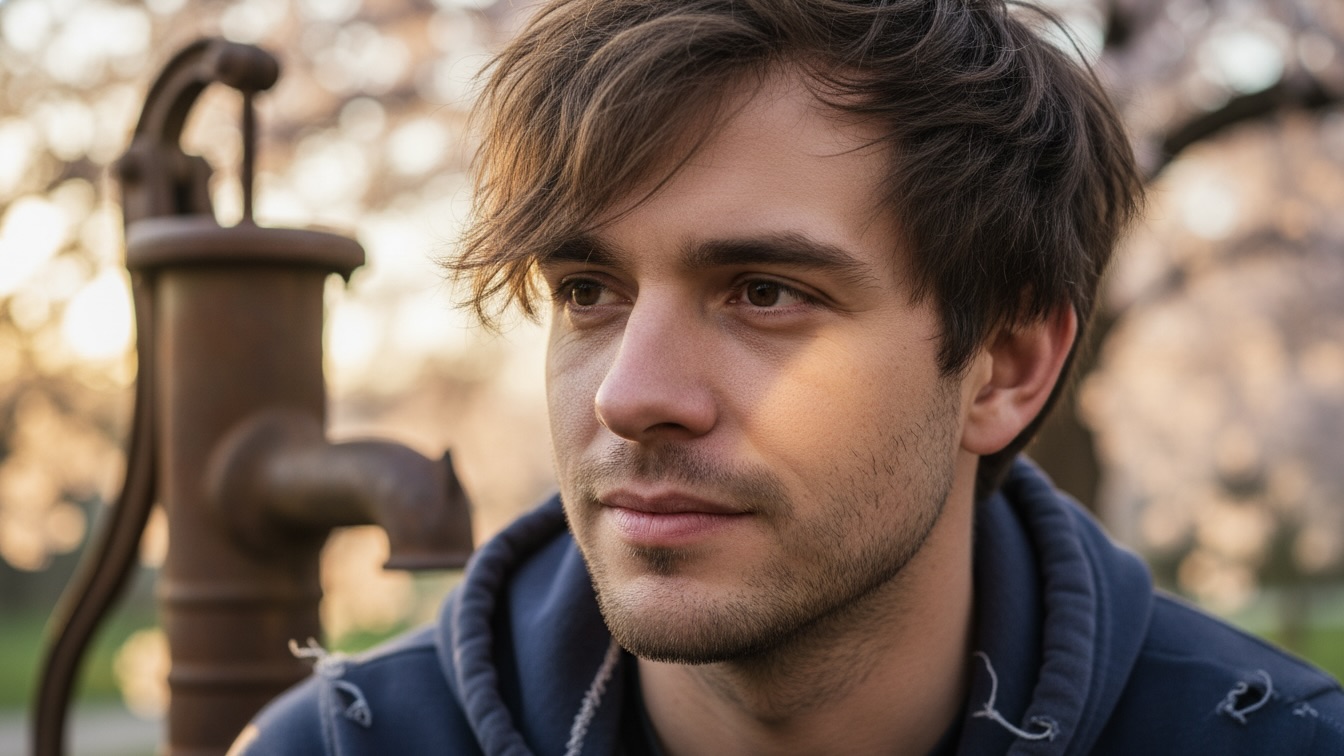
Jay is a disillusioned cloud-sorter living in a cramped "box" made beautiful only by his AR glasses, which he pays for with most of his meager salary. When a sudden, violent grid failure kills all technology, Jay is forced to confront the gray, decaying reality of his city and his own crushing thirst. He ventures into the dark to find an ancient manual water pump, a relic he only knew as a digital fountain in his AR overlay.
At the pump, he meets Tania, a woman who exists outside his compatibility algorithms and looks nothing like the filtered avatars he’s used to. They form a raw, authentic bond over the struggle of the manual pump and the silence of the city, realizing that their digital lives were designed to keep them apart. When the power flickers back on, they are faced with a choice: return to the curated safety of the Grid or destroy their devices to preserve the truth they found in the dark.
Jay: A 20-year-old "cloud-sorter" who begins the story as a passive victim of digital consumerism, defined by his "matchability" score and financial debt to the Grid. By the end, he transforms into a defiant iconoclast who values physical labor and unmediated reality over digital comfort. His arc moves from digital dependency to tactile autonomy, symbolized by his destruction of his AR glasses.
Tania: A pragmatic and observant woman who, despite being a product of the digital age, harbors a deep skepticism of the "fountain" vs. the "pump." She starts as a weary survivor struggling with the physical world and ends as Jay’s partner in a quiet revolution. Her arc is one of reclamation, choosing to "delete" her digital identity in favor of a messy, real-world existence.
Beat 1: Jay sits in his dismal apartment, his haptic band buzzing with a SoulMatch bill he can't afford while he stares at a non-responsive "98% match" profile. The AR overlay turns his peeling walls into a lush park, but the physical weight of the glasses causes him literal pain. This establishes the "comfortable lie" of his existence and the financial parasite of the subscription model.
Beat 2: A sudden, violent white flash tears through the AR display, replaced by a scream of static as the entire city’s power grid collapses. Jay falls in the darkness, experiencing the "loud silence" of a world without digital hum, and realizes his smart-valve won't release water without a server handshake. He decides to seek out the "aesthetic" garden pump, transitioning from a digital consumer to a physical seeker.
Beat 3 (Midpoint): Jay reaches the garden and finds it is a mess of weeds rather than the manicured lawn promised by the AR, where he encounters Tania struggling with the rusted pump. They share their first unmediated conversation, using precise language instead of emojis, and Jay uses his physical strength to break the oxidation and draw real water. This is the first moment of genuine, uncurated human cooperation and success.
Beat 4: As night falls, Jay and Tania sit in the "bruised purple" sunset, discussing how the SoulMatch algorithm was designed to keep them lonely for revenue purposes. They experience the beauty of the real stars for the first time, realizing that the "search" was the product, not the solution. The emotional intimacy peaks here, grounded in the smell of rotting jasmine and the coldness of the air.
Beat 5 (Climax): The grid suddenly flickers back to life, and the "ghost in the machine" returns with a barrage of pings, sparks, and predatory notifications on their devices. Jay sees a fake "Spark" from his old match and feels a wave of disgust at the transparent manipulation of the system. In a final act of defiance, Jay crushes his AR glasses and Tania drowns her phone in the bucket, choosing the "dark" world over the digital one.
The episode begins with a feeling of sterile anxiety and claustrophobia, characterized by the annoying buzz of haptics and the visual clutter of AR. As the blackout hits, the mood shifts to jarring disorientation and then to a grounded, earthy sense of wonder. The finale provides a cathartic release—a transition from the "hiss" of dying tech to the quiet, empowered resolve of two people finally seeing each other.
If expanded, the season would follow Jay and Tania as they navigate a city that is "re-plugging" itself, acting as "ghosts" who refuse to reactivate their digital IDs. They would encounter a growing underground of "Unlinkeds" who use the city's forgotten manual infrastructure to survive, creating a shadow economy based on trade rather than credits.
The thematic escalation would involve the Grid's corporate owners deploying "Optimization Squads" to track down those who haven't reconnected, framing the blackout as a terrorist act. The season would culminate in a choice for the city: a forced system-wide update that eliminates the "manual" world forever, or a coordinated effort by the Unlinkeds to permanently crash the servers.
The visual style relies on a sharp contrast between "The Overlay" and "The Deadzone." The Overlay should be hyper-saturated, with floating UI elements, soft-focus glows, and a "perfect" color palette reminiscent of high-end advertising. Once the power fails, the cinematography shifts to a gritty, high-contrast "naturalism," using anamorphic lenses to capture the wide, empty sky and handheld cameras to emphasize the tactile reality of the garden.
The tone is "Dystopian Romanticism," blending the cynical social commentary of The Social Network with the atmospheric loneliness of Her. The sound design is crucial, moving from a constant, low-frequency digital drone to a world of sharp, isolated sounds: the clank of the pump, the splash of water, and the crunch of breaking glass.
The target audience is adults (18-35) who are "digitally native" but experience "tech fatigue" and concerns about algorithmic manipulation. It appeals to fans of speculative fiction and anthology dramas who enjoy social critiques of modern connectivity and the "loneliness economy."
The pacing is deliberate and atmospheric, focusing on the "real-time" experience of the blackout. The first three minutes are frantic and cluttered with UI, followed by a sudden drop in tempo for the middle six minutes of the blackout, allowing the character connection to breathe. The final two minutes accelerate as the power returns, ending on a sharp, punctuated note of defiance.
The "AR Overlay" requires sophisticated VFX to create a world that looks enticing but slightly "uncanny" and artificial. These elements should "shatter" or "glitch" violently during the power failure, requiring a mix of digital assets and practical lighting shifts to ground the transition.
The manual pump and the garden are key practical locations; the pump must be a heavy, functional prop that conveys a sense of weight and resistance. Production should focus on "sensory" foley work—the sound of the water, the rust, and the wind—to sell the transition from a digital world to a physical one.


