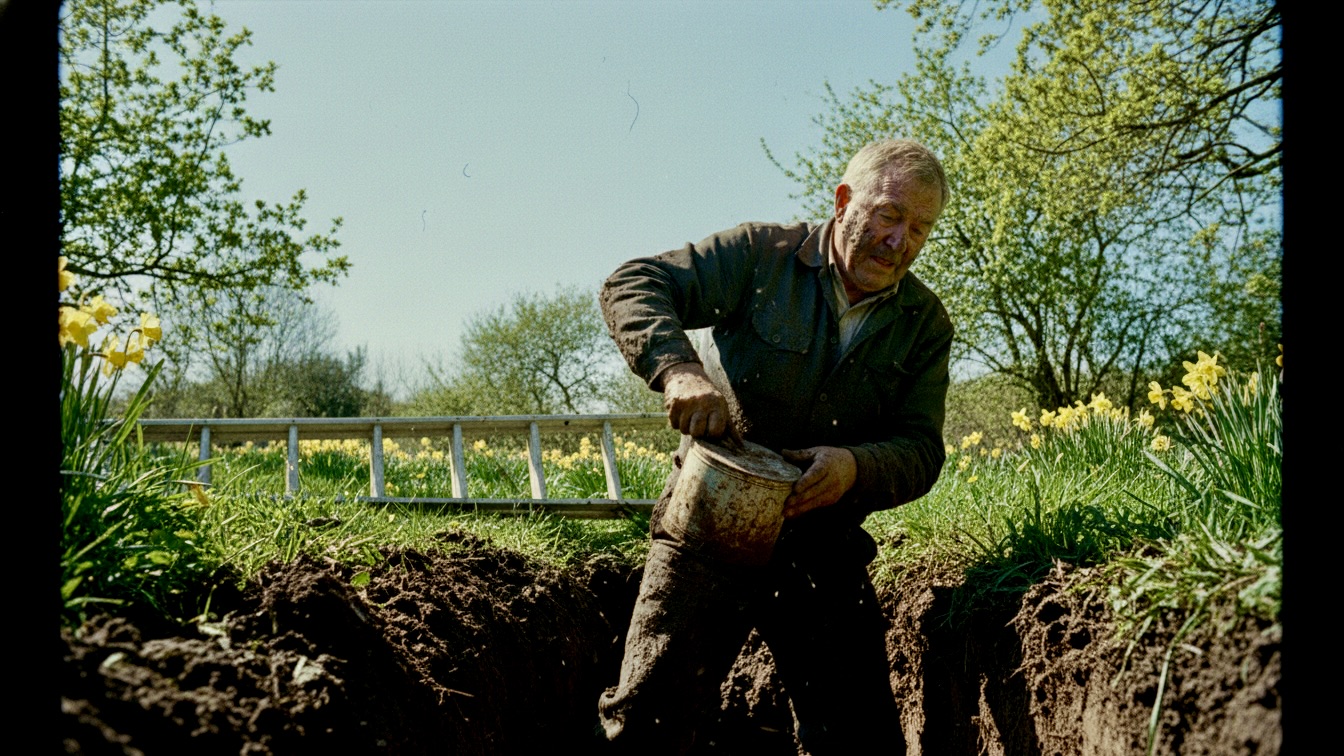
Armand survives a brutal fall in his garden only to find a piece of his past resurfacing.
The air didn't just smell like rain; it smelled like the world had finally decided to wash its feet.
Everything was dripping. The gutters were overachieving, dumping buckets of gray water onto the flagstones with a rhythmic thud that felt like a headache in the making. I stood on the back porch, my old knees clicking like a pair of castanets.
I’m seventy-two. At this age, you don't just walk; you negotiate with gravity. I took a breath, feeling the dampness settle in my lungs. It was cold, but not the kind of cold that wants to kill you. Just the kind that wants you to know it’s there. Spring in the city is a messy business. It’s not a postcard. It’s mud, worms on the sidewalk, and the realization that your roof is probably leaking.
I needed to fix the bird feeder. It was hanging at a weird angle, tilted like a drunk sailor after a night on the harbor. The squirrels had been doing parkour on it again. If I didn't straighten it, the chickadees would go on strike. I grabbed the aluminum ladder from the shed. It was cold and slick.
My hands aren't what they used to be; the grip is gone, replaced by a dull ache that lives in the knuckles. I dragged the thing across the yard, the feet of the ladder sinking into the soft, over-saturated soil. The grass was that neon green that only happens in April, the kind of color that looks like it was manufactured in a lab. I set the ladder against the old oak tree. It felt steady enough. Or, at least, as steady as anything feels when you're my age and your balance is a suggestion rather than a rule.
I started up. One rung. Two. The metal was biting into the arches of my feet through my sneakers. I should have worn my boots, but they were by the front door, and I was feeling lazy. That was my first mistake. The second mistake was looking up at the bird feeder instead of where I was putting my weight. A sudden gust of wind caught the branches above me, shaking a fresh spray of rainwater down my neck. I flinched. It was a small movement, a tiny jerk of the shoulders, but on a wet ladder in the mud, it was a death sentence. The left foot of the ladder suddenly gave way, sliding into a hidden patch of sludge.
There was no slow-motion grace here. There was just the noise. The scream of metal on bark. The wet slap of my body hitting the trunk. Then, the ground. I didn't fall so much as I was tackled by the earth. Impact. My shoulder hit a stone border, a sharp, jagged jolt that sent a white flash across my vision. My breath left me in a single, ragged wheeze.
I was down. Flat on my back in the mud, staring up through the bare branches at a sky the color of a dirty nickel. For a second, there was no sound at all. Just the ringing in my ears and the frantic thumping of my heart against my ribs. It felt like a trapped bird trying to get out. I tried to inhale, but my lungs were locked. My brain was screaming, ‘Check the legs, check the arms.’ I wiggled my toes. They worked. I moved my fingers. They were covered in cold, black muck, but they moved.
I let out a groan that sounded like a floorboard breaking. ‘Well,’ I muttered to the empty yard. ‘That was a choice.’ My voice was shaky. I rolled onto my side, the mud squelching under me. It was everywhere—up my sleeves, in my hair, probably in my ears. I felt pathetic. There’s a specific kind of indignity in being a grown man defeated by a bird feeder. I pushed myself up, my muscles screaming in protest. My shoulder was going to be a fascinating shade of purple by tomorrow. I sat there for a minute, my legs stretched out in the dirt, trying to find my center. The smell of the earth was overwhelming now. It was the smell of Elena’s potting shed. She used to spend hours out here, her hands stained dark, her hair tied back with a bit of old twine. She would have laughed her head off if she’d seen me just now.
‘Armand,’ she would have said, leaning against the doorframe with a mug of coffee. ‘The ladder is for people who have health insurance and a sense of balance. You have neither. Get down before you break the lawn.’
I closed my eyes and I could see her. Not the version of her from the end, when she was thin and transparent like a piece of parchment, but the Elena from five years ago. She had this way of looking at me like I was a particularly interesting puzzle she hadn't quite solved yet. My mind drifted back to the last spring we had together. We were in the sunroom. The rain was coming down just like this, a steady, relentless gray curtain. She was sitting in the armchair, a tablet in her lap, scrolling through something with a look of intense concentration.
‘What are you doing?’ I’d asked her. ‘Unsubscribing,’ she said, her voice dry. ‘From what? The New Yorker?’ ‘From everything, Armand. I’m unsubscribing from the physical world. I’ve reached the end of my free trial, and frankly, the service has been spotty lately.’
I’d laughed, but it was the kind of laugh that had a sharp edge to it. ‘That’s not funny, El.’ ‘It’s a little funny,’ she said, looking up. Her eyes were still bright, even if the rest of her was fading. ‘I’m making a list. No sad music at the funeral. If I hear a cello, I’m coming back to haunt your Netflix account. I’ll make sure your ‘Recommended for You’ section is nothing but Cocomelon and documentaries about competitive yarn spinning.’ ‘I’ll play disco,’ I’d promised. ‘Top-tier, high-bpm disco.’ ‘Good. I want people to feel slightly confused and very sweaty,’ she’d replied. ‘And don’t you dare do that thing where you talk about me like I was a saint. I wasn't a saint. I was a woman who once threw a toaster at a moth. Tell them about the toaster. It shows character.’
She’d taken my hand then. Her skin was so soft, it felt like it might dissolve if I squeezed too hard. ‘Listen to me,’ she’d said, her tone shifting. ‘When I’m gone, don’t turn the house into a museum. It’s a house. It’s meant to be lived in. If you want to eat cereal over the sink for every meal, do it. If you want to stop weeding the garden, let it go wild. But don’t sit in the dark waiting for a ghost that’s too busy exploring the afterlife to show up for a haunting.’ ‘I don’t think I know how to do the garden without you,’ I’d said. My voice had broken, just a little. ‘Sure you do,’ she’d said. ‘You dig a hole, you put a thing in it, you hope for the best. It’s basically what we’ve been doing with our lives for forty years. Most of it is just luck and showing up.’
Sitting in the mud now, the memory felt so vivid I could almost smell her lavender hand cream. The pain in my shoulder was a dull throb now, a physical reminder that I was still very much subscribed to the physical world, whether I liked it or not. I looked at the ladder. It was lying in the grass like a dead animal. The bird feeder was still tilted. I felt a surge of irrational anger at the thing. I stood up, my legs wobbling, and wiped my hands on my jeans. It didn't help much; I just moved the mud from one place to another.
I started to pick up the ladder, but something caught my eye. Where the ladder’s foot had gouged a deep trench into the soil, something metallic was peeking through the black earth. I frowned. It wasn't a rock. It was too flat, too reflective. I knelt back down—carefully this time—and began to dig with my fingers. The mud was cold and thick, clinging to my skin like grease. As I cleared the dirt away, the shape of a small, rectangular tin emerged. It was rusted around the edges, the lid sealed shut by decades of pressure and moisture.
I recognized it immediately. It was an old tea tin, something from the seventies. Elena had a dozen of them in the pantry once. I didn't remember burying anything in the garden. We’d lived here since 1988, and as far as I knew, the only things in this dirt were dead bulbs and the occasional pet hamster. My heart started that frantic thumping again. Why was this here? I sat back on my heels, the tin heavy in my muddy palms. I tried to pry the lid off, but it was stuck fast. I needed a screwdriver, or maybe a hammer.
I looked around the yard. The neighbor’s dog, a golden retriever named Pete who was about as sharp as a bowling ball, was watching me from behind the fence. He let out a low, inquisitive woof. ‘Not now, Pete,’ I said. ‘I’m having a moment.’ I stood up, holding the tin against my chest. The rain was starting to pick up again, the drops larger now, turning the mud into a soup. I felt a strange sense of peace, despite the fall and the throbbing shoulder. It was as if the earth had finally decided to give something back after all the years of us pouring our sweat into it. I walked toward the back door, leaving a trail of muddy footprints on the porch. I didn't care about the rug. I didn't care about the mess.
I went into the kitchen and set the tin on the counter. I looked like a disaster. My face in the reflection of the microwave was streaked with dirt, my hair standing up at odd angles. I looked old. I looked tired. But for the first time in months, I didn't feel like I was just waiting for the clock to run out. I found a flathead screwdriver in the junk drawer—everyone has a junk drawer, it’s the universal law of homeownership—and brought it back to the counter.
I wedged the tip of the screwdriver under the lip of the lid. I hesitated. Once I opened this, things might change. The peace I’d felt outside was a fragile thing, built on the memory of Elena’s voice and the smell of spring rain. This tin could contain anything. Old photos? A key? A letter? Or maybe just some rusted nails and a sense of disappointment. I thought about what Elena would say. She’d tell me to stop being a drama queen and just open the damn thing. ‘It’s not Pandora’s box, Armand. It’s a tin of Earl Grey.’
I twisted the screwdriver. There was a sickening, metallic screech as the rust gave way. The lid popped up an inch. A faint, musty smell drifted out—old paper and something sweet, like dried flowers. My hands were shaking. I put the screwdriver down and gripped the lid with my fingers. I pulled. The lid came off with a final, stubborn snap, clattering onto the granite counter.
Inside, wrapped in a piece of yellowed plastic, was a stack of envelopes. On the top envelope, in a handwriting I would know anywhere—sharp, elegant, and slightly rushed—was my name. But it wasn't a letter from the past. The date stamped on the corner of the plastic was from only six months ago, weeks before she died. My breath hitched. She’d been too sick to come out to the garden then. Or so I thought. I reached in and pulled out the first envelope. It was heavy.
‘Armand,’ the note inside began. ‘If you’re reading this, it means you finally decided to fix that bird feeder. I told you it was a two-man job, you stubborn old goat.’
I sank into a kitchen chair, the mud on my jeans soaking into the cushion. She’d known. She’d known I would fall. She’d probably counted on it. I looked at the stack of envelopes. There were twelve of them. One for each month? One for each year I had left? I felt a tear track through the mud on my cheek. The wit, the banter, the sharp edges—she’d packaged them all up and buried them in the one place she knew I’d eventually find them, provided I stayed as clumsy as I’d always been.
I opened the second envelope. Inside wasn't a letter, but a small, silver key and a map of the local cemetery. Not to her plot, but to a section I’d never visited. I stared at the key. It was small, like the kind used for a diary or a safe-deposit box. My mind raced. Elena had always been a woman of secrets, but I thought I’d known them all. We’d shared everything for four decades. Or so I’d told myself.
I looked out the window. The rain had stopped. The sun was trying to break through the clouds, casting long, watery shadows across the yard. The garden looked different now. It wasn't just a patch of dirt and chores. It was a map. I looked back at the key in my hand. The metal was cold, but it felt like it was burning a hole in my palm. The peace was gone, replaced by a buzzing energy that made my skin itch. I wasn't just a widower in a muddy kitchen anymore. I was a man with a destination.
I picked up my phone. My thumb hovered over the contact for our daughter, but I stopped. This wasn't for her. Not yet. This was between me and the woman who’d unsubscribed from the world but left the Wi-Fi password behind. I stood up, ignoring the ache in my hip. I needed to wash my face. I needed to change my clothes. And then, I needed to find out what this key opened, because if I knew Elena, the punchline to this joke was going to be legendary.
I walked to the bathroom and splashed cold water on my face, watching the black mud swirl down the drain. The man in the mirror looked back at me, his eyes clearer than they’d been in a long time. I thought about the toaster. I thought about the disco. I thought about the way she’d looked at me in the sunroom. She’d given me one last puzzle to solve, and I realized then that she hadn't just left me a treasure hunt. She’d left me a reason to keep showing up.
I went back to the kitchen and picked up the key. It felt heavier than it should. I checked the map again. The X wasn't on a grave. It was on a bench near the old mausoleum at the edge of the grounds. Why a bench? I tucked the key and the map into my pocket. My shoulder was screaming now, but I didn't care. I grabbed my jacket and headed for the door. As I stepped out onto the porch, the smell of the spring air hit me again. It was fresh, clean, and full of possibilities.
I walked toward my car, my boots crunching on the wet gravel. I didn't look back at the bird feeder. It could stay crooked for all I cared. I had work to do. As I pulled out of the driveway, I saw Pete the neighbor’s dog watching me again. I gave him a little wave. ‘Wish me luck, Pete,’ I whispered.
The drive to the cemetery was short, but it felt like it took hours. Every red light was a personal insult. I kept reaching into my pocket, making sure the key was still there. The silver bit into my thumb. I arrived at the gates just as the sun was beginning to set, painting the sky in streaks of orange and pale violet. The cemetery was quiet, the only sound the wind whistling through the headstones. I found the path on the map and started walking. My heart was a drum in my chest, a steady, insistent beat that drowned out everything else. I reached the mausoleum, a grand, crumbling structure of gray stone. And there, tucked under a weeping willow that was just beginning to bud, was the bench.
It was a simple granite bench, weathered by the elements. I walked up to it, my breath coming in short bursts. I looked for a lock. I looked for a hidden compartment. Nothing. Just solid stone. I sat down, feeling the cold seep through my pants. Maybe I’d misinterpreted the map. Maybe the fall had knocked something loose in my head. I put my head in my hands, feeling the weight of the day crashing down on me. I was a seventy-two-year-old man sitting on a cold bench in a graveyard, chasing a ghost.
And then, I felt it. A small, circular indentation on the underside of the stone seat. I reached under, my fingers trembling. It wasn't a lock. It was a magnetic key box, the kind people hide under their cars. I pulled it free. Inside was a single, folded piece of paper and a small, digital thumb drive. I unfolded the paper. There was no long letter this time. Just five words in her perfect, sharp script.
‘Check the car's trunk, Armand.’
“I stood in the fading light of the cemetery, the thumb drive cold in my hand, wondering what on earth could be in the trunk of a car I hadn't opened since her funeral.”


