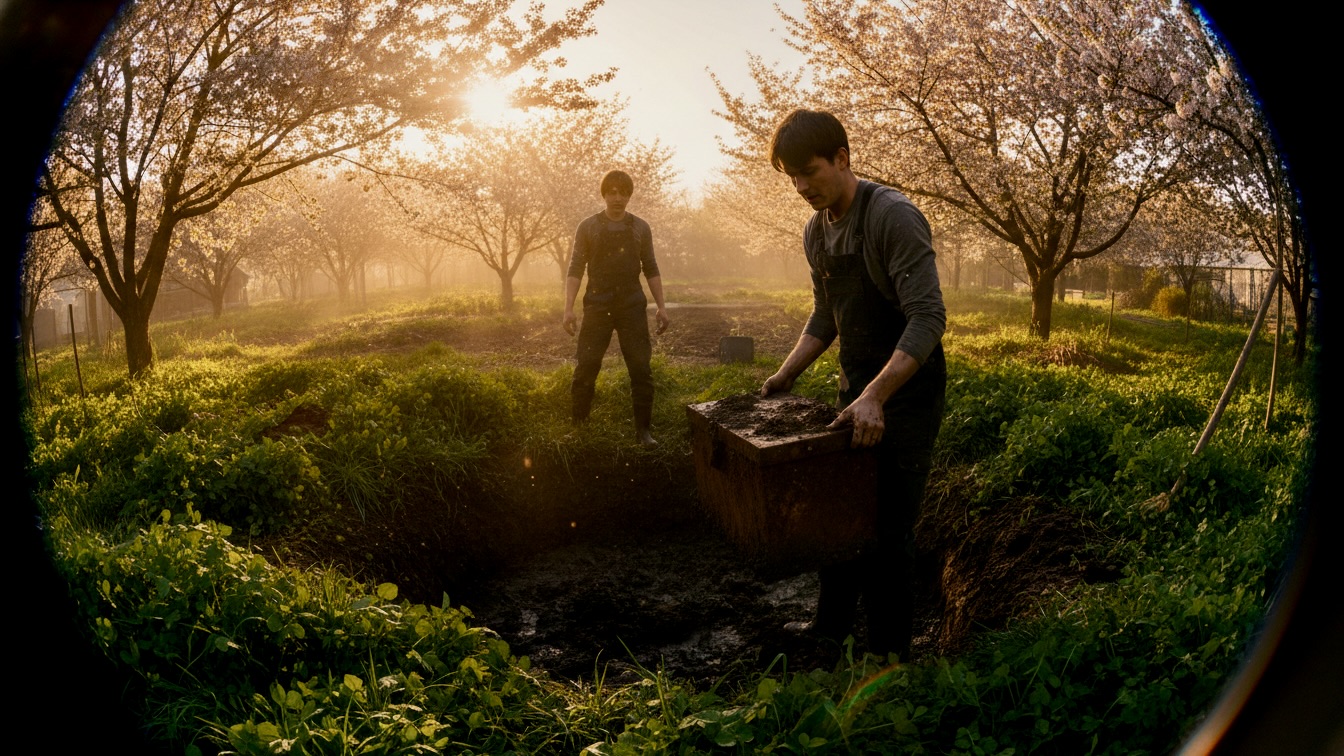
The shovel blade struck solid iron, sending a jarring vibration straight up the fiberglass shaft into Ben's jaw.
Ben drove his boot down on the lip of the shovel. The blade sliced through the wet spring earth, sinking deep into the mud. He leaned back on the fiberglass shaft, using his body weight for leverage. The clump of soil tore loose with a thick, wet squelch.
He threw the dirt over his shoulder. It hit the growing pile next to the raised bed. Sweat stung his eyes. He wiped his forehead with the back of a canvas glove, leaving a streak of brown clay across his brow. The morning air was already heavy. Spring had arrived overnight, violent and loud. Yellow pollen coated the nearby parked cars. Bright green weeds choked the chain-link fence bordering the community garden.
"You are digging way too deep," Mark said.
Mark stood three feet away. He wore clean white sneakers. He held a small plastic trowel loosely in his left hand, like he forgot he was holding it. He wasn't sweating.
"Tomatoes need deep roots," Ben said. His voice was tight, out of breath. He drove the shovel down again.
"It is a raised bed, Ben. The roots go in the topsoil. You are just digging a crater into the municipal dirt. That dirt is probably toxic."
Ben ignored him. He stomped on the shovel again. The blade hit something hard.
It didn't sound like a rock. Rocks gave off a dull, chalky thud. This was a sharp, metallic clank. A violent vibration shot up the shovel handle, rattling the bones in Ben's forearms. His teeth snapped together. He cursed, dropping the shovel. He pulled his gloves off and shook his hands out. His knuckles throbbed.
"What did you hit?" Mark asked. He took a half-step back.
"I don't know. A pipe maybe."
Ben knelt in the mud. The knees of his jeans soaked through instantly, the cold water seeping into his skin. He reached into the hole. The soil was dense, packed tightly from the winter freeze and the sudden spring thaw. He dug his bare fingers into the muck, scraping away the loose dirt.
His fingertips brushed against cold, hard metal. It wasn't round like a pipe. It had a sharp, right angle. A corner.
"It feels like a box," Ben said.
He dug faster, clearing the mud away from the top. Rusted edges emerged from the brown sludge. The top of the object was flat, heavily corroded, flaking off in sharp orange scabs. The smell of the hole changed. It stopped smelling like wet leaves and earthworms. It smelled like copper and old blood. It smelled like iron.
"Stop touching it," Mark said. His voice pitched up, thin and tight.
Ben kept scraping. He found another corner. The box was about two feet long, maybe a foot wide. It was heavy, buried deep in the compacted clay. He hooked his fingers under the top lip and pulled. It didn't budge.
"Hand me the pry bar," Ben said.
"No."
Ben looked up. Mark was staring at the hole, his arms crossed over his chest. His foot tapped a frantic rhythm against the wooden frame of the garden bed. He looked pale. The bright morning sun washed out his features, making the dark circles under his eyes look like bruises.
"Pass me the bar, Mark."
"I am not handing you the bar. Leave it in the ground."
Ben wiped his dirty hands on his jeans, leaving dark smears across his thighs. He stood up. His lower back ached. The heat of the morning suddenly felt oppressive. The buzzing of a large wasp near the fence sounded like a power tool.
"It is in the middle of my plot," Ben said. He kept his voice low, controlled, though his chest felt tight. "I can't plant over it. It has to come out."
"It has been in the ground for decades," Mark said, gesturing sharply at the mud. "Look at the rust on that thing. You think someone buried a box of treasure in a vacant lot in the city? It is garbage. It is probably a car battery, or chemical waste, or some boomer's toxic runoff they didn't want to pay to dispose of."
"I am not planting food over a leaky car battery. All the more reason to dig it out."
"Or we just abandon this plot. We go to the other side of the yard. We start over."
Ben stared at him. The muscle in his jaw jumped. This was exactly it. This was always it with Mark. The second things got complicated, the second they hit resistance, Mark wanted to walk away. It wasn't just the garden. It was the apartment lease. It was the conversations they never finished at night. It was the way Mark pulled away when Ben got too close, too real.
"I already paid the fee for this plot," Ben said. "I already cleared the weeds. I am not moving."
Ben turned his back on Mark. He grabbed the heavy steel pry bar from the wheelbarrow. He dropped back down to his knees in the mud. He jammed the wedge of the bar into the dirt next to the rusted box. He threw his weight against the iron bar.
The mud sucked at the metal box. Bubbles of brown water burst at the edges, releasing more of that sharp, metallic smell. Ben pushed harder. The bar slipped on the wet rust. Ben's knuckles slammed into the side of the box.
The sharp edge sliced right through the skin of his index finger.
Ben hissed, pulling his hand back. Bright red blood welled up from the cut, mixing with the dark mud on his knuckles.
"You are bleeding," Mark said. His voice was loud, panicked. "Look at that. You cut yourself on a rusted piece of biohazard waste. You probably just got tetanus."
Ben sucked on the cut, tasting copper and dirt. He spit into the weeds. "It is a scratch."
"We are done," Mark said. He dropped the plastic trowel into the dirt. "We are packing up. I am not watching you infect yourself because you have some obsessive need to fix everything."
Ben looked at the trowel in the dirt. Then he looked at Mark. "Someone has to fix it, Mark. Someone has to dig it out. We can't just leave it buried because it's ugly."
"It is not our mess!" Mark yelled. The sound echoed off the brick wall of the adjacent apartment building. A pigeon flew off the fire escape. Mark ran a hand through his hair. His breathing was shallow. "It is not our mess, Ben. The people before us ruined the soil. They dumped their garbage, they poisoned the water, they left us a broken world, and now you want to dig it up with your bare hands and bleed all over it? For what? For some tomatoes?"
Ben stayed on his knees. He looked at the box. It wasn't just garbage. The shape of it was too deliberate. As the mud cleared, he saw hinges. He saw a latch.
"It's a lockbox," Ben said quietly.
"I don't care what it is," Mark said. His voice was shaking now. Not with anger, but with genuine panic. "Please. Ben. Leave it alone."
Ben looked up at Mark. Mark was looking at Ben's hands, at the blood dripping slowly down his wrist. There was a desperate vulnerability in Mark's eyes, a fear that had nothing to do with toxic waste or tetanus. It was the fear of opening something that couldn't be closed again.
Ben wanted to stand up. He wanted to wash his hands, grab Mark by the shoulders, and pull him in. He wanted to tell him that they didn't have to inherit the rot. That they could clean it out. That they could survive it.
Instead, Ben grabbed the pry bar again.
"I'm opening it," Ben said.
He jammed the crowbar directly under the heavy, rusted padlock hanging from the front latch. He didn't look at Mark. He couldn't. If he looked at Mark, he would stop, and if he stopped, he would never know what was rotting beneath them.
Ben braced his boots against the sides of the mud hole. He pulled back on the heavy steel bar with both hands. The metal groaned. The rust flaked off in jagged chunks. His muscles burned. His breath tore through his teeth in harsh, ragged gasps.
"Ben, stop!"
Ben threw his entire body weight backward. The heavy iron lock finally snapped open with a loud crack, the sound echoing across the empty garden as the heavy lid shifted upward.
“The heavy iron lock finally snapped open with a loud crack, the sound echoing across the empty garden as the heavy lid shifted upward.”


