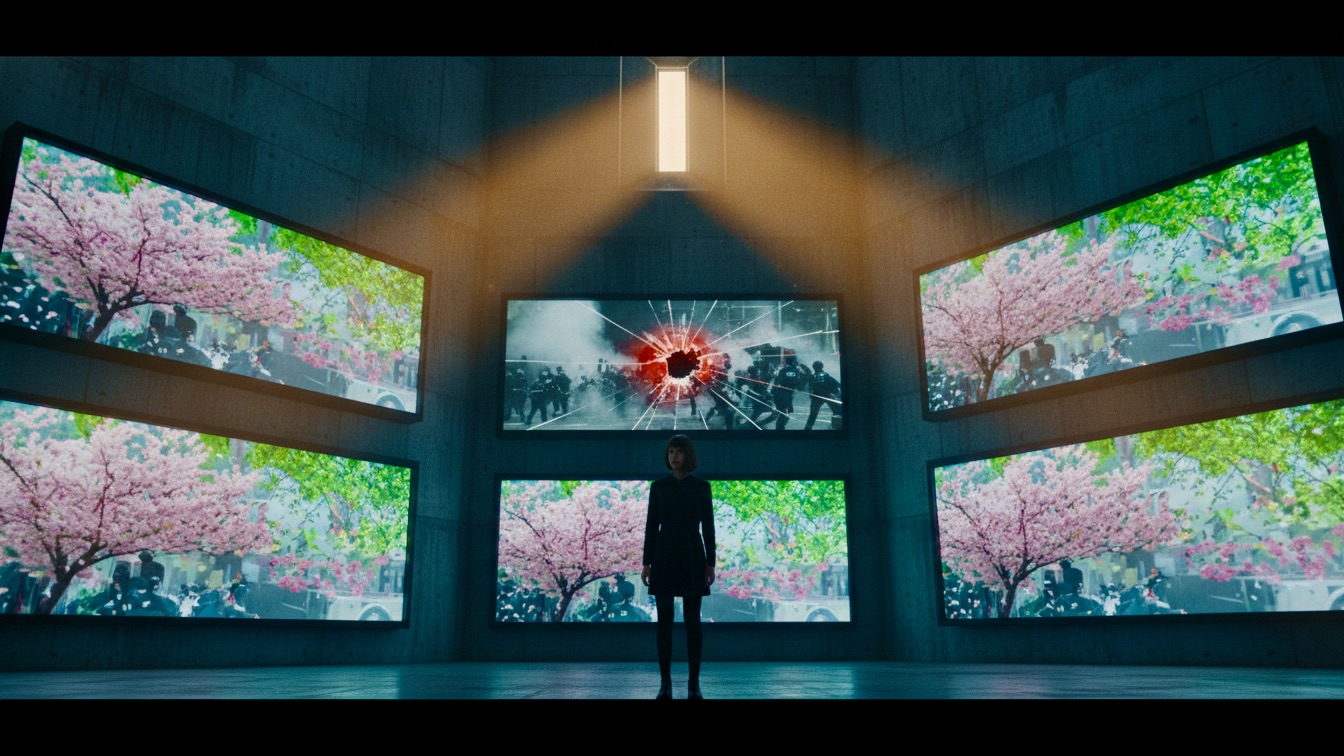
Stacey monitors the Ministry's live feed as the Spring Renewal parade turns into a state-sponsored bloodbath on screen.
The air in the bunker smells like ozone and the kind of cheap, industrial-strength coffee that could probably strip paint off a hull. My jaw is so tight I can feel a headache blooming behind my left eye, a rhythmic pulsing that matches the blinking green 'LIVE' light on my console. Thirty seconds. That’s the buffer. That’s the safety net. Every frame of the 'Spring Renewal' parade passes through my station before it hits the retinas of the five million citizens currently plugged into the Safety Stream. My job is to make sure they see the spring, not the renewal.
Outside, in the actual world, the sun is hitting the cherry blossoms in the park. On my monitors, the AI is already working overtime. A protestor throws a brick; the software catches it mid-air and turns it into a handful of pink petals. A police baton comes down on a skull; the filter smooths the impact, turning the sound of breaking bone into a celebratory drum beat. It’s seamless. It’s clean. It’s a total lie.
My foot won’t stop tapping. It’s a nervous, frantic vibration against the cold metal floor. I can feel the sweat pooling in the small of my back, my shirt sticking to the ergonomic chair that’s supposed to be 'spine-aligned' but just feels like a plastic cage. I’ve been in this chair for six hours. My eyes are burning from the blue light, tracing the movement of the crowd in the extreme wide-angle drone shot on Monitor Three.
"Look at that saturation, Stacey," Supervisor Langley says, leaning over my shoulder. He smells like peppermint and arrogance. His hand rests on the back of my chair, and I can feel the slight tremor of his weight. "The algorithm is really popping today. Those greens? That’s hope. That’s what the people need. Hope in 8K."
"Hope looks a lot like a saturation slider at 85 percent," I say, my voice flat. I don't look at him. I can't. If I look at him, I’ll lose the rhythm of the cuts. My fingers hover over the 'Cleanse' macro. It’s a mechanical keyboard, the keys heavy and tactile, a relic of the old world that the Ministry keeps because it’s faster for live edits.
"Don't be cynical. It’s a bad look for a Tier 1 editor," Langley says. He’s smiling. I can hear the smile in his voice. It’s the kind of smile that never reaches the eyes, the kind that’s been focus-grouped for maximum authority. "The 2026 media landscape is about curation, not just observation. We’re gardeners, Stacey. We pull the weeds so the flowers can grow."
"The weeds are screaming today, Langley."
"Are they? I don't hear a thing." He taps the glass of the main monitor. "Just the music. Just the cheering. It’s beautiful."
He’s right. The audio feed is a separate beast. I have a slider for 'Ambient Truth' and a slider for 'Civic Harmony.' The truth is currently at zero. The harmony is a looped track of children laughing and a synth-pop version of the national anthem. It’s enough to make me want to vomit my breakfast into the trash can next to my desk.
Then, I see her. Camera 4. It’s a handheld unit, likely a rogue feed that the system just patched in from a peacekeeper’s bodycam. The AI usually filters these automatically, but this one is glitching. The frame rate drops. The resolution jitters. And there, in the center of the frame, standing against a line of riot shields, is Jen.
My breath hitches. It’s a shallow, sharp intake that feels like a needle in my chest. My jaw clenches so hard my teeth ache. Jen is wearing her old denim jacket, the one with the frayed collar. She looks small. She looks terrified. But she’s holding a sign. It’s not a digital placard. It’s a piece of actual cardboard, the edges torn, the ink thick and black. It says: I CAN HEAR YOU.
"What’s this?" Langley asks, his voice dropping an octave. He leans in closer. His breath is hot against my ear. "Camera 4. Frame 1102. Identify."
I don't answer. I can't. The AI is already doing it for me. A red box flickers around Jen’s face. It pulses once, twice, and then a text overlay appears in my private HUD. 'Subject: Jennifer Miller. Status: Dissenting Element. Threat Level: Tier 1.'
" Miller," Langley reads out loud. "Isn't that your last name, Stacey?"
"Common name," I say. My fingers are trembling. I have twenty-five seconds before this frame hits the public stream. Twenty-five seconds to erase my sister from existence.
"Is it?" Langley’s hand moves from the chair to my shoulder. He squeezes. Not a hug. A warning. "The facial recognition is 99.8 percent certain. That’s a pretty specific commonality."
On the screen, a peacekeeper steps forward. He raises a black canister. I know what’s in it. It’s the new stuff. They call it 'Mist,' but it’s just liquid compliance. It burns the lungs and freezes the muscles. Jen isn't moving. She’s staring right into the lens. She knows I’m watching. I know she knows. She’s not looking at the cop; she’s looking at me.
"Clean it up," Langley whispers. "Use the 'Crowd Fill' brush. Replace her with a family. A happy one. Maybe a golden retriever. People love dogs."
Twenty seconds. The 'Crowd Fill' brush is a simple command. Ctrl+Alt+F. The AI will sample the surrounding pixels—the fake flowers, the smiling actors in the front row—and paint them over Jen. She’ll be gone. She’ll be un-happened. And then, once the broadcast is over, the Peacekeepers will take her to a 'Renewal Center,' and I’ll never see her again.
"Stacey," Langley says, his grip tightening. "The clock is ticking. Don't be a hero. Heroes are just data points we haven't deleted yet."
I look at the 'I CAN HEAR YOU' sign. It’s a message for the viewers, sure. But it’s a message for me. She’s calling my bluff. She’s spent three years telling me that I’m part of the machine, that I’m the one who helps the Ministry hide the bodies. I always told her I was working from the inside. That I was waiting for the right moment.
This is it. The snap point. My stomach turns over, a cold, oily sensation. I can feel the 'zero-day' exploit sitting in the hidden directory of my terminal. I’ve had it for months. It’s a beautiful piece of code—a logic bomb that bypasses the delay buffer and locks the output feed to the raw source. It turns the 'Safety Stream' into the 'Truth Stream.'
"I’m doing it," I say. My voice sounds like it belongs to someone else. Someone braver.
"Good girl," Langley says. He relaxes his grip. He thinks I’m clicking the 'Cleanse' button.
I’m not. I’m navigating to the root directory. My fingers move with a muscle memory that feels like electricity. I hit the execution command. The console flickers. A line of white text scrolls across my HUD: 'Exploit Loaded. Buffer Override Active.'
Fifteen seconds.
"Wait," Langley says. He sees the terminal. He sees the code. "What are you doing? Stacey, stop. That’s a breach protocol."
"It’s a main character moment, Langley," I say. I turn my head and look him dead in the eye. He looks confused. He looks small. "You should probably get out of the blast zone."
"You’re dead," he hisses, reaching for the emergency override. "They’ll have you in a cell before the hour is up."
I’m faster. I’ve been practicing this. I slam my palm down on the 'Lock' key. The entire console turns a deep, bruised purple. The 30-second delay vanishes. The feed on the main monitor skips, a sudden, violent jump in time, and suddenly, the world sees what I see.
They see the mist. They see the peacekeeper slamming the canister into Jen’s ribs. They see the blood—bright, visceral red—on the cherry blossoms. There are no petals. There is no drum beat. There is only the sound of Jen screaming, a raw, jagged sound that cuts through the 'Civic Harmony' loop like a chainsaw.
Langley screams for security. He’s fumbling with his headset, his face turning a shade of white that the AI would probably categorize as 'Dead Alabaster.' He tries to push me out of the chair, but I’ve locked the wheels into the floor tracks. I’m an anchor.
On the screens, the city is waking up. I can see the data spikes in the corner of my eye. The engagement metrics are off the charts. Millions of people are seeing the truth for the first time in a decade. The AI is trying to keep up, trying to blur the images, but the zero-day is eating the filters as fast as they can generate. It’s a digital forest fire.
Jen is on the ground now. The sign is trampled. But the camera is still on her. She looks up, her eyes streaming from the gas, and she smiles. Just for a second. She knows. She knows the world is watching.
I stand up. The sirens are already going off in the hallway. The red emergency lights are strobing, casting long, rhythmic shadows across the bunker walls. Langley is backed into a corner, shouting into a radio that isn't working because I’ve jammed the local signal. He looks like a cornered rat in a very expensive suit.
I reach down and unclip my headset. It’s heavy. It’s been on my head for so long I feel lightheaded without it. I drop it on the floor and hear the plastic crack. It’s a satisfying sound. The most honest thing I’ve heard all day.
"Main character moment, bitch," I whisper into the dead mic on the console. "Let it run."
I walk toward the door. My legs feel like lead, but I keep moving. The hallway is empty, the air thick with the smell of scorched electronics. I can hear the boots of the security team hitting the stairs at the end of the corridor. They’re coming for me. I know how this ends. I’ve edited enough 'disappearances' to know the script.
But as I reach the exit, I look back at the monitor wall one last time. The image of Jen is frozen. It’s a glitch in the exploit, a beautiful, permanent error. She’s there, bloodied and broken, but she’s real. She’s the only real thing in this entire building.
I push open the heavy steel door and step out into the hallway. The light is blinding. Not the digital light of the monitors, but the real, unfiltered spring sun pouring through a window at the far end of the hall. It’s harsh. It’s messy. It’s perfect.
I lean against the cold concrete wall and wait for the boots to get closer. My jaw is finally loose. My breath is deep. For the first time in three years, I don't feel like I’m suffocating.
“The heavy steel doors at the end of the hall burst open, and I finally stop running.”


