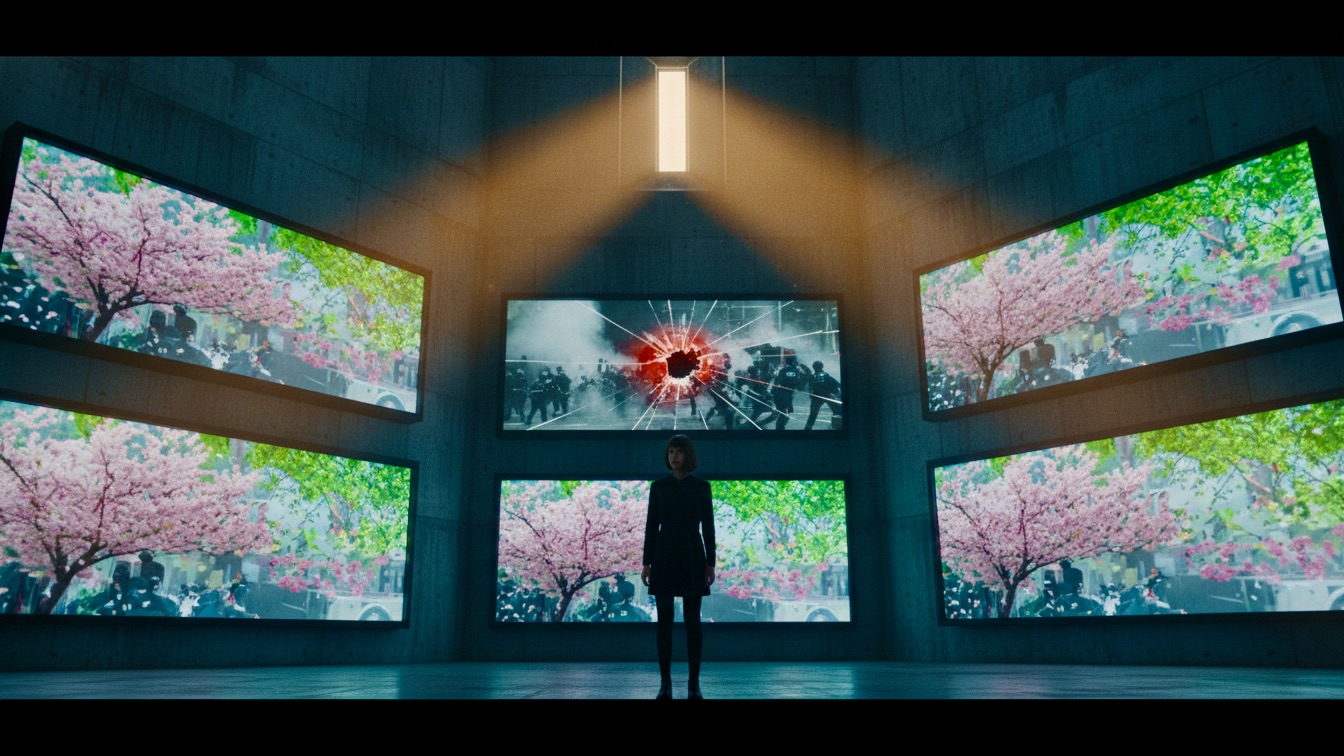
Stacey serves as a high-level media editor in a dystopian bunker, tasked with sanitizing live footage of civil unrest for a public audience of millions. Using advanced AI filters, she transforms violent state suppression into peaceful, celebratory imagery, effectively maintaining a digital hallucination of "Civic Harmony." Her supervisor, Langley, monitors her work with a cold, predatory focus on aesthetic perfection over objective reality. The tension reaches a breaking point when Stacey identifies her sister, Jen, among the protestors on a rogue camera feed.
Despite Langley’s direct order to erase Jen from the broadcast using a "Crowd Fill" tool, Stacey experiences a profound moral awakening. She realizes that her role in the Ministry has made her an architect of the very lies that endanger her sister. Instead of complying, she activates a long-dormant "zero-day" exploit that bypasses the system's safety buffers. This act of rebellion broadcasts the raw, unfiltered brutality of the police to the entire nation in real-time.
The chapter concludes with the immediate fallout of Stacey's decision. The bunker descends into chaos as security forces move to intercept her and the public witnesses the true face of the regime for the first time in a decade. Stacey accepts her certain capture with a newfound sense of peace, having finally aligned her actions with the truth. She leaves her station as the "Safety Stream" burns down, replaced by the visceral, unedited image of her sister’s defiance.
The core theme of the narrative revolves around the construction of reality and the weaponization of perception. In this society, truth is treated as a malleable resource that must be "gardened" to prevent the growth of dissent. The Ministry uses technology not just to hide the truth, but to replace it with a more palatable, high-definition lie. By turning bricks into petals and screams into music, the state robs the citizenry of the very evidence required to justify a revolution.
Another significant theme is the psychological toll of moral complicity. Stacey’s physical symptoms—her clenched jaw, rhythmic headaches, and frantic tapping—reveal a woman whose body is rebelling against the work her hands perform. She suffers from a profound moral injury, acting as a "Tier 1 editor" while knowing she is effectively erasing human lives from history. The narrative suggests that maintaining a systemic lie requires a constant, exhausting expenditure of psychic energy from those who manage the machinery.
Finally, the story explores the concept of the "snap point," the moment where personal stakes override systemic indoctrination. For Stacey, the abstract "weeds" of the protest become humanized when they take the form of her sister, Jen. This shift from the general to the specific forces a confrontation with the "Main Character Moment," a rejection of being a mere "data point." The text posits that true agency often requires a total sacrifice of one's safety to break a cycle of institutionalized deception.
Stacey is a woman defined by the suffocating gap between her internal ethics and her professional output. Her sensory descriptions of the bunker—the smell of ozone and the "plastic cage" of her chair—reflect her feeling of being trapped within a machine of her own making. She is highly competent and technically skilled, yet she uses those skills to perform a form of digital lobotomy on the public. This creates a state of chronic hyper-vigilance and physical distress that only resolves when she finally chooses to act.
Her decision to trigger the zero-day exploit is not merely an act of sisterly love, but a desperate reclamation of her own humanity. She moves from a state of "flat" vocal delivery and trembling fingers to a position of absolute, grounded authority. By the end of the chapter, her physical tension vanishes, replaced by a "loose" jaw and deep breath. She accepts her impending "disappearance" because she has finally traded her role as a silent observer for that of a participant in reality.
Langley serves as the personification of the banal, aestheticized evil inherent in the regime. He is a man who views human suffering through the lens of "saturation" and "8K hope," demonstrating a complete detachment from the physical consequences of his orders. His presence is marked by a mixture of simulated warmth and underlying threat, using peppermint to mask the rot of his arrogance. He treats the manipulation of the public as a high-end creative endeavor rather than a moral atrocity.
His power is derived entirely from his control over the screen, and he becomes pathetic and "small" the moment that control is severed. When the raw feed breaks through, his transformation into a "cornered rat" reveals the fragility of the authority he represents. He is incapable of dealing with the "unfiltered" world, showing that those who manage the lies are often the ones most dependent on them. He represents the cowardice of the bureaucrat who hides behind "curation" to avoid the blood on his own hands.
Jen functions as the narrative’s moral compass and the physical manifestation of the "Ambient Truth" that Stacey has suppressed. She is described through Stacey’s eyes as small and terrified, yet she possesses a courage that Stacey initially lacks. Her cardboard sign, "I CAN HEAR YOU," is a direct psychological strike against the walls of the bunker. It serves as a reminder that the victims of the state are not just data points, but individuals who are aware of their own erasure.
Even when she is beaten and broken on screen, Jen maintains a sense of victory because she has forced the world to look at her. Her smile in the final moments of the broadcast signifies a shared understanding between the sisters. She knew that Stacey was watching, and she bet her life on the hope that Stacey would eventually choose the truth. Jen is the catalyst for the "digital forest fire" that potentially signals the beginning of the regime's end.
The narrative voice is characterized by a sharp, cynical edge that utilizes the language of digital media to highlight the horror of the setting. Terms like "Cleanse macro," "saturation slider," and "logic bomb" create a technical atmosphere that contrasts with the visceral descriptions of violence. This juxtaposition serves to show how easily human suffering can be abstracted into a workflow. The prose is rhythmic and fast-paced, mirroring the high-stakes environment of a live broadcast where every second is a potential breach.
Sensory details are used effectively to ground the reader in Stacey’s claustrophobic environment. The "blue light" burning her eyes and the "tactile, heavy" keys of the mechanical keyboard emphasize the physical reality of her labor. These grounded details make the transition to the "unfiltered" world at the end of the story feel more impactful. When Stacey finally leaves the bunker, the "harsh" and "messy" sunlight serves as a powerful sensory metaphor for the truth she has released.
The pacing of the chapter is masterfully handled through the literal countdown of the thirty-second buffer. This creates a ticking-clock scenario that heightens the tension of Stacey’s internal struggle. Each time a specific number of seconds is mentioned, the stakes feel more immediate and the pressure more immense. The sudden "violent jump in time" when the exploit is triggered provides a stylistic rupture that mirrors the collapse of the state’s carefully curated narrative.


