A stranger crashes the family egg hunt with a gold relic and a claim that ruins their inheritance forever.
The wind off the Atlantic didn’t smell like spring. It smelled like wet dogs and rotting kelp. I stood on the porch of the manor, watching Lenny kick a clump of mud off his expensive boots. The house was leaning. Not literally, but the porch felt slanted, the paint peeling in long, gray strips like dead skin. My mother, Betty, was busy hiding plastic eggs in the overgrown grass. She wore a bright yellow cardigan that made her look like a target. This was the Sterling family tradition. We pretend everything is fine until someone actually believes it.
"Sylvie, get out here," Lenny shouted. He didn't look at me. He was checking his watch. It was a Rolex he couldn't afford. "We’re starting the hunt in five. Mom’s losing it. Look at her."
I looked. Betty was talking to a bush. She was shoving a pink egg into the dirt near the roots of a dying rhododendron. The sun was out, but it was that thin, pale spring light that doesn't actually provide any warmth. It just makes the shadows look sharper. The property was six acres of marsh and crumbling stone walls. It was worth millions on paper, but only if you didn't look at the foundation.
"I’m coming," I said. I stepped off the porch. The wood groaned. Everything in this place was tired. I felt tired too. I’m twenty-two, but living here makes me feel like I’m eighty. I walked over to the edge of the lawn where the driveway turned into gravel and weeds.
Lenny joined me. He smelled like espresso and desperation. "Dad would’ve hated this," he muttered. "The lawn is a disaster."
"Dad’s been gone twenty years, Lenny. The lawn doesn't care about his opinion," I said.
"Optics matter, Sylvie. If we’re going to sell this year, we need it to look like a home, not a set for a horror movie."
"Nobody's buying a house that smells like sea salt and mold," I said.
Betty skipped toward us. Her smile was too wide. It was the kind of smile people wear when they’re about to have a breakdown. "Ready?" she asked. "The big prize is by the old well. Don't tell your sister."
Sylvie was already out there. She was twenty-four and had spent the last hour on her phone, probably live-streaming the 'aesthetic' of our crumbling heritage. She was wearing a white dress that was already stained at the hem. She looked like a ghost that had given up.
"I heard that," Sylvie said, not looking up from her screen. "I’m not looking for plastic junk. I’m looking for a signal. The Wi-Fi is dead out here."
"It’s Easter," Betty said. Her voice had a sharp edge. "We do the hunt. We eat the lamb. We act like a family."
We started walking. It was pathetic. Four adults wandering through tall grass looking for fifty-cent toys. I found a blue egg. It was empty. I found a yellow one. It had a damp nickel inside. The air was getting colder. The clouds were moving in fast, blocking that weak sun.
Then I saw him.
A man was standing by the gate. The gate was iron, rusted shut years ago, but he was just leaning against it. He wore a heavy wool coat and boots that actually looked like they were meant for mud. He wasn't moving. He was just watching us.
"Who is that?" I asked.
Lenny stopped. He squinted. "Probably a hiker. The trail cuts through the back."
"He’s at the front gate, Lenny. That’s not the trail."
Betty froze. She was holding a green egg, and her knuckles went white. She didn't say anything. She just stared. The man pushed off the gate and started walking toward us. He didn't rush. He walked like he owned the grass.
"Hey!" Lenny yelled. "Private property!"
The man didn't stop. He kept coming until he was ten feet away. He was older than us, maybe late forties. His face was lined, tanned from being outside. He looked solid. Real. We looked like cardboard cutouts next to him.
"Happy Easter," the man said. His voice was low. No heat in it.
"You’re trespassing," Lenny said. He tried to puff out his chest. It didn't work.
"I’m James," the man said. He looked at Betty. "Hello, Elizabeth."
Betty’s voice was a whisper. "You shouldn't be here."
"I thought I’d join the hunt," James said. He reached into his pocket. He pulled something out. It wasn't plastic. It was gold. Not solid gold, maybe, but it was heavy. It was an egg, the size of a real one, with intricate carvings on the side. It looked like a relic.
"What is that?" Sylvie asked, finally putting her phone away.
"The master key," James said. He held it up. The light caught the metal. "Your father hid it twenty years ago. The last thing he did before he left. He told me whoever found it would own the Sterling name."
"That’s bull," Lenny said. "Dad didn't leave anything like that. He left us the house and the debt."
"He left you a lie," James said. He looked at the house. "And it looks like the lie is finally falling apart."
Betty stepped forward. "James, please. Not today."
"Why not today?" James asked. "It’s the day of rebirth, right? Let’s talk about how this house was actually bought."
"Inside," Betty said. She was shaking. "We’ll talk inside."
Dinner was a train wreck. The dining room was freezing. We have a fireplace, but the flue is blocked, so we just sat there in our coats. The lamb was overcooked. The mint jelly looked like radioactive sludge. James sat at the head of the table. Lenny’s chair. Lenny was fuming, stabbing at his potatoes like he wanted to kill them.
"So," Sylvie said. She was leaning back, watching James. "Are you like, a secret brother? Is this a DNA test thing?"
James laughed. It was a dry sound. "Nothing so dramatic. My father was the groundskeeper here. Before your father 'bought' the place."
"He did buy it," Lenny said. "We have the deeds. We have the history."
"You have papers," James said. "My father had the land. Your dad was a lawyer. He found a loophole in the old man's will. He didn't buy the estate. He stole it through a series of shell companies and fake signatures. My father died in a trailer two miles from here while you guys were playing croquet on his lawn."
"You’re lying," I said. But I looked at Betty. She wasn't eating. She was staring at a crack in the table.
"Am I, Elizabeth?" James asked.
Betty didn't look up. "It was a long time ago, James. Things were complicated."
"They weren't complicated," James said. "It was fraud. Simple and clean. And for ten years, you’ve been making sure I didn't tell anyone."
Lenny stopped chewing. "What do you mean, making sure?"
James took a sip of wine. He winced. "This is cheap. You guys really are broke, aren't you?"
"Answer the question," Lenny said.
"Your mother has been wire-transferring me two thousand dollars a month since 2016," James said. "Hush money. To keep the 'Master Key' hidden. But the bank is dry now, isn't it? The last check bounced."
I felt a cold drop of sweat slide down my spine. I looked at Betty. "Mom?"
Betty finally looked up. Her eyes were glassy. "I did it for you. To keep the house. To keep your father's reputation. If people knew the truth, we’d lose everything. The Sterling brand... it’s all we have."
"The Sterling brand is a joke!" I yelled. "We live in a house that’s literally rotting! We have no money!"
"We have the name," Betty said. Her voice was suddenly hard. "And the name gets us into the clubs. It gets Lenny his meetings. It gets you your internships. Without the name, you’re just kids from a trailer park, just like James."
James smiled. It wasn't a nice smile. "Except I’m not in a trailer park anymore. I’ve got the original documents. The ones your father thought he burned. My dad kept copies. The gold egg? It’s a thumb drive inside. Scans of everything."
He set the gold egg on the table. It sat there among the greasy plates and the half-eaten bread. It looked like a bomb.
"What do you want?" Lenny asked. His voice was small.
"The house," James said. "Sign it over to me. I’ll sell it to a developer. They’ll knock it down and build condos. I get the money. You get to keep your 'reputation' because I’ll stay quiet. You can tell everyone you sold it because the taxes were too high. Very classy. Very Sterling."
"We can’t just give you the house," Sylvie said. "Where would we go?"
"Not my problem," James said. "You’ve had twenty years of luxury you didn't earn. Time’s up."
He stood up. "I’ll give you an hour. Discuss it. I’ll be outside. I like the air better out there."
He walked out. The front door clicked shut.
The silence was heavy. I could hear the wind whistling through the gap in the window frame. A piece of wallpaper in the corner peeled back a little further, making a soft scratching sound.
"Is it true?" I asked.
Betty nodded. She looked small. "Your father... he was desperate. We were going to lose everything back then too. He thought he was being smart. He thought he was protecting us."
"He was a thief," I said.
"He was our father," Lenny snapped. He was standing now, pacing the small space between the table and the sideboard. "If we lose this house, we’re nothing. I have a deal closing next week. If the partners find out I’m involved in a fraud scandal, I’m done. I’ll go to jail."
"We all will," Sylvie said. "Aiding and abetting. Receiving stolen property. Whatever the legal term is for being a fake rich person."
"We have to kill him," Lenny said.
I looked at my brother. He wasn't joking. His face was pale, his eyes wide. He looked like a cornered animal.
"No," I said. "We’re not doing that."
"Then what?" Lenny asked. "We just hand him the keys and go live in a motel?"
"There’s another way," Betty said. She stood up. She looked composed now. The panic had been replaced by a cold, calculating stillness. It was scarier. "James is right about one thing. The brand is everything. But he’s wrong about the documents."
"He has the thumb drive," Sylvie pointed out.
"In the egg," Betty said. "But the physical records... the ones he thinks I don't have. They’re in the basement. Your father didn't burn them all. He kept them as insurance against James’s father. He was a paranoid man."
"So?" I asked.
"If we burn them now," Betty said. "And we destroy that egg... it’s his word against ours. He’s a nobody. A groundskeeper’s son with a grudge. No one will believe him without proof."
"He’s outside, Mom," I said. "He has the egg with him."
"No," Sylvie said. She pointed to the table.
The gold egg was still there. James had left it as a taunt. A display of power. He thought we were too weak to do anything but stare at it.
Lenny grabbed the egg. He tried to twist it. It didn't budge. He hit it against the table. Nothing. "It’s solid. How do you get into this thing?"
"The fireplace," Betty said. "The heat will melt the wax seal. Then it opens."
We didn't talk. We moved like a team of ghosts. Lenny went to the basement and came back with three heavy boxes. They were filled with old ledgers, letters, and signed contracts. The paper was yellow and smelled like dust.
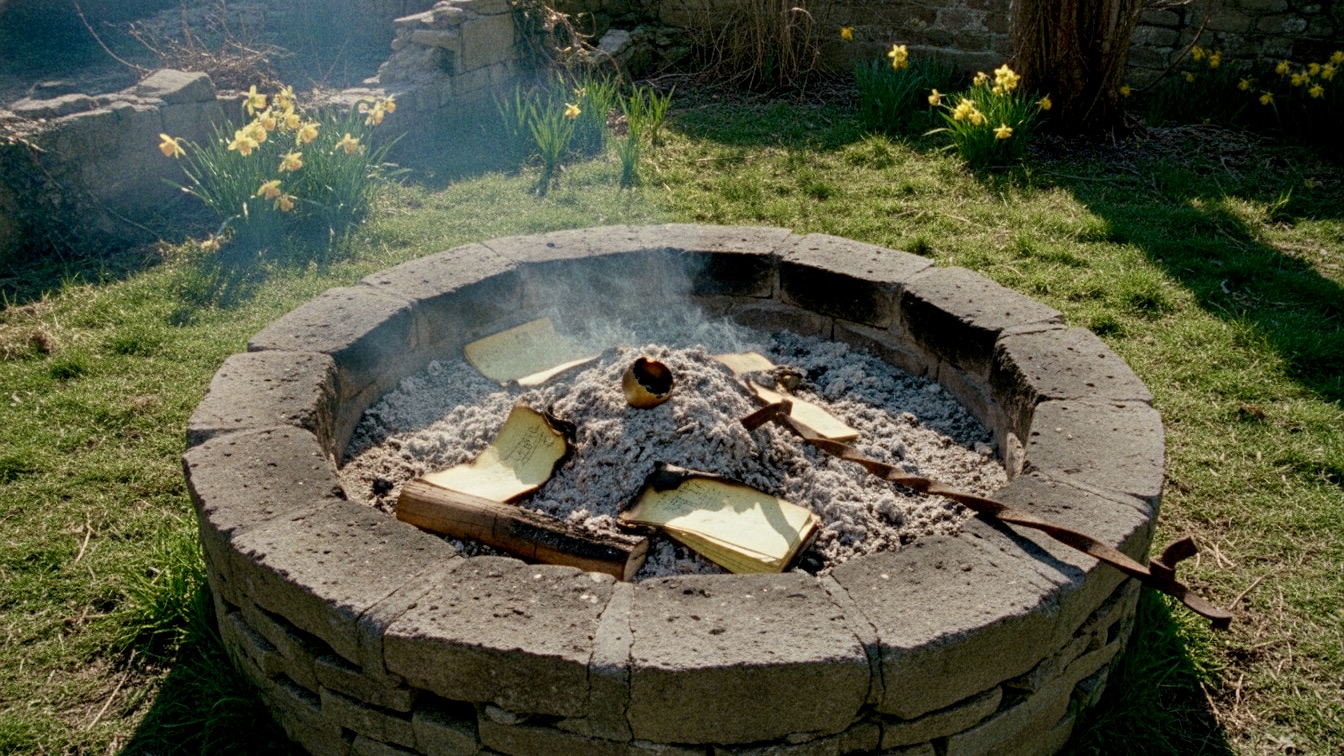
We went out to the back patio. There was a stone fire pit we used to use for summer parties. It was filled with old leaves and rainwater. Lenny dumped a gallon of lighter fluid on the leaves. He threw a match. The fire roared up, orange and angry against the blue-black spring sky.
"Give me the egg," Betty said.
Lenny handed it to her. She tossed it into the center of the flames. We stood around the pit, watching. The gold didn't melt, but the black gunk holding the seams together began to bubble and hiss.
I started throwing the papers in.
Sterling Estates LLC. Final Transfer. 2004. Agreement of Silence: James Miller Sr. Payment Ledger: April 2018.
One by one, the secrets turned into ash. The smoke was thick and smelled like chemicals. It stung my eyes. I looked at Sylvie. She was recording it on her phone.
"Delete that," I said.
"I’m not posting it," she said. Her voice was flat. "I just want to remember the moment we became villains."
"We’re surviving," Lenny said. He was throwing handfuls of paper into the fire now. He looked manic. "We’re protecting the legacy."
"The legacy is trash," I said. But I didn't stop. I picked up a ledger and tossed it in. I watched the names of people our father had cheated disappear into the heat.
The gold egg began to crack. A small, black plastic object fell out of the metal shell and into the embers. The thumb drive. It curled and melted in seconds.
"Hey!"
James was standing at the edge of the patio. He looked at the fire, then at us. His face went from confusion to rage. He ran toward the pit.
Lenny stepped in his way. Lenny was smaller, but he had a heavy iron poker from the fireplace. He didn't swing it, but he held it like he would.
"Stay back," Lenny said.
James stopped. He looked at the melting plastic in the fire. "You idiots. You think that was the only copy?"
"We know it was," Betty said. She stepped forward, the firelight reflecting in her eyes. "You’ve been begging for money for years, James. If you had other copies, you would have used them by now. You played your hand too early."
James looked at the fire. The rage drained out of him, replaced by a hollow kind of defeat. He looked old. He looked like the house.
"You’re just like him," James said. "Your father was a parasite. And you’re just the next generation of bugs."
"Get off our land," Betty said.
James didn't move for a long time. The fire was dying down, the papers mostly gone. The spring wind caught some of the ash and blew it across the patio. It looked like gray snow.
"Enjoy the house," James said. "I hope it falls down while you’re sleeping."
He turned and walked away. He didn't go back to the gate. He walked into the dark toward the marsh. We watched him until he was just a shadow, and then nothing.
We stood there for a long time. The fire was just a pile of glowing red coals and white ash. My throat felt raw. My clothes smelled like a bonfire.
"Is it over?" Sylvie asked. She tucked her phone into her pocket.
"It’s over," Betty said. She smoothed her yellow cardigan. She looked perfectly calm. "Lenny, go put the boxes back in the basement. Empty ones. Sylvie, help me with the dishes. Sylvie, go get the rest of the eggs. We didn't finish the hunt."
"Mom, it’s dark," I said.
"We have flashlights," Betty said. "We’re a family. We finish what we start."
I walked out into the grass. The air was freezing now. I pulled my jacket tight. I found the gold egg shell in the ashes using a pair of tongs. It was hot, but the metal was dull now, scorched black. I took it out to the edge of the property, near the old well.
I dropped it into the dark. I didn't hear it hit the bottom.
I looked back at the house. The lights were on in the dining room. From here, it looked beautiful. It looked like a grand estate. It looked like a dream. If you didn't know about the mold, or the rot, or the theft, you’d think the people inside were happy.
I found a red plastic egg near the well. I picked it up. It was light. Empty.
I walked back toward the house, my feet sinking into the soft, spring mud. Every step felt heavy, like the ground was trying to pull me under, but I kept moving. I had to. I was a Sterling. And we always keep up appearances.
Inside, the house was quiet. The smell of the fire had followed me in. Betty was in the kitchen, humming a song I didn't recognize. She was washing the plates from dinner, her movements methodical and slow.
"Did you find the rest?" she asked without turning around.
"Most of them," I said. I set the empty red egg on the counter.
"Good," she said. "We’ll have the rest of the lamb for lunch tomorrow. It’s important not to waste things."
I went to my room. It was small, the ceiling stained with water marks that looked like maps of countries that didn't exist. I sat on the bed and looked at my hands. They were stained with soot. I tried to rub it off, but it just smeared, turning my skin a bruised, ugly gray.
I thought about James out there in the marsh. I thought about the gold egg at the bottom of the well. I thought about the way the fire looked when it took the documents. It was the brightest thing I’d seen in years.
I laid back and closed my eyes. The house creaked. A floorboard snapped in the hallway. Usually, that sound made me jump. Usually, I thought it was a ghost or a thief.
But tonight, I knew what it was. It was just the house, settling into its lies, getting comfortable in the dark.
“I realized then that the only thing more permanent than the truth was the fire we used to kill it.”


