The story unfolds on a bleak Easter Sunday at the Sterling family’s decaying coastal estate. The narrator and her siblings, Lenny and Sylvie, engage in a hollow tradition of hunting for eggs directed by their seemingly fragile mother, Betty. This performance of normalcy is shattered by the arrival of James, the son of a former groundskeeper, who reveals that the Sterling patriarch stole the estate through legal fraud. James presents a "master key"—a gold egg containing a thumb drive with evidence of the crime—and demands the family sign over the house to settle the debt of the past.
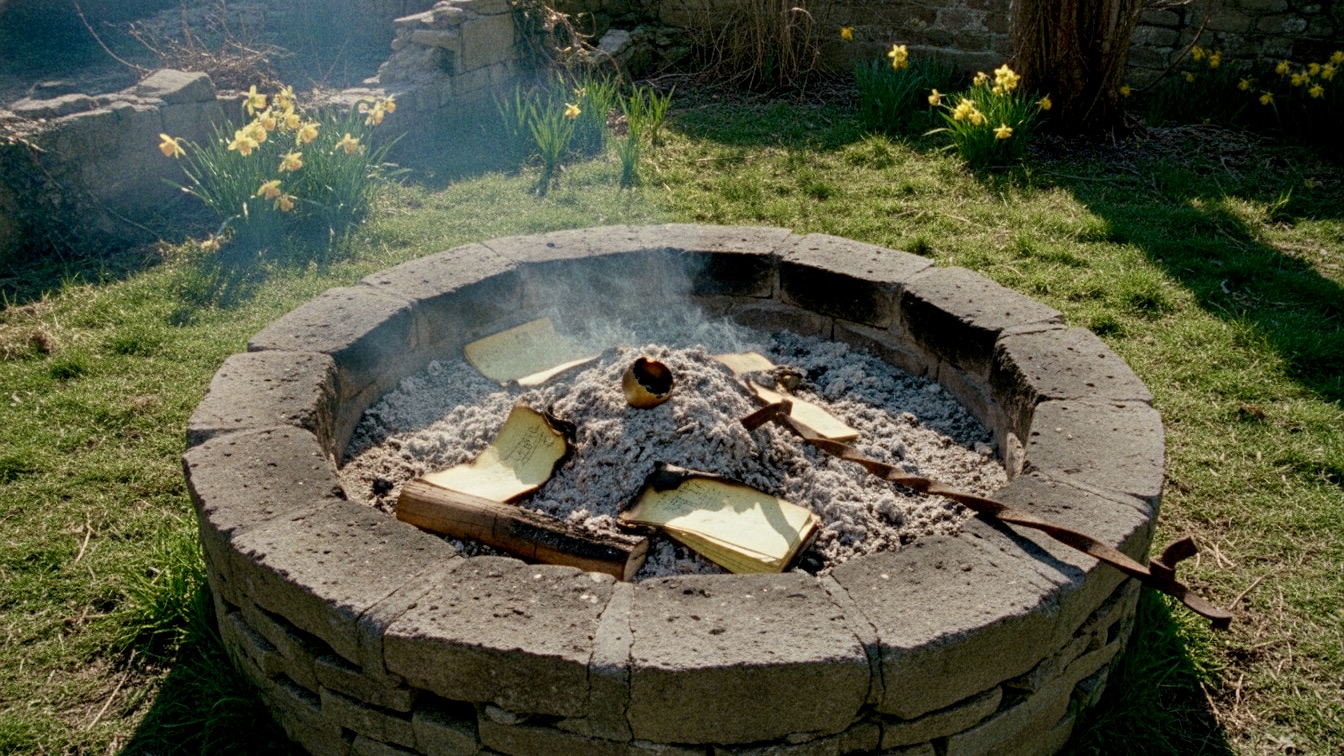
Inside the freezing manor, the family confronts the reality of their bankruptcy and the fraudulent nature of their social standing. Betty reveals her hidden ruthlessness, admitting she has been paying hush money for years and that physical copies of the incriminating documents still exist in the basement. In a desperate bid to preserve their "brand," the family burns the records and the thumb drive in a backyard fire pit. James is forced to leave without his proof, and the family returns to their charade, choosing to live within the rot of their lies rather than face the poverty of the truth.
The central theme of the narrative is the destructive power of "legacy" and the lengths individuals will go to maintain a hollow reputation. The Sterling family is obsessed with the "brand," a concept that Betty prioritizes over moral integrity or physical comfort. They live in a house that is literally and figuratively rotting, yet they cling to the name because it provides the only currency they have left. The story suggests that when a family's identity is built on a lie, the members become prisoners of that lie, forced to act as curators of a crumbling museum of their own making.
Another prominent theme is the juxtaposition between appearance and reality, symbolized by the "Rolex he couldn't afford" and the "gold egg" that is actually a digital storage device. The Sterlings are experts at performance, using Easter traditions and expensive labels to mask their insolvency. This theme highlights a psychological state of collective delusion, where the family members recognize the decay but choose to ignore it to avoid the ego death associated with losing their status. The "Master Key" represents the ultimate truth that threatens to unlock their carefully constructed prison, but they choose to incinerate it instead.
Finally, the story explores the cycle of corruption and the loss of innocence. The narrator observes her siblings and herself becoming "villains" as they burn the evidence of their father's crimes. By participating in the destruction of the documents, the children are no longer just beneficiaries of a crime; they are active accomplices. This transition marks the death of their moral autonomy, as they sacrifice their souls to protect a house that is already falling down. The ending suggests that the "rebirth" associated with Easter is, in this case, a rebirth into a deeper, more conscious state of depravity.
The narrator serves as the weary consciousness of the story, acting as both a participant and a cynical observer of her family's downfall. At twenty-two, she feels aged by the weight of the house’s secrets and the "smell of wet dogs and rotting kelp" that permeates her life. While she initially seems more grounded than Lenny or Betty, she ultimately lacks the moral courage to break away from the family unit. Her decision to help burn the ledgers confirms her complicity, showing that she is just as susceptible to the fear of social ruin as the rest of her kin.
She experiences a profound sense of psychological exhaustion, which is reflected in her descriptions of the house as "tired." She recognizes the absurdity of their situation, yet she finds herself unable to resist the gravity of the Sterling name. By the end of the night, she is physically and metaphorically stained with soot, a mark of her transformation into a guardian of the family's dark secret. Her final act of dropping the scorched gold shell into the well signifies her role in burying the truth forever, ensuring she remains trapped in the "maps of countries that didn't exist" on her bedroom ceiling.
Betty is the most psychologically complex figure in the narrative, transitioning from a seemingly senile woman talking to bushes to a cold, calculating matriarch. Her "bright yellow cardigan" and wide, desperate smile are masks used to hide a sharp, predatory instinct for survival. She views the family name as a holy relic that justifies any sin, including the theft of a man's livelihood and the corruption of her own children. Her strength is not born of virtue, but of a terrifying commitment to the "brand" that she has spent decades defending.
Psychologically, Betty represents the "gatekeeper" of the family's shadow. She is the one who managed the hush money and the one who knew exactly where the incriminating files were hidden. She does not feel guilt for the original theft; she only feels a maternal, albeit twisted, obligation to keep her children from becoming "kids from a trailer park." Her calm demeanor after the fire reveals a woman who has completely integrated her husband's criminality into her own identity, making her the true architect of the family's continued deception.
Lenny is a portrait of fragile masculinity and the anxieties of the "newly poor" trying to maintain a facade of wealth. He is obsessed with "optics" and the symbols of status, such as his expensive boots and the Rolex he cannot afford. His aggression toward James is a defense mechanism intended to cover his intense fear of being exposed as a fraud. He is a man who defines himself entirely through the lens of social perception, and without the Sterling name, he possesses no internal sense of worth.
His suggestion to kill James reveals the depth of his desperation and his lack of a moral compass. He is not a criminal mastermind like his father, but a cornered animal willing to lash out to protect his precarious position in the world. When he burns the papers, he does so with a "manic" energy, suggesting a cathartic release of his anxieties. For Lenny, the fire is not just about destroying evidence; it is about incinerating the reality of his own inadequacy so he can continue to play the role of a successful businessman.
James enters the story as a figure of justice, representing the "real" world that the Sterlings have spent twenty years avoiding. He is described as "solid" and "real," a stark contrast to the "cardboard cutouts" of the Sterling family. His motivation is not just financial, but a desire for historical correction; he wants the Sterlings to acknowledge the harm their father caused. He carries the weight of his father’s displacement, and his presence acts as a psychological mirror reflecting the family’s ugliness back at them.
However, James makes the mistake of underestimating the Sterlings' commitment to their own delusion. He leaves the "master key" on the table as a taunt, believing the family is too weak to act, which ultimately leads to his defeat. His departure into the marsh marks his failure to reclaim his heritage, leaving him as a ghost of a past that the Sterlings have successfully erased. He represents the truth that is spoken but not heard, a man who has the facts but lacks the ruthlessness required to defeat those who have nothing left to lose but their pride.
The narrative style of the story is heavily influenced by the "Coastal Gothic" aesthetic, using a bleak, sensory-rich environment to mirror the internal decay of the characters. The author utilizes olfactory details, such as the smell of "rotting kelp" and "espresso and desperation," to create a visceral sense of unease. The pacing begins as a slow, atmospheric crawl during the Easter egg hunt and accelerates into a frantic, high-stakes confrontation during the dinner and the subsequent fire. This shift in tempo effectively mimics the family’s sudden transition from passive denial to active, desperate preservation.
The tone is consistently cynical and sharp, delivered through a narrative voice that refuses to romanticize the family’s predicament. The use of metaphors, such as the house "leaning" or the paint peeling like "dead skin," reinforces the idea that the Sterling estate is a living corpse. The dialogue is sparse and biting, particularly the exchanges between James and the siblings, which strip away the polite veneers of the upper class. The author successfully creates a claustrophobic atmosphere where even the open marsh feels like a trap, emphasizing the psychological prison the characters have built for themselves.
In the final scenes, the imagery of the fire provides a stark visual contrast to the "thin, pale spring light" mentioned earlier. The fire is described as "orange and angry," symbolizing the violent act of erasure the family is performing. The contrast between the "beautiful" appearance of the house from a distance and the "mold" and "rot" known to the narrator highlights the story's preoccupation with the deceptive nature of surfaces. This stylistic choice ensures that the reader feels the same sense of hollow victory as the narrator—a victory that preserves a name but destroys the soul.


