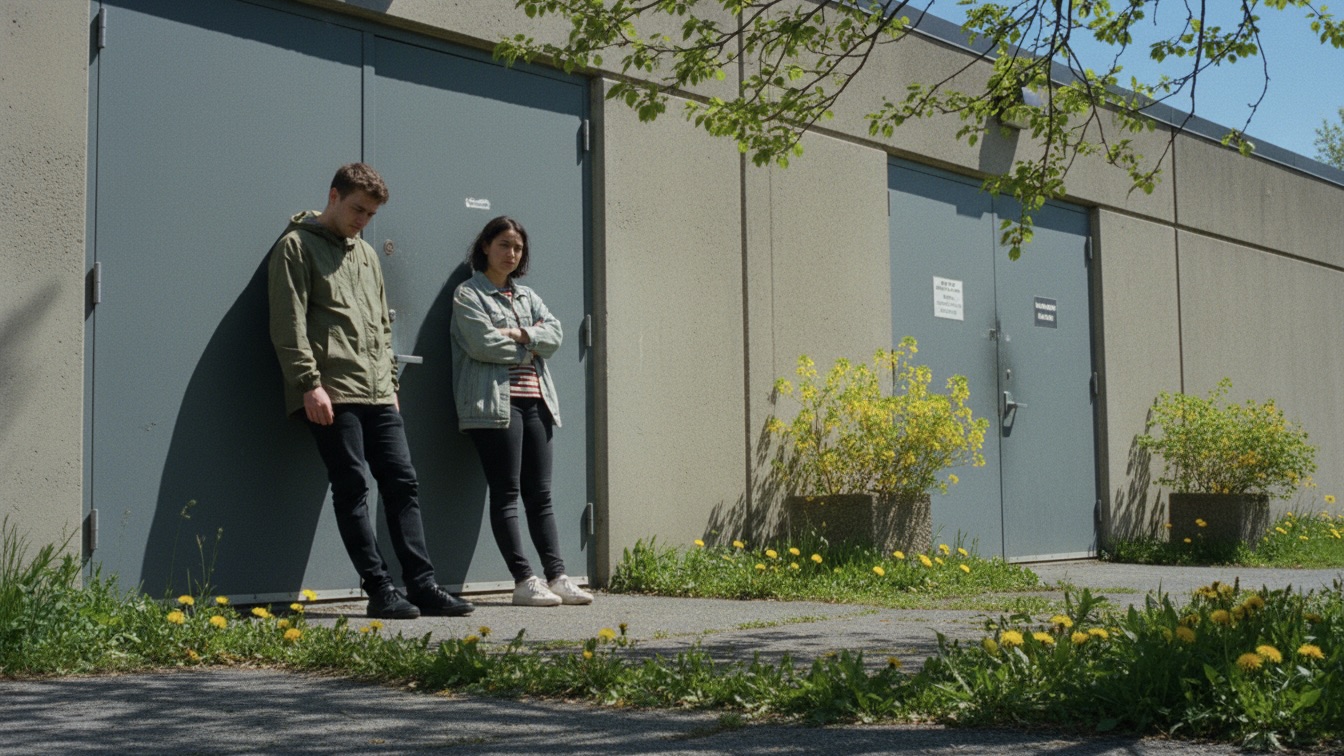
Leo stares at a bowl of chili that costs more than his weekly groceries while playing pool in April.
The cue ball hit the rack with a sound like a bone breaking. It was a clean break, but nothing fell. Leo watched the colored spheres scatter across the stained green felt. The felt was pilled, worn down by decades of bad shots and spilled beer. It felt like his own skin—thin and perpetually irritated. Spring had arrived outside, but inside the St. Jude’s Community Hall, the air was still holding onto the damp chill of February. A window was cracked open, letting in the smell of wet pavement and budding trees. It was supposed to be a season of renewal. Leo just felt older.
"The physics of this table are fundamentally dishonest," Sarah said. She leaned against the wood paneling of the wall. Her phone screen flickered in her hand, a constant source of blue light that made her skin look like marble. "I believe the floor is slanting toward the radiator. Every shot is a negotiation with gravity that we are destined to lose."
Leo didn't look at her. He looked at the bowl of chili sitting on the narrow ledge of the ball return. It was steaming. The scent was incredible—rich, smoky, and heavy with the kind of fat that coats the back of your throat. It had cost the committee two hundred and twelve dollars to produce. He knew this because he had seen the itemized receipt on the bulletin board. It was a list of grievances: organic heirloom beans, grass-fed brisket, three types of dried chilies sourced from a boutique farm in New Mexico, and a pinch of saffron that seemed like an act of war against the local economy.
"Two hundred dollars for a pot of brown sludge," Leo said. He picked up his cue and chalked the tip. The blue dust coated his thumb. "It is a performance of wealth in a room that smells like industrial floor cleaner. It is theatrical. It is almost Shakespearean in its futility."
Sarah laughed, but there was no humor in it. She was twenty-four and worked three jobs. One of them involved transcribing medical records for people who were already dead. "It is the most honest thing in this building. At least the chili delivers on its promise. It is warm. It is filling. Unlike the career counseling seminar they held here last Tuesday, which was merely a collective exercise in hallucination."
Leo leaned over the table. He aimed for the seven ball. His back ached. It was a dull, persistent throb from sitting in a chair that didn't support his spine for eight hours a day. He took the shot. The ball wobbled, hit the lip of the pocket, and stayed there. It was a mockery. He straightened up and took a spoonful of the chili. It was, objectively, the best thing he had ever tasted. It tasted like security. It tasted like a future where he didn't have to check his banking app before buying a gallon of milk.
"The brisket is tender," Leo remarked. He held the plastic spoon like it was a piece of fine silverware. "It suggests a life of leisure. A cow that was never stressed. I find myself envious of the livestock."
"Do not romanticize the ingredients, Leo," Sarah said, finally putting her phone away. She walked toward the table, her boots clicking on the linoleum. "The cow is dead. We are eating the evidence of its demise. The fact that it cost two hundred dollars only proves that we are willing to pay a premium for the illusion of quality. We are patrons of a very small, very spicy museum."
She took the cue from him. Her movements were precise, practiced. She didn't have his hesitation. She saw the table for what it was—a series of angles and friction. She hit the two ball. It disappeared into the corner pocket with a satisfying thud. The sound echoed in the empty hall. The fluorescent lights hummed above them, a low-frequency vibration that Leo felt in his teeth. It was the sound of a building that was slowly giving up.
"The committee chair, Mr. Henderson, told me the saffron was essential," Leo said. He sat down on a folding chair. The metal was cold. "He spoke of 'depth of flavor' as if he were discussing the soul. I told him the depth of my bank account was currently shallow. He didn't see the irony. He just offered me a second helping."
"Mr. Henderson is a relic," Sarah said. She circled the table, looking for her next shot. "He belongs to a generation that believes effort is directly proportional to outcome. He thinks if he spends enough on the chili, the community will suddenly heal. He is trying to buy a social fabric with gourmet legumes."
Leo watched her. They had been coming to this hall since they were ten. Back then, the pool table felt massive, a landscape of endless possibility. Now, it was just a piece of furniture that needed leveling. The walls were covered in faded flyers for events that had already happened—blood drives from 2022, a yoga class that never found an instructor, a missing cat that was likely a grandfather by now. It was a graveyard of good intentions.
"The spring air is deceptive," Leo said, looking toward the window. "It promises change, but it only delivers mud. I find the entire season to be a marketing gimmick by the floral industry."
"You are being particularly exhausting tonight," Sarah noted. She missed her shot. The ball bounced off the cushion and rolled toward the center. "Is it the chili? Does the high price point make you feel inadequate?"
"It makes me feel like a transaction," Leo replied. "Everything is a trade. My time for a paycheck that barely covers the rent. This evening for the hope that I might feel less lonely. Two hundred dollars for a bowl of soup. We are just moving numbers around a screen until we die."
Sarah leaned on her cue, looking at him. Her eyes were tired. There were dark circles under them that no amount of expensive chili could fix. "We are not just numbers, Leo. We are also disappointments. Get it right."
They stood in silence for a moment. The hum of the lights seemed to grow louder. Outside, a car drove past, its headlights sweeping across the ceiling, illuminating the dust motes dancing in the air. It was a brief, beautiful moment of clarity before the darkness returned. Leo reached for his bowl again. It was getting cold. The fat was starting to congeal on the surface, forming a thin, orange film. It looked like a map of a country he didn't want to visit.
"I think I should like to meet the person who sold Mr. Henderson this saffron," Leo said. "I want to understand the level of charisma required to convince an old man that a flower stamen is worth more than silver. It is a career path I haven't considered. Professional deception."
"You wouldn't be good at it," Sarah said. She sat down next to him. "You are too honest. You would tell the mark that the saffron is just a yellow lie. You would ruin the bit."
"Perhaps," Leo conceded. He looked at the pool table. The game was far from over. Most of the balls were still clustered in the center, a chaotic mess of colors. It would take an hour to finish at this pace. "But the lie is so delicious. If I could sell people a moment of flavor that made them forget their student loans, wouldn't that be a public service?"
"It would be a drug, Leo. You're describing a drug."
"Is there a difference?"
Sarah didn't answer. She took a bite of her own chili. They sat there in the flickering light of the community hall, two young people eating a luxury meal in a room that was falling apart. The contrast was sharp. It was the physical manifestation of their lives—high-definition desires on a standard-definition budget.
Leo felt a sudden urge to leave, to walk out into the cool spring night and keep walking until the smell of the chili left his clothes. But he didn't. He stayed. He stayed because the chair was there, and the heat was free, and Sarah was the only person who understood that the world was a series of bad trades.
"We should finish the game," Leo said. He stood up, his joints popping. "It is a matter of principle. We cannot leave the table in this state of disorder. It would be a surrender to the chaos."
"The chaos has already won, Leo," Sarah said, but she stood up anyway. She handed him the cue. "But I suppose we can pretend to have control for another twenty minutes. It is the polite thing to do."
Leo took the cue. He felt the weight of it. It was solid. Real. He looked at the balls on the table. He didn't see the game anymore. He saw the two hundred dollars. He saw the rent. He saw the spring. He took a breath, the damp air filling his lungs, and he aimed. He didn't think about the physics. He didn't think about the slant of the floor. He just hit the ball.
It flew across the table, struck the edge, and soared off the felt entirely. It landed on the linoleum with a loud, hollow crack and rolled under a stack of folding chairs in the corner.
"That," Sarah said, "was a very expensive mistake."
"It was an exit strategy," Leo corrected. He put the cue back in the rack. "The game is over. The ball has escaped the system. I think we should follow its lead."
Sarah looked at the corner where the ball had disappeared. She looked at the empty bowls of chili. She looked at Leo. A small, genuine smile touched her lips. It was the first one he had seen in weeks. "The ball is under the chairs, Leo. It hasn't escaped. It’s just hiding in the dark."
"Then we shall join it," Leo said. He reached for his jacket. It was a thin windbreaker, not nearly enough for the evening air. "I have heard that the darkness is much more affordable than the light. There is no markup on shadows."
They walked toward the door. Leo stopped by the bulletin board. He looked at the receipt one last time. Two hundred and twelve dollars. He thought about the person who grew the chilies. He thought about the truck driver who hauled the brisket. He thought about the cashier who rang it all up. All of them were just parts of the machine, grinding away to produce a single pot of food for a group of people who didn't know each other's last names.
"Are you coming?" Sarah asked. She was standing by the exit, the heavy metal door held open. A gust of wind blew in, carrying the scent of cherry blossoms and exhaust.
"I am contemplating the supply chain," Leo said.
"Stop. It is a path to madness. Just walk through the door."
Leo stepped out into the night. The transition from the stale air of the hall to the crisp spring evening was jarring. The sky was a deep, bruised purple. The streetlights were flickering to life, casting long, distorted shadows on the sidewalk. He felt small. He felt exhausted. But for the first time in a long time, he felt like he was moving forward.
"Where to?" Sarah asked. She was shivering slightly.
"I want to find the source," Leo said.
"The source of what?"
"The saffron. The brisket. The lies. I want to see the place where things actually cost what they are worth. If such a place exists."
Sarah tucked her hands into her pockets. "That sounds like a very long walk, Leo."
"I have nothing but time," he replied. "And I am still full of very expensive chili. I have the calories to spare."
They started walking down the cracked pavement. The neighborhood was quiet, the houses huddled together like mourners. Behind them, the lights of the community hall stayed on, a lonely beacon in the middle of a world that was trying to figure out how to pay for itself. Leo didn't look back. He kept his eyes on the horizon, watching for the first sign of a truth that didn't come with a receipt.
“He kept his eyes on the horizon, watching for the first sign of a truth that didn't come with a receipt.”


