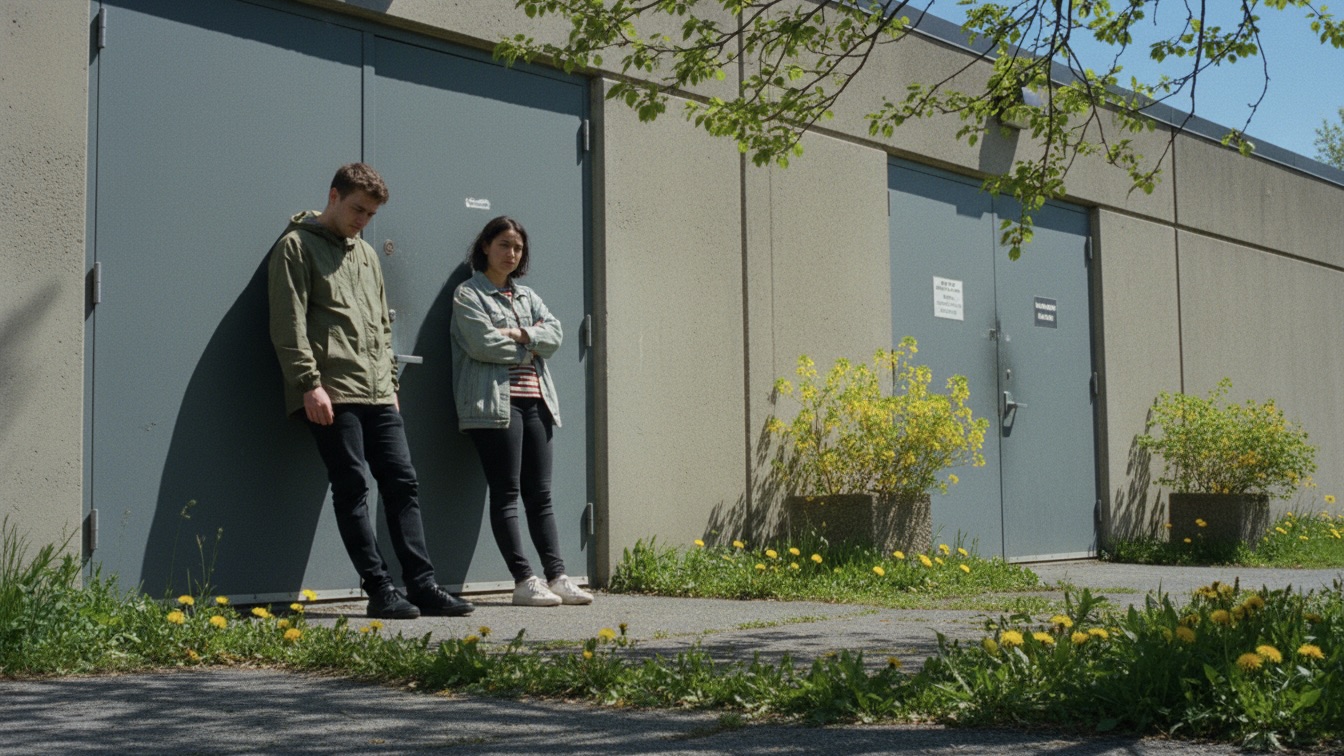
The chapter unfolds within the decaying confines of St. Jude’s Community Hall, where two young acquaintances, Leo and Sarah, share a game of pool and an atypically expensive pot of chili. As Leo observes the worn felt of the table and the "dishonest" physics of the room, he becomes preoccupied with the absurdity of the two-hundred-dollar meal provided by the community committee. The narrative centers on a dialogue between the two characters as they navigate their own financial anxieties and the perceived futility of the world around them.
The gourmet ingredients of the chili—saffron, heirloom beans, and grass-fed brisket—serve as a sharp contrast to the industrial smell of the hall and the characters' struggling lives. Sarah, who works multiple jobs including transcribing medical records for the deceased, offers a pragmatic yet cynical counterpoint to Leo’s more philosophical lamentations. Their conversation touches upon the generational divide, the commodification of basic needs, and the "performance" of social healing through luxury goods.
The chapter reaches its climax not through a dramatic event, but through a symbolic gesture during their game. Leo, frustrated by the "system" of the table and the weight of his own existence, strikes a ball so hard that it flies off the felt and disappears into the shadows. This act of "escape" prompts the pair to abandon the game and the hall entirely. They exit into the spring night, choosing to seek a sense of worth that isn't dictated by a receipt or a transaction.
The central theme of the text is the jarring intersection of extreme wealth and systemic decay. The "Two Hundred Dollar Pot" of chili serves as a potent symbol for the performative nature of modern charity and social intervention. While the community hall literally falls apart around them, the committee chooses to invest in "boutique" ingredients rather than structural repairs or genuine social support. This highlights a world where the appearance of quality is prioritized over the functional reality of people's lives.
Another significant theme is the commodification of time and the human experience. Leo views his life through the lens of a "transaction," where his physical labor and time are traded for a paycheck that barely sustains him. The chili, despite its luxury, is described as a "drug" or a "lie" because it provides a temporary, artificial sense of security that the characters cannot actually afford. The narrative suggests that in a late-capitalist society, even a simple meal becomes an exercise in calculating one's own inadequacy.
The concept of entropy and the "dishonesty" of the physical world also permeates the story. The pool table is slanted, the floor is uneven, and the spring season is dismissed as a "marketing gimmick." These elements reflect the characters' internal psychological states, where they feel the "system" is rigged against them. The "chaos" Sarah mentions is not just a lack of order in the room, but a fundamental breakdown of the social fabric that the characters are forced to navigate every day.
Leo is a man defined by a sense of premature aging and profound disillusionment. He perceives his own skin as being as "thin and perpetually irritated" as the worn felt of the pool table, suggesting a deep-seated exhaustion with his environment. His psychological state is one of hyper-awareness; he cannot simply enjoy the meal because he is haunted by the itemized receipt and what it represents. He feels like a "transaction" rather than a person, indicating a loss of agency and a feeling of being a mere cog in an economic machine.
His internal conflict stems from his inability to participate in the "lies" that others use to cope with reality. Sarah notes that he is "too honest" to be a professional deceiver, which suggests that his misery is a byproduct of his clarity. He seeks a "truth that doesn't come with a receipt," showing a desperate desire for authentic value in a world he views as fundamentally fraudulent. His act of hitting the ball off the table is his only way to exert control over a game he believes he is destined to lose.
Sarah serves as a pragmatic, though equally weary, mirror to Leo’s philosophical brooding. At twenty-four, she is already hardened by the necessity of working three jobs, one of which involves the grim task of transcribing records for the dead. This occupation likely contributes to her clinical view of the world as a series of "angles and friction." Unlike Leo, who romanticizes the "leisure" of the livestock they are eating, she views the meal as "evidence of demise," showing a refusal to engage in sentimentality.
Her movements are described as "precise" and "practiced," contrasting with Leo’s hesitation and physical pain. This suggests that she has developed a survival mechanism based on efficiency and the acceptance of "the chaos." While she acknowledges their status as "disappointments," she remains the more grounded of the two, eventually being the one to lead Leo out of the hall. Her small, genuine smile at the end indicates that she finds a grim sort of humor and solidarity in their shared recognition of the world's "bad trades."
The prose is characterized by a heavy use of sensory details that emphasize the contrast between luxury and squalor. The "rich, smoky" scent of the brisket is juxtaposed with the "industrial floor cleaner" and the "damp chill of February." These descriptions ground the abstract philosophical debates in a tangible, albeit unpleasant, reality. The author uses the physical environment, such as the "pilled" felt and the "humming" fluorescent lights, to create a tone of oppressive stagnation.
The pacing of the chapter is deliberate and conversational, allowing the dialogue to carry the weight of the narrative. The pool game acts as a rhythmic device, punctuating the conversation with the "thud" of balls and the "clack" of cues. This structure mirrors the characters' lives—repetitive, constrained by rules, and ultimately leading nowhere. The "low-frequency vibration" of the hall serves as an atmospheric backdrop that heightens the sense of a world "slowly giving up."
The narrative voice is deeply empathetic toward the characters' plight while maintaining a sharp, cynical edge. Metaphors are used effectively to convey psychological depth, such as the congealed fat on the chili looking like a "map of a country" Leo doesn't want to visit. The final transition from the "stale air" of the hall to the "bruised purple" sky of the spring night provides a visual and emotional shift. It moves the story from a state of claustrophobic introspection to one of uncertain but necessary movement.


