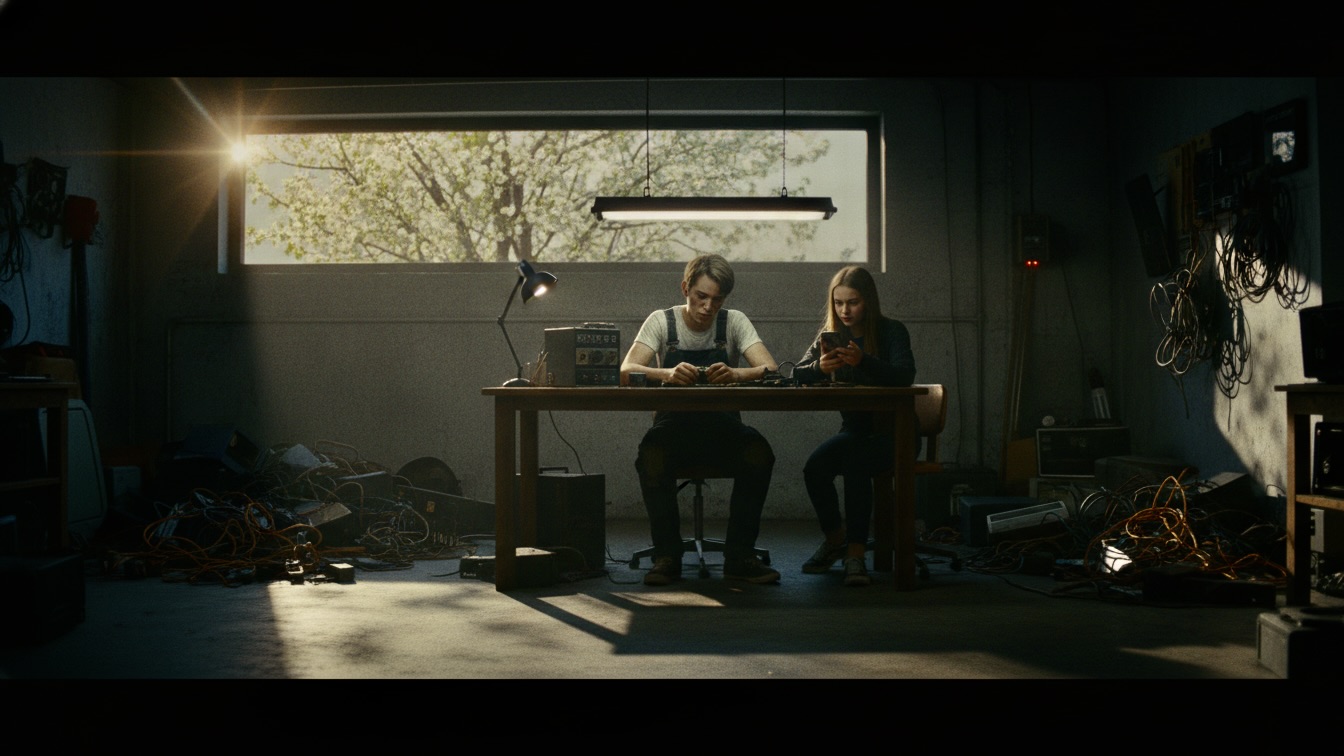
A discarded phone reveals photos of a life we never lived, making the humid spring air feel heavy.
The air in the basement of Refresh & Recycle smelled like ozone and old coffee. It was a thick, heavy scent that stuck to the back of your throat. Outside, it was mid-April, and the city was doing that thing where it tries to pretend it’s a garden. The trees on the curb were exploding in white blossoms that looked like popcorn and smelled like bleach. I could see them through the narrow, grime-streaked window at street level. Every time a car drove over a pothole, a cloud of yellow pollen drifted down into the window well, coating the glass in a layer of fuzzy dust. It was the kind of spring day that felt less like a renewal and more like an allergy attack waiting to happen.
I was sitting at the back bench, the one with the flickering fluorescent light that buzzed like a trapped hornet. My job was simple: sorting the dead. People brought in their broken lives—cracked tablets, laptops with fried motherboards, phones that had taken a swim in a toilet—and I decided if they were worth the effort to fix or if they were just scrap. It was a series of transactions. My time for their trash. The boss’s money for my back-pain. The universe didn't give you anything for free. Everything had a price, usually paid in small, annoying increments of your life.
I picked up a Z-Phone 4. The screen was a spiderweb of cracks, but the chassis wasn't bent. I plugged it into the diagnostic rig. The red light blinked. Once. Twice. Then it stayed solid. It was alive, barely.
"Norman, you in here?"
The door at the top of the stairs creaked. I didn't look up. I knew the sound of those sneakers—treads worn down to nothing, dragging slightly on the wood. Mae. She was the only person who came down here without being paid to do it.
"Back bench," I said. My voice sounded scratchy. I hadn't used it in three hours.
Mae appeared in my peripheral vision. She was wearing an oversized hoodie even though it was eighty degrees outside. She had a cardboard tray with two iced coffees. One of them had my name misspelled on the side. 'Lio.' Close enough.
"Brought you a bribe," she said, sliding the drink onto the workbench, dangerously close to a pile of lithium batteries.
"What do you want fixed?" I asked. I took a sip. It was mostly sugar. I needed the sugar.
"Why do you assume I want something? Maybe I just missed your charming personality."
"Mae."
"Fine. My charging port is acting up again. I have to hold the cable at like, a forty-five-degree angle and pray to the tech gods just to get it to five percent."
"Hand it over," I said. I didn't look at her, but I could feel her watching me. She was always watching things, like she was trying to find the seam where the world was glued together. She had this intensity that made me feel tired just being near it. She lived in a world of possibilities; I lived in a world of hardware that eventually broke.
She handed me her phone. It was sticky. "Is this syrup?"
"I spilled a bubble tea. Don't judge me."
"I'm judging you."
I set her phone aside and looked back at the Z-Phone on the rig. The screen had finally flickered to life. It didn't have a passcode. That was rare. Usually, people locked their secrets behind six digits. This one just slid open to a home screen with a default wallpaper. A mountain range. Boring.
"What's that?" Mae leaned in, her shoulder brushing mine. She smelled like the spring outside—pollen and something sharp, like citrus.
"Scrap," I said. "Or a refurb. Depends on the battery health."
I tapped the photo gallery icon. I don't know why. Habit, maybe. Usually, it's just a hundred blurry pictures of cats or food. But when the grid of thumbnails loaded, I stopped breathing for a second. The somatic shock hit me in the pit of my stomach. My heart did a weird, jagged thud against my ribs.
"Norman," Mae whispered. Her voice had lost that playful edge. "Is that us?"
I zoomed in on the first photo. It was a high-resolution shot of two people standing on a bridge. The background was unmistakable—the London Eye, the grey sprawl of the Thames, the Big Ben tower in the distance. The two people were us.
It wasn't just 'us' in the way a deepfake is us. It was the specific way I tilted my head when I was trying to look cool. It was the way Mae’s hair frizzed out when it was humid. In the photo, we were laughing. We looked... happy. Not the 'I just got a paycheck' happy, but the 'the world is actually okay' happy. I was wearing a leather jacket I’d never seen before. Mae had a piercing in her eyebrow that she’d talked about getting but never did because she was afraid of needles.
"Check the date," Mae said, her hand reaching out to steady herself on the bench. Her fingers were cold.
I swiped up on the image info.
April 14, 2026. 2:14 PM.
I looked at the digital clock on the wall. It was 4:03 PM. April 14, 2026.
"That's not possible," I said. "We've been in this basement since noon."
"Maybe it's a prank?" Mae said, but she didn't sound like she believed it. "Like, someone photoshopped it and left the phone here?"
"Who? No one knows we're here. No one knows I'm working this shift. And look at the metadata, Mae. The GPS coords are in London. The light—look at the shadows. That’s real sunlight. You can’t fake that kind of ray-tracing in two hours."
"So what? Is there a multiverse? Are we looking at ourselves in another timeline?" She laughed, but it was a dry, brittle sound. It was her defense mechanism. Irony. The default setting for everyone our age when things got too heavy to process.
"Don't start with the sci-fi stuff," I said, though my hands were shaking. I put the phone down on the ESD mat. It felt hot. "It’s a glitch. A server error. Some AI-generated garbage that got dumped into a cloud sync."
"An AI generated a leather jacket you don't own and put us in London two hours ago?" Mae grabbed the phone. She started swiping through the gallery. There were dozens of them. Us at a pub. Us walking through a park with cherry blossoms that actually looked healthy, not like the bleached-out ones outside. Us on a train.
In every photo, we were together. In this reality, we were two kids barely holding onto a friendship because we were both too tired to put in the effort. We traded coffees and tech support. We complained about our parents and the price of rent. We were a transaction. But on that screen, we were something else. We were a story.
"Look at this one," she said, her voice small.
It was a selfie. We were close together, faces touching. I was kissing her cheek. In the reflection of my eyes in the photo, you could see the city lights. It looked so physical. I could almost feel the cold wind from the river through the screen.
I looked at Mae. She was looking at the phone, then at me. Her eyes were searching for something in my face, some confirmation that I felt the same hollow ache in my chest.
"It’s not us," I said, more to myself than her. "It’s just data."
"It feels like us," she countered. "It feels more like us than... this."
She gestured to the basement. The piles of cracked screens. The tangled nests of charging cables that looked like black snakes. The flickering light. The smell of burning solder. This was our reality. It was worn out. It was a series of broken parts waiting to be recycled or thrown away.
"Life isn't a movie, Mae. We don't just wake up in London. We wake up here, we go to work, we try to save enough money to not be miserable, and then we do it again."
"Why are you so determined to make it suck?" she snapped. She stood up, the coffee tray wobbling. "Does it hurt you to think that somewhere, somehow, we’re actually having a good time? That we’re not just... transactions?"
"It hurts to see what I don't have," I said. The honesty of it felt like a bruise.
I took the phone back from her. My thumb brushed her hand, and for a second, the contact felt electric, like a short circuit. We both pulled away. The air between us was suddenly too thin. The humidity of the spring day felt like it was pressing in on the basement walls.
"I have to fix your port," I said, my voice flat.
"Forget the port, Norman. What are we going to do with that?"
"I'm going to wipe it. It’s a security risk. If the boss sees it, he’ll think I’m screwing around with customer data."
"You can't wipe it!" she yelled. "That’s proof!"
"Proof of what? That the internet is broken? We already knew that."
I picked up the heat gun. I needed to focus on something tactile, something I could control. I started warming the adhesive on her phone, the one with the bubble tea syrup. I worked with a precision that I didn't feel. My mind was still on the bridge in London. I could see the leather jacket. I could see the way my 'other' self looked at her—with a total lack of skepticism. He wasn't tired. He was wide awake.
Mae sat back down. She didn't say anything for a long time. She just watched the Z-Phone screen as it timed out and went black. The reflection of the fluorescent light stretched across the cracked glass like a scar.
"Do you think they're happy?" she asked eventually.
"Who?"
"The other us. In the photos."
I pried the back glass off her phone with a plastic pick. "Happiness is a temporary state, Mae. It’s a chemical spike. They’re probably arguing about where to eat five minutes after that photo was taken."
"You're such a buzzkill."
"I'm a realist."
"No, you're a coward. You're afraid to believe in anything that isn't broken."
I stopped. The heat gun hissed in the silence. I looked at her. Her face was flushed, her eyes bright with a kind of desperate hope that I hadn't seen in years. It was the kind of look that made people do stupid things. It was the kind of look that started wars and ended friendships.
"I'm not afraid," I said. "I'm just tired, Mae. I'm so tired of looking for 'more.' There isn't more. This is the world. It’s dirty, it’s expensive, and the trees smell like bleach. Deal with it."
She stood up again, but this time she didn't stop. She grabbed her bag. "Keep the coffee. I don't want the phone back until it's fixed. And don't touch that other one. If you wipe it, we're done."
"Mae—"
But she was already up the stairs. The door slammed, and a little more dust drifted down from the ceiling.
I was alone with the dead tech.
I looked at the Z-Phone. It was sitting there, a small slab of glass and metal that contained a miracle or a lie. I reached out and tapped the screen. It stayed dark. The battery had finally given up.
I thought about the multiverse. I thought about a version of me that wasn't covered in solder burns and cynicism. A version of me that could afford a leather jacket and a trip to London. A version of me that knew how to kiss Mae without it being a 'transaction' of comfort for loneliness.
I picked up my screwdriver. I had a job to do. I had to fix the charging port. I had to earn my wage.
But as I worked, I kept looking at the window. The sun was starting to set, casting a long, orange glow across the basement floor. It caught the dust motes in the air, making them look like tiny sparks of gold. For a second, just a second, the basement didn't look like a graveyard. It looked like a workshop where things were being reborn.
I didn't wipe the phone. I tucked it into the back of my drawer, under a pile of old manuals. I told myself it was for 'research.' But deep down, in the part of me that I usually kept locked behind a passcode, I knew I was just waiting.
I was waiting for the screen to flicker again. I was waiting for the other Norman to tell me how he got out.
Outside, the spring wind picked up, shaking the white blossoms from the trees. They swirled in the air for a moment, bright and beautiful, before they hit the pavement and turned into something to be swept away.
“The screen flickered one last time, and for a second, the other Norman looked back at me.”


