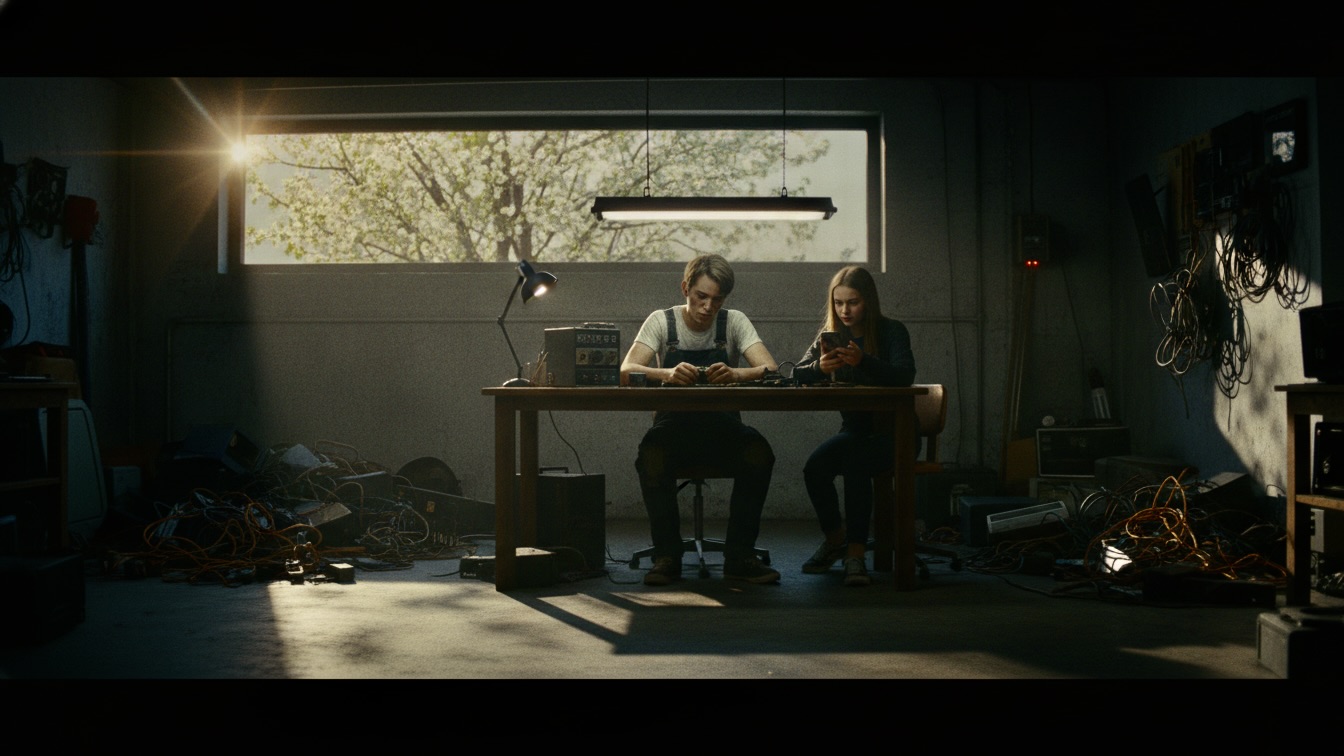
Format: Short Film / Anthology Episode | Est. Length: 10-12 minutes
Imagine a world where the discarded remnants of our digital lives hold the keys to the doors we never opened. The Glitch Archive is an anthology series exploring the intersection of obsolete technology and inexplicable temporal anomalies, where low-income protagonists discover "ghost data" that reveals fractured, superior versions of their own lives. In this world, the "Right to Repair" becomes a quest for existential truth, as every cracked screen serves as a potential window into a more vibrant, impossible reality that challenges the bleakness of the present.
In a grime-streaked basement repair shop, a cynical technician boots up a "dead" Z-Phone only to find high-resolution photos of himself and his best friend laughing on a London bridge—taken exactly two hours ago, despite neither of them having left the room.
A cynical tech repairman discovers photos of himself and his best friend in London on a discarded phone, despite neither of them leaving their basement shop. He must decide if the images are a digital prank or a glimpse into a life he’s too afraid to claim.
The primary theme is the conflict between protective cynicism and the vulnerability of hope. Norman uses his "realism" as a survival mechanism in a late-capitalist landscape where everything is a transaction and beauty is viewed as a temporary chemical spike; the discovery of the photos forces him to confront the idea that his misery might be a choice rather than an inevitability.
Secondary themes include the "Digital Ghost" and the Multiverse as a metaphor for regret. The story explores how technology captures not just who we are, but the idealized versions of ourselves we wish we could be, questioning whether seeing a "better" version of one's life is a gift or a curse when one is stuck in a cycle of decay and repair.
The stakes are purely emotional and existential, centering on the survival of Norman’s psyche and his relationship with Mae. For Norman, the risk is the total collapse of his defensive worldview; if the photos are real, his philosophy of "transactional living" is a lie, leaving him vulnerable to the pain of wanting a life he cannot afford. For Mae, the stakes are the survival of their friendship, as she risks losing her only connection to a person she cares about if he continues to choose the safety of his "graveyard" over the possibility of a shared future.
The external conflict is the mystery of the Z-Phone and its impossible metadata, which acts as a catalyst for the internal conflict within Norman. He battles his own cognitive dissonance, struggling to reconcile the physical evidence on the screen with his rigid, cynical understanding of reality. This is exacerbated by the interpersonal conflict with Mae, whose desperate hope acts as a mirror to Norman's self-imposed isolation, creating a pressurized environment where the truth is less important than the emotional reaction to it.
Norman, a cynical technician in a basement repair shop called "Refresh & Recycle," spends his days sorting through "dead" electronics while ignoring the vibrant, bleach-scented spring blooming outside his street-level window. When his friend Mae drops off a sticky phone for repair, Norman discovers a discarded Z-Phone containing high-resolution photos of himself and Mae in London—dated that very afternoon, despite neither having left the city. The photos show a version of them that is happy, well-dressed, and deeply connected, standing in stark contrast to their current reality of sugar-laden coffee and lithium dust.
The discovery sparks a bitter confrontation as Mae sees the photos as proof of a better life or a "multiverse" connection, while Norman dismisses them as a cruel digital glitch or AI fabrication. As the tension peaks, Norman threatens to wipe the data to protect his own peace of mind, leading to a rift that sends Mae charging out of the shop. Left alone in the quiet of the basement, Norman finishes his repairs but finds himself unable to delete the evidence of his "other" self. He hides the phone away, finally allowing himself to wait for a signal from a world he claimed didn't exist.
Norman: Starts as a nihilistic "realist" who views life as a series of broken transactions, using his technical skills as a shield against disappointment. He is physically and emotionally "covered in solder burns," preferring the predictable failure of hardware to the unpredictable nature of human hope. By the end, the shield is cracked; though he remains in the basement, he transitions from a state of total closure to one of quiet, agonizing anticipation, finally acknowledging the "hollow ache" in his chest.
Mae: Begins as a persistent optimist seeking connection in a world she finds suffocating, using her "broken" tech as an excuse to visit Norman. She is the "citrus and pollen" to Norman’s "ozone and old coffee," always searching for the seams where the world is glued together. Her arc concludes with a shift from playful persistence to righteous anger, as she realizes that Norman’s refusal to believe in the photos is a rejection of their potential together, leading her to abandon her phone and force him to face his own cowardice.
Beat 1: The basement of Refresh & Recycle is established as a tomb of ozone and dust, where Norman meticulously sorts through electronic scrap while the world outside blooms in an ugly, bleached-white spring. The buzzing fluorescent light and the smell of old coffee underscore the monotony of Norman’s "transactional" existence as he plugs a dead Z-Phone into a diagnostic rig. He watches as the device barely flickers to life, a digital ghost in a graveyard of hardware that he intends to either refurbish or scrap for parts.
Beat 2: Mae enters the basement, bringing the outside world with her in the form of sugary coffee and the scent of citrus, immediately clashing with Norman’s sterile, cynical environment. She presents a "sticky" phone repair as a thinly veiled excuse for interaction, but Norman remains focused on the hardware, treating her presence as just another task to manage. Their banter reveals a deep-seated history of Mae pushing for emotional depth and Norman retreating into the safety of repair manuals and technical jargon.
Beat 3: Norman opens the gallery on the refurbished Z-Phone and is struck by a somatic shock when he finds photos of himself and Mae laughing on a bridge in London. The metadata confirms the photos were taken two hours ago, creating an impossible paradox that shatters the quiet of the basement and makes Norman’s hands shake. Mae leans in, captivated by the image of a happier, more stylish version of themselves, while Norman desperately searches for a logical, technical explanation to debunk the miracle.
Beat 4: The midpoint tension escalates into a philosophical war as Mae embraces the photos as a glimpse into a better timeline, while Norman lashes out, calling the images a "security risk" and threatening to wipe the data. He uses his tools as weapons of denial, heating the adhesive on Mae’s phone with a hiss that mirrors his own rising frustration and fear of disappointment. The argument strips away their usual masks, forcing Norman to admit that the "other" life hurts him because it highlights the misery of his current reality.
Beat 5: Mae leaves in a storm of disappointment, leaving Norman alone with the flickering Z-Phone and the weight of his own refusal to believe in "more." He finishes the repair on her device but finds himself unable to follow through on his threat to erase the London photos, instead tucking the device away like a forbidden relic. The episode ends with Norman watching the sunset turn the basement dust into gold, finally waiting for a signal from the "other" Norman to tell him how to escape the graveyard.
The episode begins with a "flatline" mood of clinical detachment and industrial boredom, established through the cold, buzzing atmosphere of the basement. Upon the discovery of the photos, the emotional trajectory spikes into "somatic shock" and high-frequency anxiety, creating a sense of vertigo for both the characters and the audience. The climax is a fever pitch of frustration and "bruised honesty," which eventually settles into a haunting, melancholic resonance—a "hopeful ache" that leaves the audience feeling the weight of the characters' missed connections.
Over the course of a season, the "Z-Phone" anomaly would be revealed as part of a larger "Data Leak" from a parallel timeline where a global event took a different, more prosperous turn. Norman would begin to find more devices with similar "ghost data," eventually forming an underground network of "Refurbishers" who trade these glimpses of better worlds like contraband, creating a secret community of people living for their digital reflections.
The thematic escalation would move from personal regret to systemic rebellion as the characters realize their world is a "broken" version of a better reality. As Norman and Mae’s relationship continues to fracture, they must decide whether to simply watch the other timeline through their screens or find a way to "solder" the two realities together. This arc would culminate in a choice between staying in their safe, decaying world or risking a "total system wipe" to cross over into the life they saw on the screen.
The visual style relies on a high contrast between the "grimy" reality of the basement and the "vibrant" clarity of the phone screen. The basement scenes should be shot with a cool, sickly palette of blues and greens, using handheld camera work to create a sense of claustrophobia and industrial decay. In contrast, the photos on the Z-Phone should be hyper-saturated and steady, representing an idealized cinematic world that feels more "real" than the physical one Norman inhabits.
The tone is "Lo-Fi Sci-Fi," blending the grounded, tactile realism of a workplace drama with the eerie, existential dread of The Twilight Zone. Tonal comparables include the "San Junipero" episode of Black Mirror for its emotional yearning and Tales from the Loop for its quiet, melancholic approach to impossible technology. The sound design is crucial, utilizing a constant low-frequency hum of electronics that cuts to absolute silence whenever the characters look at the "other" world on the screen.
The target audience is adults aged 18-35 who enjoy character-driven speculative fiction and "aesthetic" sci-fi. It appeals specifically to a generation experiencing "doom-scrolling" fatigue and economic anxiety, offering a narrative that validates their sense of being "stuck" while introducing a sublime element of mystery. The viewing context is ideal for anthology platforms (Netflix, Hulu) where audiences seek short, high-impact stories that provoke philosophical discussion.
The pacing is a "slow-burn" that accelerates sharply in the middle. The first 4 minutes are methodical and tactile, focusing on the sensory details of repair work to ground the audience in Norman’s world. The middle 4 minutes are high-tension and dialogue-heavy as the paradox is introduced, and the final 2-4 minutes slow down into a contemplative, atmospheric coda. The 10-12 minute runtime ensures the central mystery remains tight without requiring a definitive scientific explanation.
The production requires a single, highly detailed "basement" set filled with authentic electronic waste, old manuals, and flickering industrial lighting. This "bottle episode" format keeps costs low while allowing for a high focus on performance and atmosphere. Sound design is the most critical technical element; the constant buzz of the fluorescent light and the hiss of the soldering iron must create an immersive, slightly grating auditory environment that makes the eventual silence of the "London" photos feel more profound.
VFX requirements are minimal but must be high-quality. The photos on the Z-Phone must look like genuine, high-resolution smartphone photography with realistic lighting and "ray-tracing" to ensure the audience shares Norman's conviction that they cannot be faked. Practical lighting should be used to transition the basement from a cold, industrial space to a warm, "golden hour" environment in the final scene to visually represent Norman's internal shift from cynicism to a tentative, painful hope.


