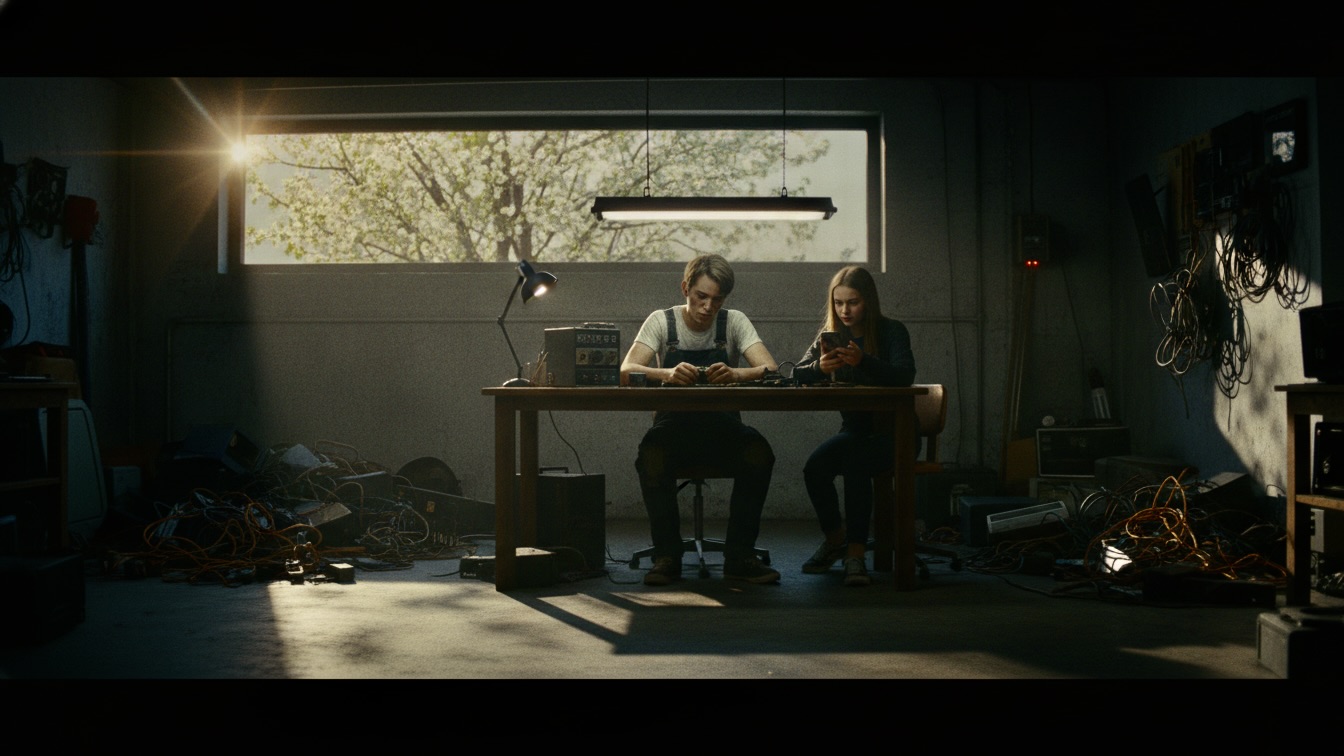
The story begins in the cramped, ozone-scented basement of a repair shop called Refresh & Recycle, where the protagonist, Norman, spends his hours triaging broken electronics. He views his work and his life through a lens of weary cynicism, perceiving every interaction as a transaction where time is traded for meager survival. Outside, the spring season offers a jarring contrast, appearing not as a beautiful renewal but as a harsh, bleach-smelling irritant that underscores his sense of stagnation.
His routine is interrupted by Mae, a friend who brings him coffee and a broken phone for repair. While processing a separate, discarded device, Norman discovers a series of high-resolution photographs that appear to depict him and Mae together in London. The metadata indicates the photos were taken that very afternoon, despite both of them having been confined to the basement. This impossible discovery sparks a heated debate between the two characters regarding the nature of reality and their own relationship.
Mae is captivated by the images, seeing them as evidence of a more meaningful existence where they are happy and adventurous. Norman, however, desperately attempts to rationalize the anomaly as a digital glitch or an artificial intelligence error, fearing the emotional vulnerability that believing in the photos would require. The tension culminates in Mae leaving in frustration after Norman threatens to wipe the data to protect his job.
In the aftermath of her departure, Norman finds himself unable to follow through with his cynical resolve. He hides the mysterious phone instead of erasing it, signaling a quiet shift in his internal landscape. As the sun sets, the basement is briefly transformed by light, and he begins to harbor a secret hope that the "other" version of himself might offer a way out of his current malaise.
The central theme of the story revolves around the conflict between transactional existence and the yearning for emotional authenticity. Norman perceives the world as a series of cold exchanges, where even his friendship with Mae is reduced to "coffee and tech support." This worldview acts as a psychological armor, protecting him from the disappointment of unfulfilled potential. By viewing life as "scrap," he avoids the pain of trying to build something that might eventually break.
Another prominent theme is the tension between digital simulation and physical reality. The photographs on the Z-Phone represent a "hyper-reality" that feels more vibrant and "real" than the characters' actual lives. The story questions whether a digital memory can hold more truth than a physical experience. Mae argues that the photos feel more like "us" than their current surroundings, suggesting that their true selves are suppressed by the weight of their economic and social circumstances.
The narrative also explores the concept of stagnation versus rebirth. The setting of a repair shop is symbolic of a liminal space where things are either discarded or given a second life. While Norman initially sees himself as a mere sorter of the dead, the ending suggests a thematic shift toward the possibility of his own "refurbishment." The "silver solder" of the title serves as a metaphor for the fragile but necessary connections that hold a broken life together.
Finally, the story touches on the fear of hope. Norman’s cynicism is presented not just as a personality trait, but as a survival mechanism. To him, the photos are a "security risk" because they threaten the stability of his misery. The narrative suggests that believing in a better world is a courageous act, one that requires a person to move past the safety of being "tired" and embrace the terrifying possibility of "more."
Norman is a man defined by his defensive detachment and a profound sense of exhaustion. He operates as a "realist" to avoid the "somatic shock" of acknowledging his own unhappiness. His internal monologue reveals a person who has internalized the mechanical nature of his work, seeing humans as hardware that inevitably fails. He is cognitively dissonant, as he possesses the technical skill to fix complex machines but feels entirely powerless to repair the trajectory of his own life.
Psychologically, Norman exhibits signs of a suppressed emotional core that he keeps "locked behind a passcode." When he sees the photos of himself in London, his immediate reaction is a physical manifestation of anxiety—a "jagged thud" in his ribs. He rejects the evidence of his own happiness because it highlights the "hollow ache" of his current reality. By dismissing the photos as "data," he attempts to maintain his intellectual control over a situation that threatens his emotional equilibrium.
Despite his insistence on being a "buzzkill," Norman’s final actions reveal a hidden capacity for wonder. His decision to keep the phone instead of wiping it is his first non-transactional act in the story. He is no longer just earning a wage; he is waiting for a "flicker" of something transcendent. This transition suggests that beneath his layer of solder burns and cynicism, he is a man who is desperately waiting for permission to be "wide awake."
Mae serves as the emotional and philosophical foil to Norman’s rigid cynicism. She is described as having an intensity that seeks out the "seams" of the world, suggesting she is a person who refuses to accept the surface-level reality of their bleak environment. Unlike Norman, she is willing to embrace the impossible if it offers a sense of meaning. Her reaction to the photos is one of immediate emotional investment, seeing them as a "story" rather than just a collection of pixels.
Her relationship with Norman is characterized by a persistent attempt to bridge the gap between his isolation and her need for connection. She uses the "bribe" of coffee not just as a transaction, but as a way to remain present in his life. When she confronts him about being a "coward," she is challenging his habit of using fatigue as an excuse for emotional withdrawal. She represents the catalyst for change, forcing him to look at a version of himself that he has long since buried.
Mae’s departure at the end of the chapter is a crucial moment of agency. She refuses to let Norman "wipe" the possibility of their shared happiness, setting a firm boundary against his nihilism. Her anger is a testament to her hope; she only fights with him because she believes there is something worth saving. She leaves him with the "dead tech" as a challenge, forcing him to decide which version of reality he is going to invest his time in fixing.
The narrative voice is characterized by a gritty, sensory-heavy realism that grounds the more fantastical elements of the plot. The author uses olfactory details—the smell of ozone, old coffee, and bleach—to create a claustrophobic atmosphere that mirrors Norman's mental state. This "thick, heavy scent" establishes a world that is physically oppressive, making the eventual discovery of the "clean" and "vibrant" photos feel like a literal breath of fresh air.
The pacing of the story is deliberate, starting with the slow, rhythmic descriptions of the basement before accelerating during the discovery of the Z-Phone. The dialogue between Norman and Mae is sharp and rhythmic, echoing the "flickering" of the fluorescent lights. The author uses technical metaphors, such as "ray-tracing," "metadata," and "ESD mats," to reinforce Norman’s identity as a technician while simultaneously using these terms to describe his emotional experiences.
The tone of the piece shifts from weary resignation to a tense, electric uncertainty. The contrast between the "spiderweb of cracks" on the phone and the "high-resolution" beauty of the images serves as a visual metaphor for the characters' conflicting perspectives. The author successfully balances the mundane details of a repair shop with the existential weight of a multiverse mystery, ensuring that the emotional stakes feel as real as the hardware Norman handles.
In the final paragraphs, the prose becomes more lyrical, reflecting Norman’s internal softening. The description of dust motes looking like "tiny sparks of gold" signals a shift in the narrative’s visual palette. This stylistic choice underscores the theme of rebirth, suggesting that even in a "graveyard" of dead tech, there is the potential for beauty. The ending leaves the reader in a state of suspended animation, mirroring Norman’s own wait for the screen to flicker back to life.


