Olga finds green grass growing through the snow, leading her back to a husband she thought was gone forever.
The snow wasn't melting; it was retreating like a losing army, leaving behind a battlefield of gray slush and dead mud. Olga stood on her back porch, holding a mug of coffee that had gone cold ten minutes ago. It was Spring, or whatever the world called Spring now. After the Great Freeze, seasons didn't just change; they updated.
She looked at her garden. It was a mess of rotted tomato cages and flattened hydrangea bushes. But there was something else. About ten feet from the porch, a patch of color hit her eyes like a physical weight. It was green. Not the sickly, pale green of new shoots struggling through the frost, but a deep, saturated neon. It looked like someone had photoshopped a piece of an Irish meadow onto a funeral shroud.
Olga set the coffee on the railing. Her knees popped as she climbed down the stairs. The mud sucked at her boots, making a wet, disgusting sound. As she got closer, the green took shape. It wasn't a patch. It was a footprint. Then another. They weren't indented into the snow. They were made of thick, lush grass that had simply replaced the snow in the shape of a man's boot.
"What the hell," she muttered. Her voice sounded flat in the heavy air.
She knew that stride. She’d watched it for twenty years. The way the left foot turned out slightly, the heavy heel-strike. It was Leo. It was her husband’s path toward the shed, the one he took every morning before the world turned into an ice cube. But Leo had been dead for fourteen months. The Freeze had taken him, along with the power grid and the internet and the sense that tomorrow would look like today.
She reached the first print. It wasn't just grass. It was vibrating. The blades of clover and fescue were humming at a frequency she could feel in her molars. She looked back at the house. The windows were dark. No one was watching. The neighbors were probably busy hosing the gray slime off their siding.
Olga lifted her foot and placed it directly into the green footprint.
Everything changed. The world didn't go away, but a layer of static dropped over it. The gray sky stayed gray, but a sound ripped through her head—a sharp, low-fi crackle, like a needle hitting a dusty record.
"Did you see the keys?"
It was Leo's voice. It wasn't a ghost. It was a recording played through a broken speaker. It was grainy, compressed, and perfectly clear. She felt a jolt of electricity run up her leg, a phantom heat that made her skin itch.
"Olga, seriously, the keys. I’m going to be late."
She gasped, pulling her foot back. The sound vanished. The silence of the garden rushed back in, feeling twice as heavy as before. Her heart was hammering against her ribs like a trapped bird.
"Glitch-tracking," she whispered. She’d heard about it on the emergency broadcasts. The government warned people not to touch the echo-prints. They called it 'temporal contamination.' They said it could fry your synapses or leave you stuck in a loop of your own worst day.
She didn't care. She stepped into the next print.
"Found them. Under the mail. Again." Leo’s laugh was a burst of white noise. It was the sound of him being alive. It was the sound of a Tuesday morning in June, before the sky turned white and stayed that way.
Olga moved to the third print. Then the fourth. She was walking backward toward the shed, but the memories were moving forward. She was a DJ scratching the record of her own life.
"The soil is too dry," Leo’s voice said, sounding closer now. "We need to get the irrigation fixed before the heat hits."
Olga felt tears prickling her eyes, but she blinked them back. She didn't have time for a breakdown. She had to see where he was going. The prints led away from the shed now, veering toward the old oak tree at the edge of the property. This wasn't his normal routine.
"Olga!"
A voice, sharp and modern, shattered the loop.
She froze, her foot hovering over a bright green patch of clover. She turned. Miller was standing by the fence. He was wearing the official Council vest—bright orange and covered in reflective tape that looked too new for this world. He held a tablet in his gloved hand.
"Step away from the artifacts, Olga," Miller said. He didn't sound mean. He sounded bored. Which was worse.
"It’s my garden, Miller," she said, her voice trembling. "Go check the street lights."
"The Council issued a directive," Miller said, walking toward her. His boots stayed on the gray mud, avoiding the green. "Glitch-tracking is a health hazard. You’re absorbing raw data without a filter. You’ll get a migraine that’ll last a month, or worse, you’ll start seeing things that aren't there."
"I'm already seeing things that aren't there!" Olga shouted. "I'm seeing a lawn! I'm hearing my husband!"
Miller stopped. He looked at the trail of green feet. "Leo?"
"Yes."
"Look, I get it. We all lost people. But this isn't him. It’s a temporal leak. It’s trash data. It’s like... like a cookie from a website that doesn't exist anymore. It’s just junk code."
"It doesn't feel like junk," she said. She looked down at her feet. The grass was so bright it hurt. "It feels like the only real thing in this entire gray town."
"You're hitting level three exposure," Miller said, tapping his tablet. "I’m getting a reading from here. Your heart rate is up. Your brain is spiking. If I don't report this, and you stroke out, it's on me."
"Then don't report it. Go home, Miller. Eat your ration bars and watch the static on the TV."
"I can't do that."
Miller moved to grab her arm, but Olga stepped back, landing both feet in a large, double-printed patch of green.
THE SOUND exploded. It wasn't just a voice anymore. It was the smell of charcoal. The sound of a lawnmower. The feeling of a sun-warmed t-shirt against her cheek.
"I hid it," Leo’s voice whispered, but it was layered over itself, a hundred Leos speaking at once. "Under the drift. The last one. For you."
Olga felt a sharp pain behind her eyes, a needle of white light. She stumbled.
"Olga!" Miller yelled, his voice sounding like it was coming from the bottom of a well. "Get out of there! You’re peaking!"
She ignored him. She could see the end of the trail. The footprints stopped abruptly at a massive snowdrift near the back fence, a pile of frozen slush that hadn't moved in a year. The last footprint was deep, a lunge.
She ran. Her boots slipped in the mud, but she didn't fall. She reached the drift and began to dig. The snow was hard, crusted with ice that sliced her fingers, but she didn't feel the cold. She felt heat. The snowdrift was radiating warmth like a radiator.
"Stop!" Miller was behind her now, his hand on her shoulder. "You’re going into a feedback loop! Olga, listen to me!"
She shoved him off. She was a woman possessed. She tore away a chunk of gray ice, and there, in the center of the frozen mound, was a hollow. A small, dry pocket of summer.
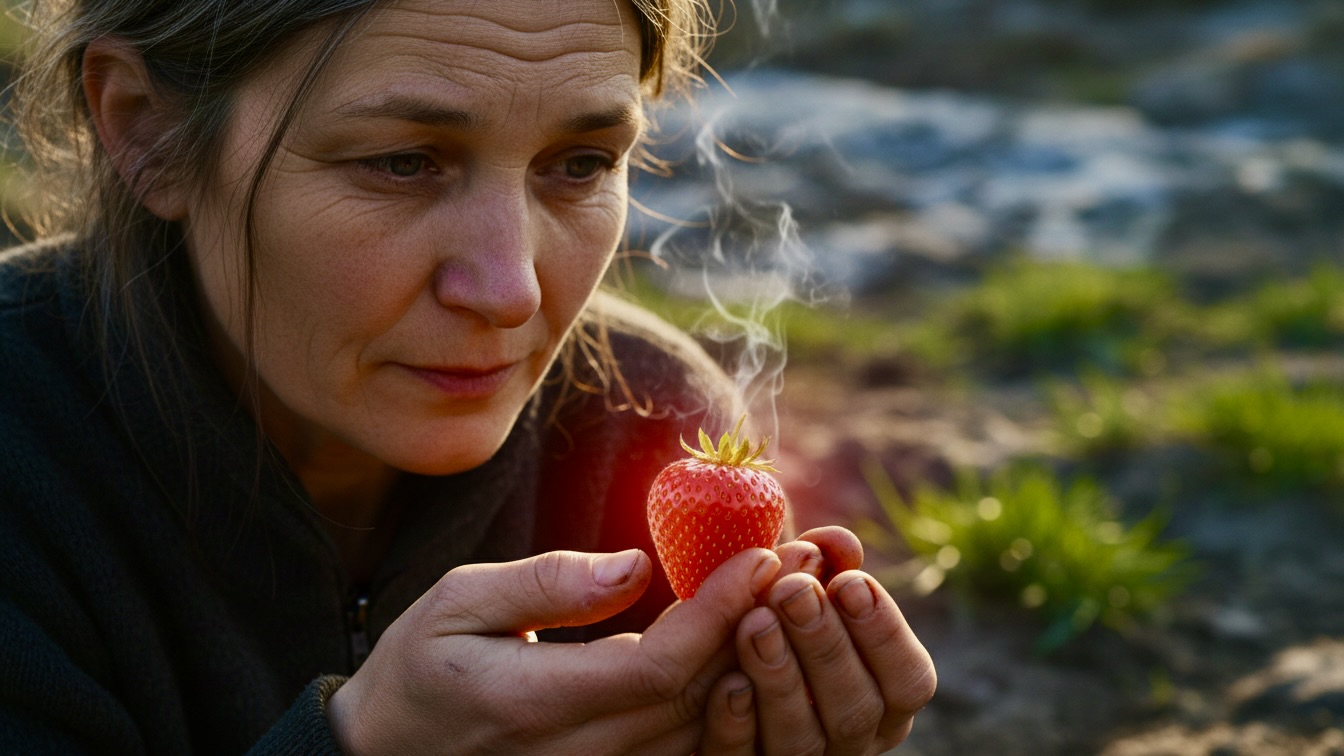
And in the middle of that pocket, sitting on a bed of fresh, damp soil, was a single strawberry.
It was huge. It was the color of a heart. It wasn't a glitch. It wasn't a recording. She could smell the sugar, the tartness, the life of it. It was steaming slightly in the cold air.
Olga reached out her hand. Her fingers were bleeding, the red of her blood matching the red of the fruit.
"Don't touch it," Miller whispered. He sounded terrified now. "That shouldn't be there. The physics... it doesn't work. That’s a physical manifestation of a memory. That’s impossible."
Olga didn't listen. She picked up the strawberry. It was hot. It felt like holding a small, beating heart.
"Leo," she breathed.
She looked at Miller. His face was pale, his tablet forgotten in the mud. The green footprints behind them were beginning to flicker, the grass turning back into gray slush as the data dissipated. The audio was fading, a long, dying hiss of static.
Olga looked back at the strawberry in her hand. She felt a strange, humming vibration traveling up her arm, settling into her chest. It wasn't junk code. It was a gift.
She took a bite.
The sweetness was violent. It was an explosion of summer, of sweat, of laughter, of a life she thought had been deleted. For a second, the gray garden vanished, replaced by a blinding, golden heat.
Then, the ground beneath her feet began to glow.
“Then, the ground beneath her feet began to glow.”


