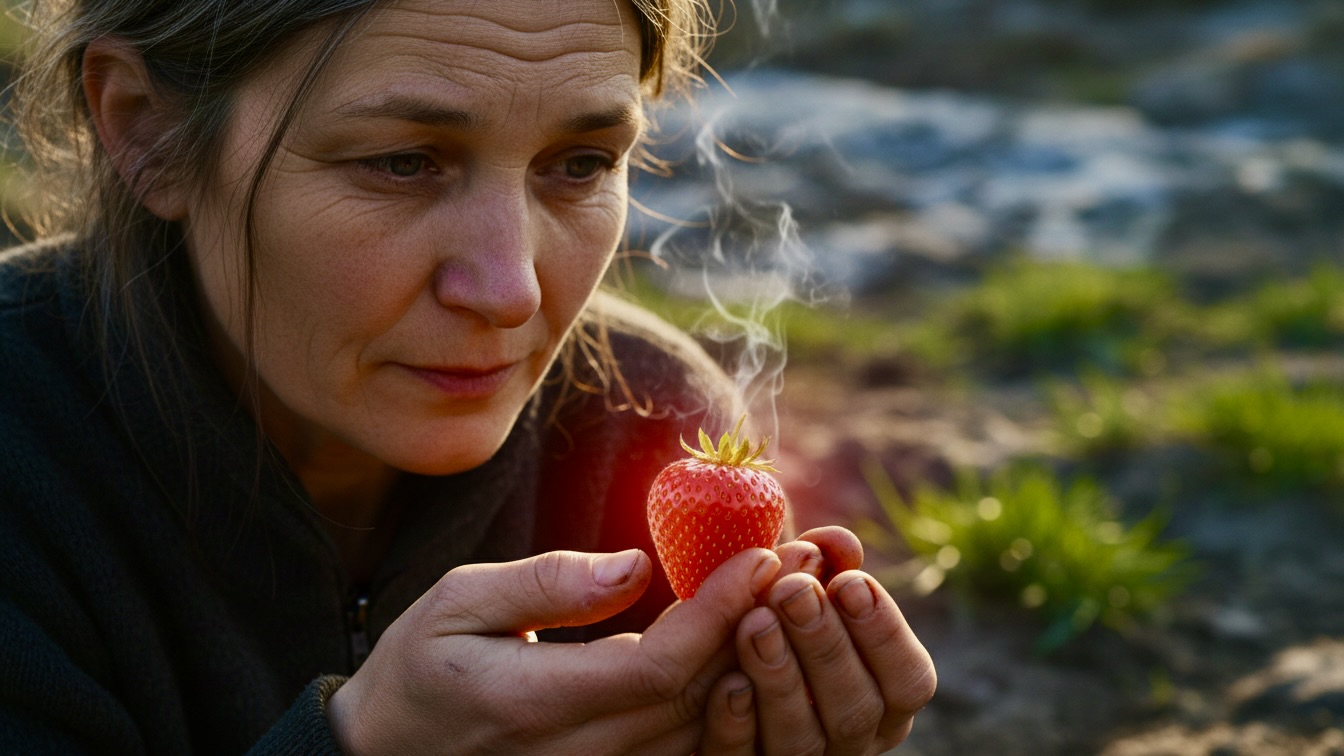
Olga, a survivor of a global climate catastrophe known as the Great Freeze, discovers a trail of vibrant green footprints in her otherwise desolate, gray garden. These prints are "glitch-tracks," temporal anomalies that recreate the movements and sounds of her deceased husband, Leo. Despite the warnings of a local official named Miller, who views these occurrences as dangerous "junk code," Olga follows the trail through the slush. The experience allows her to relive fragments of her past life, hearing Leo's voice and feeling the warmth of a world that no longer exists.
The journey leads her to a massive snowdrift where the temporal data culminates in a physical impossibility: a fresh, warm strawberry. Miller attempts to intervene, fearing the psychological and physical consequences of "temporal contamination," but Olga is driven by a desperate need for connection. She retrieves the fruit, which radiates the heat of a lost summer, and consumes it. This act of defiance triggers a massive sensory overload and a mysterious glowing reaction from the earth, suggesting a fundamental shift in the reality of her environment.
One of the most prominent themes in the narrative is the intersection of grief and technology. In this post-apocalyptic setting, memory is no longer a purely internal process; it has become externalized as "raw data" or "temporal leaks." The story explores how the bereaved might cling to these digital or physical echoes, even when they are dismissed as "junk code" by the authorities. For Olga, these glitches are not malfunctions but a lifeline to a more vibrant past.
The conflict between organic life and sterile bureaucracy is also central to the text. Miller represents the Council’s desire to categorize and control the remnants of the old world, viewing the temporal anomalies as hazards to be avoided. Olga, conversely, rejects the "ration bars" and "static" of her current existence in favor of the "violent sweetness" of a memory. This suggests that human emotional needs often override the practical concerns of survival and safety.
Resilience and the persistence of nature serve as a final major theme. The "Reverse Melt Path" indicates a world that is not merely thawing but is actively reasserting its previous states through localized anomalies. The strawberry, described as a "physical manifestation of a memory," blurs the line between what is real and what is remembered. It posits that the past is not truly gone but is waiting to be unearthed beneath the layers of "gray slush" that define the present.
Olga is a woman defined by her profound sense of loss and her refusal to accept the diminished reality of the post-Freeze world. Her internal state is one of weary stagnation, mirrored by the "dead mud" of her garden, until the appearance of the green footprints reignites her agency. She displays a reckless courage, prioritizing the emotional truth of her husband’s presence over her own physical safety. Her decision to eat the strawberry is the ultimate act of reclaiming her humanity in a world that has become a "funeral shroud."
Psychologically, Olga is experiencing a complex form of mourning where the boundaries between her internal memories and external reality have dissolved. She treats the "glitch-tracking" as a legitimate reunion rather than a dangerous hallucination. This suggests a mind that has reached its breaking point with the "gray" monotony of survival and is willing to risk "temporal contamination" for a single moment of genuine sensation. Her defiance of Miller shows her rejection of a society that prioritizes "junk code" over human connection.
Miller serves as the pragmatic foil to Olga’s emotional desperation. He is motivated by a combination of professional duty and a genuine, albeit detached, concern for Olga’s well-being. His reliance on his tablet and "official Council vest" highlights his role as a guardian of the new, sterile order. He views the world through the lens of "directives" and "exposure levels," revealing a psychological defense mechanism that uses technical jargon to distance himself from the tragedy of the Freeze.
Despite his bureaucratic exterior, Miller exhibits a subtle fear that hints at his own suppressed trauma. He is terrified by the physical manifestation of the strawberry because it defies the logical rules he relies on to stay sane. His character represents the segment of humanity that seeks to survive by ignoring the ghosts of the past. By labeling Leo’s voice as "trash data," he attempts to protect himself from the same overwhelming grief that consumes Olga.
The narrative voice utilizes a stark, sensory-rich prose that emphasizes the contrast between the "gray slush" of the present and the "neon" vibrancy of the past. The author employs vivid metaphors, such as the snow "retreating like a losing army," to establish a world that is hostile and exhausted. This creates a heavy, oppressive tone that makes the sudden appearance of the green grass feel like a profound intrusion of hope. The use of "low-fi crackle" and "white noise" to describe Leo’s voice adds a haunting, technological texture to the supernatural elements.
Pacing in the chapter is handled with a deliberate build-up of tension, starting with a quiet observation and escalating into a frantic physical confrontation. The transition from Olga’s slow, rhythmic steps into the footprints to her desperate digging in the snowdrift mirrors the rising stakes of her emotional journey. The dialogue between Olga and Miller provides a sharp, rhythmic counterpoint to the atmospheric descriptions, grounding the surreal events in a tense social conflict.
The sensory details are particularly effective in conveying the "temporal contamination" as a visceral experience. The author focuses on tactile and auditory sensations—the "humming" in Olga’s molars, the "sharp pain" behind her eyes, and the "violent sweetness" of the fruit. These descriptions bridge the gap between the digital metaphor of "junk code" and the physical reality of a living garden. The final image of the glowing ground leaves the reader with a sense of awe and uncertainty, signaling a shift from a story of mourning to one of potential transformation.


