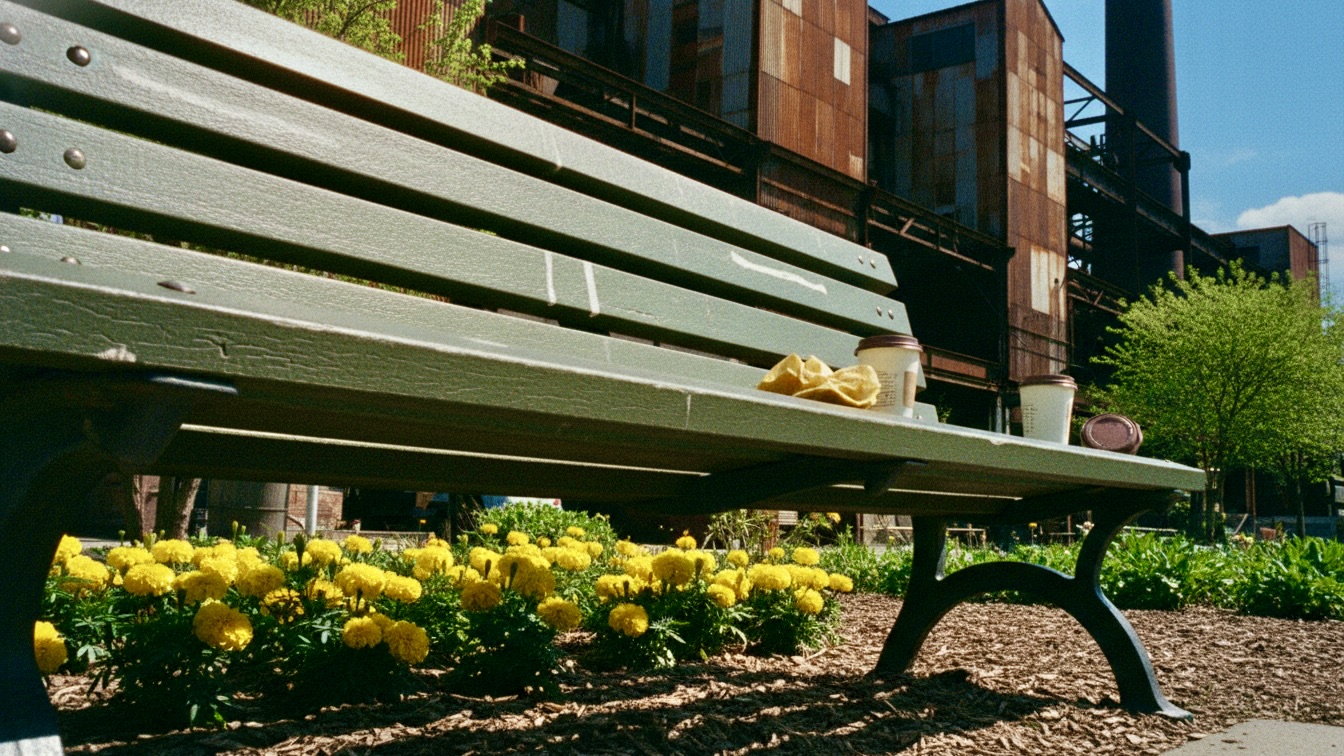
Larry and Sarah clash over urban development in a damp city park until a resident changes the political math.
The wind coming off the river tasted like wet metal. It was April in the city, the kind of spring that felt less like a rebirth and more like a messy cleanup. Larry Thomas sat on a bench made of recycled plastic slats. He felt the cold through his trousers. He checked his watch—a cheap digital one he wore to look grounded. Sarah Eastman was three minutes late. Larry didn't mind. It gave him time to look at the dirt.
The North End Greenery used to be a graveyard for industrial cooling units. Now, it was a grid of raised beds and thin saplings. The mulch was so fresh it smelled like a forest fire that had been put out an hour ago. It was heavy, damp, and thick. Every breath felt like swallowing a spoonful of earth. It was better than the diesel fumes that used to live here.
Sarah appeared at the edge of the gravel path. She wasn't walking; she was vibrating. She had her phone in one hand and a cardboard coffee carrier in the other. Her hair was pulled back so tight it looked painful. She wore a windbreaker that crinkled with every step. She stopped five feet away and stared at the dirt under Larry’s boots. She didn't say hello. She didn't offer him coffee. She just stood there, a vertical line of tension against the horizontal sprawl of the park.
"You're late," Larry said. He didn't look up. He was watching a beetle struggle with a wood chip.
"Traffic on the bridge," Sarah said. Her voice was flat. "You know it's a mess. You're the one who voted to delay the repairs."
"The budget was tight."
"The budget is always tight when it’s not a stadium."
She sat down on the far end of the bench. There was enough space between them for a third person, or at least a very large dog. She placed the coffee carrier between them. The steam rose in a straight line before the wind caught it and shredded it. Larry looked at the cups. He didn't take one. He knew the game. If he took the coffee, he owed her a favor. If he didn't, he was being rude. He chose to be rude.
"The Green Roofs mandate," Larry said. "Let's do it."
"You're killing the district, Larry," she said. She finally looked at him. Her eyes were tired. There were faint dark circles under them, the kind you get from staring at spreadsheets until three in the morning. "The developers are circling. They’ve got the blueprints ready. Three-thousand-dollar studios. No parking. No soul."
"It’s growth, Sarah. This place was a crater five years ago."
"It was a neighborhood. People lived here."
"People lived in squalor. The tax base was zero. We couldn't afford to pick up the trash, let alone plant these marigolds."
He gestured to the yellow flowers nearby. They looked small and vulnerable in the gray light. The spring sun was trying to break through the clouds, but it wasn't winning. The light was flat and clinical. It made everything look like a crime scene photo.
"You’re a shill," she said. It wasn't an insult; it was a diagnosis. "How much did they give you? Or was it just the promise of a seat on the board after you lose the next election?"
Larry felt his jaw tighten. He looked at his hands. They were clean, too clean. He missed the days when he worked at the garage, when his cuticles were permanently stained with oil. Now he just moved numbers from one column to another. He felt the weight of the city on his chest, a physical pressure that made it hard to take a full breath. The air in the park was supposed to be better, but it felt thin.
"If we don't give them the tax breaks, they walk," Larry said. "They go to the suburbs. They build another strip mall. Then this lot stays a lot. The weeds come back. The needles come back. Is that what you want? A monument to your purity?"
"I want people to have a roof over their heads without being priced out of their own lives."
"The Green Roofs mandate makes the build more expensive. That cost goes to the tenant. You're the one raising the rent, Sarah. Not me."
She laughed. It was a short, dry sound. "Logic is a weapon in your hands, isn't it? You twist it until it breaks."
They sat in silence for a minute. A truck rumbled by on the street behind them, its engine a low-frequency vibration that rattled the bench. A plastic bag caught on a branch of a nearby sapling and flapped like a dying bird. Larry watched it. He wanted to get up and tear it down, but he didn't want to show Sarah he cared about the aesthetics of the place. He had to be the pragmatist. That was his brand.
Sarah took a sip of her coffee. It was black. She didn't use sugar. She didn't believe in masking the bitterness of things. She looked out over the garden beds. A few blocks away, the skeletons of new condos rose into the sky, cranes perched on top like giant insects. They were building a new world on top of the old one, and the old one wasn't going quietly.
"The 4th Street project," she said. "Thirty percent."
"Ten," Larry countered. "And that’s pushing it."
"The median income here is twenty-two thousand. Ten percent of low-income units won't even cover the people we displaced to build the park."
"Twenty-two thousand is the old number. It's climbing."
"Because the poor people are leaving, Larry. That's how the average goes up. It’s a trick."
"It’s math."
"It’s a lie told with numbers."
Larry felt the claustrophobia returning. The park, which was supposed to be an open space, felt like a box. The buildings around it were the walls. The sky was the lid. He felt the urge to stand up and run, to go somewhere where the air didn't smell like politics and damp wood. He looked at Sarah. She was clutching her coffee cup like it was a lifeline. She was just as trapped as he was.
Then, an old woman walked toward them. She wore a thick wool coat that had seen better decades and a bright purple hat. She was carrying a small plastic trowel. She stopped by the marigolds, her knees creaking as she bent down to inspect them. She didn't seem to notice the two people arguing on the bench. Or if she did, she didn't care. She reached out and touched a leaf with a gnarled finger.
"Beautiful, aren't they?" she said. She didn't look at them.
Larry blinked. "Excuse me?"
"The flowers," the woman said. She looked up. Her face was a map of deep lines and sunspots. She smiled, and for a second, the gray light seemed to soften. "I live in the brick building on the corner. Third floor. I used to look out my window and see broken glass. Now I see these. Thank you."
She didn't wait for an answer. She stood up, patted the dirt around the flower, and continued her walk. She disappeared behind a row of hedges, leaving a silence that felt different than the one before. It wasn't the silence of a standoff. It was the silence of a reset.
Larry felt a sudden shift in his chest. It was like a heavy door had been unlatched. The air felt colder, sharper, but clearer. He could see the individual veins in the leaves of the saplings. He could hear the distant whistle of a train. The claustrophobia vanished, replaced by a strange, vibrating clarity. The woman wasn't a voter to him in that moment. She wasn't a statistic. She was just a person who liked the flowers.
Sarah was looking at the spot where the woman had been. Her posture had slumped. The tension in her shoulders had leaked out. She looked younger, more vulnerable. She set her coffee cup down on the bench.
"She's in 402," Sarah whispered. "Mrs. Gable. She’s been there forty years."
"I know the building," Larry said. "It needs a new boiler."
"It needs more than that."
Larry reached into his pocket. He didn't have any paper. He found a napkin from a fast-food place he'd visited earlier. It was crumpled and had a small yellow mustard stain in the corner. He smoothed it out on his knee. He took a pen from his jacket pocket—a heavy, metal pen that felt solid in his hand.
"Thirty percent," Larry said. He didn't look at her.
Sarah turned. "What?"
"Thirty percent low-income. Guaranteed. For the life of the building. Not just the first ten years."
Sarah stared at him. She looked for the catch. She looked for the irony. She found nothing but the mustard-stained napkin and the scratch of his pen.
"The developers will scream," she said.
"Let them scream. I'll tell them we'll fast-track the permits for the East End project if they swallow this. They’ll grumble, but they’ll take it. They want the dirt moving before the interest rates spike."
He wrote it down. 4th Street Project: 30% Affordable/Low-Income. Perpetual. He signed his name at the bottom in messy, jagged letters. He handed the pen and the napkin to her.
Sarah took the pen. Her hand was shaking slightly. She looked at the napkin, then at Larry. The skepticism was still there, tucked away in the corners of her mouth, but the fire had gone out of her eyes. She signed her name next to his. The ink bled into the soft paper, making the letters look thick and permanent.
"This isn't enough," she said, handing it back.
"I know," Larry said. "But it’s thirty percent more than we had ten minutes ago."
He took the napkin and looked at it. It was a pathetic document. A piece of trash with a mustard stain. But it was the most real thing he’d touched in months. He felt a sense of oxygen returning to his lungs, a physical lifting of the weight. The park didn't feel like a box anymore. It felt like a start.
He stood up. The wind caught his jacket, billowing it out behind him. He felt the cold, but it didn't bother him. It felt like a reminder that he was alive.
"You want that coffee?" Sarah asked. She was looking at the carrier.
Larry looked at the cups. He thought about the debt, the rudeness, and the politics. Then he thought about the cold. He reached down and took a cup. The cardboard was warm against his palm.
"Yeah," he said. "I do."
He took a sip. It was bitter, cheap, and exactly what he needed. He started walking toward the exit, the gravel crunching under his boots. He didn't look back to see if she was following. He just watched the light hit the river, the gray clouds finally breaking to reveal a sliver of bright, unapologetic blue.
He reached the gate and paused. He looked back at the greenery. The marigolds were still there, small and bright against the dark mulch. He felt the napkin in his pocket, a small lump of paper that felt heavier than it should. The city was still a mess. The budget was still broken. But for a second, the air was easy to breathe.
Larry walked out onto the sidewalk. The noise of the city rushed in to meet him—the horns, the sirens, the shouting. It was loud and chaotic, but it didn't feel like static anymore. It felt like a pulse. He checked his phone. No notifications. No emails. Just the time. It was late afternoon. The sun was finally out, casting long, sharp shadows across the cracked pavement. He felt a sudden, sharp pang of something he couldn't name. It wasn't happiness. It was just a lack of the usual dread.
He looked at his hands again. They were still clean. He thought about the boiler in Mrs. Gable’s building. He thought about the interest rates. He thought about the napkin.
He took a deep breath, the cold spring air filling his lungs until it hurt.
“Larry folded the napkin and put it in his pocket.”


