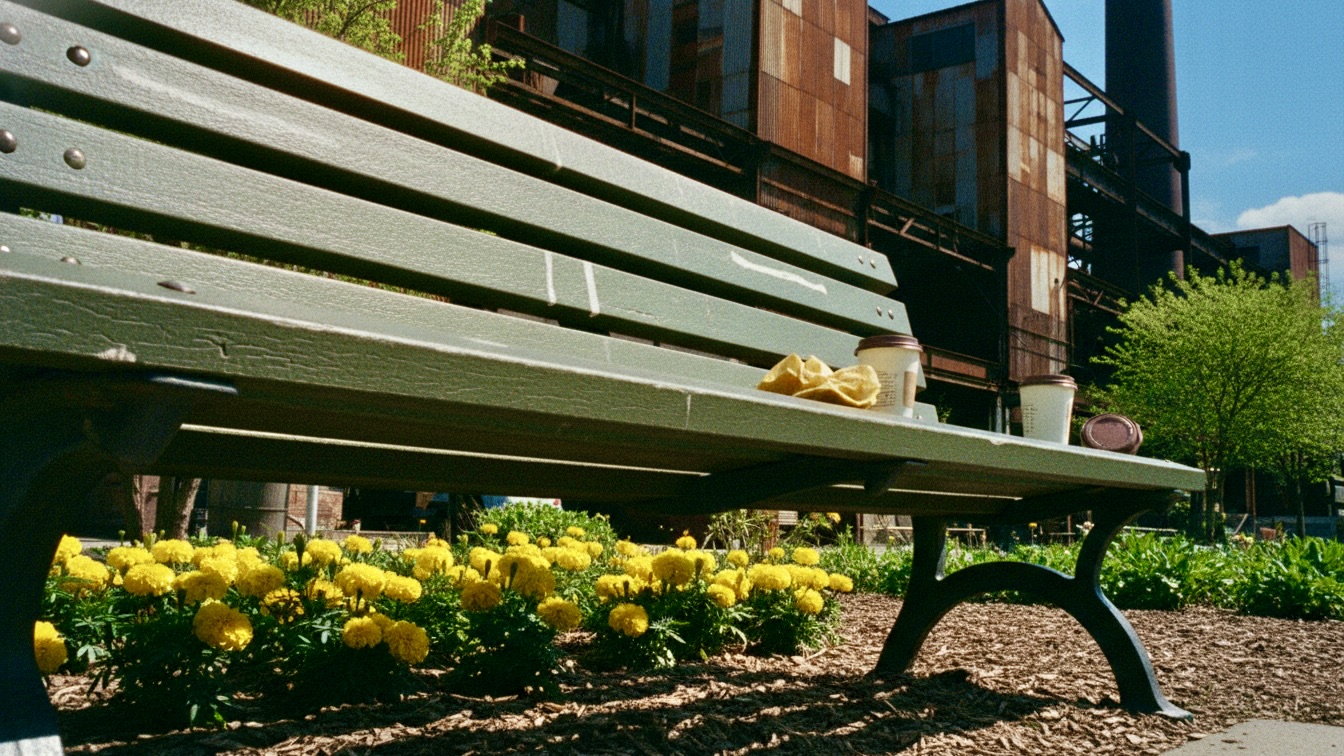
The narrative unfolds in the North End Greenery, a reclaimed industrial site turned urban park, where two city officials, Larry Thomas and Sarah Eastman, meet to negotiate the future of local development. Larry, a pragmatic and somewhat cynical figure, faces off against Sarah, a tense and weary advocate for the neighborhood's original residents. Their conversation is a sharp exchange of political bartering, centered on the Green Roofs mandate and the percentage of affordable housing in the upcoming 4th Street project.
The stalemate is broken by the unexpected arrival of Mrs. Gable, an elderly resident who expresses simple, profound gratitude for the flowers in the park. This brief human interaction pierces the bureaucratic fog surrounding Larry and Sarah, forcing a shift in perspective. Moved by the tangible impact of his work on a single life, Larry abandons his rigid pragmatism. He signs a commitment to thirty percent affordable housing on a discarded, mustard-stained napkin, signaling a rare moment of genuine political compromise and personal redemption.
The story explores the tension between urban renewal and social displacement, framed as a conflict between cold mathematics and human reality. Larry views the city through the lens of tax bases and growth, while Sarah sees the loss of soul and the erasure of the poor. This dichotomy is represented by the park itself, which is built on the ruins of industry; it is a "messy cleanup" that attempts to mask the "diesel fumes" of the past with fresh mulch and saplings.
Another central theme is the psychological weight of bureaucracy and the yearning for authentic labor. Larry’s nostalgia for his days as a mechanic, where his hands were "permanently stained with oil," highlights his current alienation. He feels the "weight of the city" as a physical pressure, suggesting that the abstraction of modern governance leads to a kind of spiritual suffocation. The clean hands he now possesses are a symbol of his distance from the actual consequences of his decisions.
The narrative also examines the power of the individual to disrupt systemic cynicism. Mrs. Gable serves as a catalyst for "the silence of a reset," proving that a single voice of gratitude can be more influential than hours of debate. Her presence transforms the park from a "box" or a "crime scene" into a living space. This shift allows the characters to move beyond their "brands"—the pragmatist and the idealist—to find a middle ground that serves the community's actual needs.
Larry Thomas is a man trapped between his blue-collar roots and his current identity as a political "shill." He wears a cheap digital watch as a performative gesture of being grounded, yet he suffers from a profound sense of psychological claustrophobia. His internal state is characterized by a feeling of thin air and a heavy chest, reflecting the moral burden of his compromises. He uses logic as a defensive shield, convincing himself that his cynicism is merely a necessary form of pragmatism.
The encounter with Mrs. Gable triggers a somatic shift in Larry, unlatching a "heavy door" in his chest. This moment of clarity allows him to see the city not as a spreadsheet, but as a collection of individuals like the woman in 402. His decision to sign the napkin is an act of rebellion against his own established "brand." By choosing to ignore the inevitable "screams" of developers, he reclaims a sense of agency and breathes "easy" for the first time in months.
Sarah Eastman is introduced as a woman on the verge of a nervous breakdown, described as "vibrating" with tension. Her physical appearance—hair pulled back painfully tight and tired eyes—betrays the high cost of her advocacy. She views Larry with a mixture of resentment and pity, diagnosing his political evolution as a loss of integrity. For Sarah, the city's transformation is not a success story but a "trick" played with numbers to hide the displacement of the vulnerable.
Despite her outward hostility, Sarah is just as "trapped" as Larry in the political machinery of the city. When the tension leaks out of her shoulders following Mrs. Gable's intervention, she is revealed to be deeply connected to the people she represents, knowing even the apartment numbers of her constituents. Her shaking hand as she signs the napkin indicates that while she is skeptical, she is still capable of hope. She accepts the imperfect compromise, recognizing that a mustard-stained victory is better than a pure defeat.
Mrs. Gable functions as the story’s moral anchor and psychological disruptor. She is described through her physical age and her connection to the "brick building on the corner," grounding her in the history of the neighborhood. Unlike Larry and Sarah, who are focused on blueprints and budgets, she focuses on the sensory beauty of the marigolds. Her presence is a reminder of the "old world" that Sarah fears is being built over and forgotten.
Her role is not to argue, but to witness. By thanking the officials for the flowers, she inadvertently validates the positive potential of their work, moving the conversation from the abstract to the personal. She does not care about the political standoff; she cares about the view from her third-floor window. This indifference to their power dynamics is exactly what allows her to break their deadlock, providing the "reset" necessary for genuine connection.
The narrative voice is marked by a gritty, industrial lyricism that mirrors the setting of the North End Greenery. Phrases like "the wind... tasted like wet metal" and mulch smelling like a "forest fire that had been put out an hour ago" create a sensory environment that is both vivid and oppressive. The author uses these details to establish a tone of urban melancholy. The transition from the "flat and clinical" light to a "sliver of bright, unapologetic blue" mirrors the protagonist's internal emotional arc.
Pacing is handled through the rhythm of the dialogue, which is sharp, cynical, and fast-paced during the negotiation. This creates a sense of friction between Larry and Sarah, emphasizing their ideological distance. The pace slows down significantly when Mrs. Gable enters the frame, allowing the reader to feel the "silence of a reset." This contrast highlights the importance of the moment, shifting the story from a political drama into a more contemplative character study.
The use of symbolism is particularly effective, especially the mustard-stained napkin and the "skeletons of new condos." The napkin represents a rejection of the polished, soul-less world of corporate development in favor of something messy but "real." The cranes described as "giant insects" reinforce the theme of a predatory urban expansion. These stylistic choices serve to deepen the psychological landscape, making the city itself feel like a character that is struggling to breathe alongside its inhabitants.


