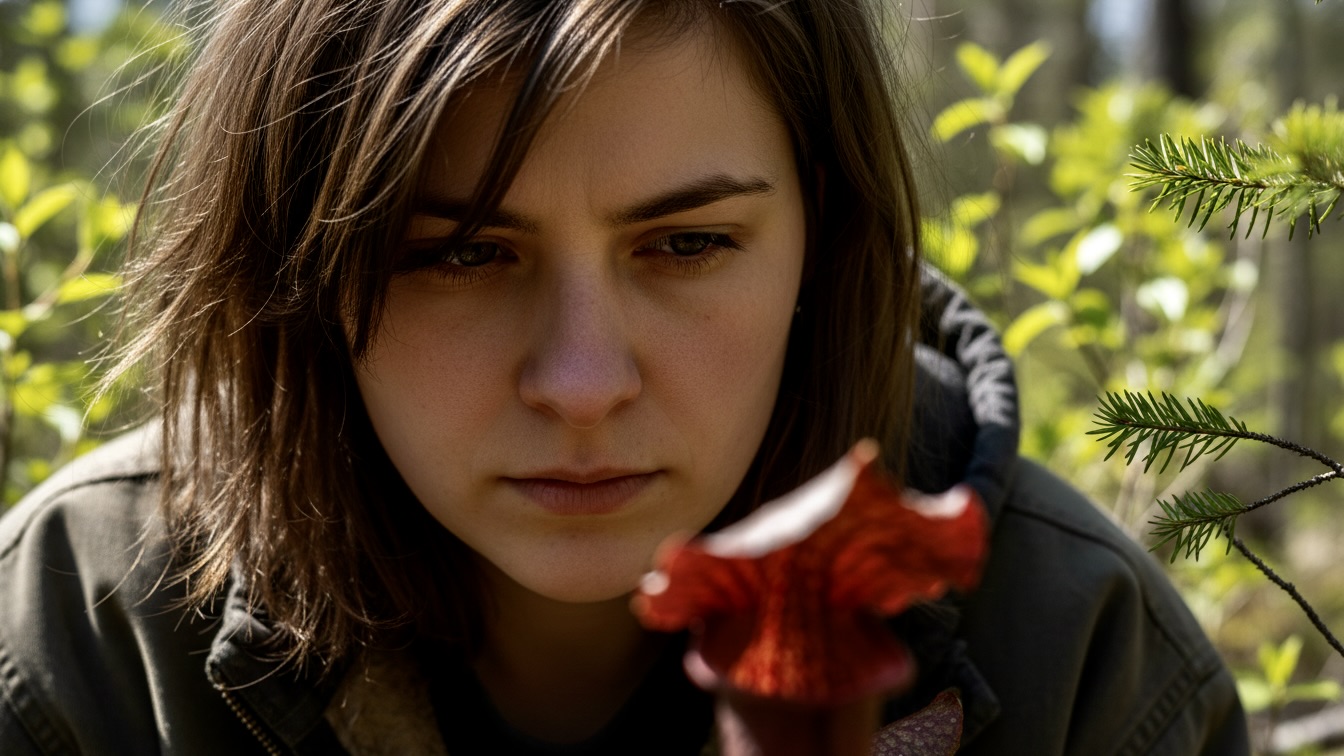
Stan panics in a northern bog until Renee finds a carnivorous plant that changes his perspective on survival.
"Don't move. Just—stop moving for a second, Stan. You're making it worse."
"It’s eating my boots, Renee. It’s literally eating them. I can feel the vacuum. It’s like the ground is a mouth."
Stan’s voice was thin, vibrating at a frequency that usually preceded a total system crash. He stood mid-stride, his left hiking boot submerged past the ankle in a soup of neon-green sphagnum moss and black, brackish water. The bog wasn't a solid thing. It was a suggestion of land, a precarious crust floating over a secret lake of prehistoric rot. Around them, the black spruce trees were stunted and twisted, looking like skeletal fingers reaching out of the muck to grab something that was already dead.
"It’s not eating you," Renee said. She didn't look up from her camera. She was crouched on a slightly firmer hummock of reindeer lichen, her knees clicking as she adjusted her position. "It’s just displaced water. Displacement, Stan. Physics. Not a monster."
"Tell that to the bog bodies," Stan hissed. He wiped sweat from his forehead with the back of a hand that wouldn't stop shaking. The spring air was deceptive. It was barely fifty degrees, but the humidity in the swamp felt like a wet wool blanket thrown over his face. "They find people in these things thousands of years later. Perfectly preserved. Leather skin. No souls. That’s going to be me. I’m going to be a museum exhibit for people in the year 4000 to judge my fit."
"At least you're wearing the good Gore-Tex today," Renee muttered. She clicked the shutter. The sound was a sharp, mechanical punctuation in the heavy silence of the swamp.
Spring in Thunder Bay wasn't like the postcards. It wasn't cherry blossoms and gentle breezes. It was a violent, muddy upheaval. The permafrost was retreating, leaving behind a landscape that felt unanchored. Everything smelled like wet iron and old basements. The black flies hadn't hit their full, murderous peak yet, but a few early scouts were already buzzing around Stan’s ears, their drones sounding like miniature chainsaws.
"Renee, seriously. We are lost. The trail markers stopped being a thing like twenty minutes ago. We’re just drifting into a glitch in the map."
"We aren't lost. We're just off-script," she replied. She finally stood up, her joints protesting. She was wearing a faded Carhartt jacket covered in patches and jeans that had more mud on them than denim. She looked at Stan, her expression a mix of pity and clinical interest. "Look at your feet. You aren't sinking anymore. The pressure equalized. You’re just standing in a puddle, man. Get a grip."
Stan looked down. The moss had stopped its hungry gurgle. He was still stuck, but the slow-motion descent had paused. He took a shaky breath, his lungs feeling tight, like they were being squeezed by the same vacuum holding his boot. "I hate this. I hate the north. Why do we live where the ground tries to swallow you?"
"Because the city is worse," Renee said simply. She stepped across a gap of open water, her movements practiced and light. She didn't walk so much as she floated across the high points of the roots. She stopped a few feet away, near a cluster of low-lying vegetation that looked out of place against the drab browns and sickly greens of the bog. "Hey. Come here. Carefully. Step on the woody bits, not the fluff."
"Why? Is it a snake? Please tell me it’s not a snake."
"It’s better than a snake. It’s a Northern Pitcher Plant. Sarracenia purpurea. They’re peak aesthetic."
Stan groaned but started to move. He pulled his left foot out with a wet, flatulent sound that made him shudder. He navigated the distance between them like he was walking across a minefield, his arms out for balance. When he reached her, he looked down at what she was pointing at.
Nestled in a bed of damp moss was a cluster of tubular leaves, deep maroon and veined with a color that looked uncomfortably like dried blood. They were shaped like narrow jugs, their mouths open to the sky, fringed with fine, downward-pointing hairs. Inside the tubes, he could see a dark, stagnant liquid.
"It looks like a prop from a low-budget body horror movie," Stan said, leaning in despite himself.
"It’s a death trap," Renee said, her voice dropping into a tone of genuine respect. "The low-key genius of the swamp. You see how the red is so intense? It’s a lure. Insects think it’s meat or nectar. They land on the rim, and these tiny hairs—see them?—they all point down. It’s like a one-way slide. They lose their footing and fall into that soup at the bottom."
Stan peered into one of the pitchers. A half-dissolved beetle floated on the surface of the rainwater and digestive enzymes. "That’s grim, Renee. That’s actually disgusting."
"Is it?" Renee pulled her phone out to check the light levels, though she knew the answer. "Think about where we are. This soil has zero nitrogen. It’s acidic. It’s garbage. Most plants would just die here. They’d just give up and turn into peat. But this thing? It decided that if the ground wouldn't feed it, it would just start eating the things that fly over it. It turned a lack of resources into a hunting license."
Stan watched a small fly hover near the rim of a pitcher. The fly landed, its legs twitching as it tasted the deceptive sweetness on the lip of the plant. It took one step too far and vanished into the tube. There was no splash. Just a disappearance.
"It’s a predator," Stan whispered. "A literal plant predator."
"It’s a survival strategy," Renee corrected. "It’s weird. It’s ugly to some people. It looks like a mistake. But it’s the only thing out here that’s actually winning. It doesn't care that the bog is trying to starve it. It just changed the rules of the game."
Stan ran a finger along the smooth, waxy exterior of a pitcher. It felt cold and surprisingly firm. He thought about his own panic—the way he felt like he was being erased by the scale of the wilderness, the way his brain always defaulted to 'victim' whenever things got uncomfortable.
"You're saying I should start eating bugs?" he asked, a small, jagged piece of his humor returning.
"I’m saying you should stop acting like the bog is a monster and start acting like you belong in it," Renee said. She stood up and adjusted her camera strap. "You’re so worried about being swallowed by the past or the mud or whatever metaphor you’re spiraling into today. But look at this thing. It’s thriving in the rot. It’s using the dead stuff to make new leaves. That’s the vibe, Stan. That’s the only way to stay sane in 2026."
Stan looked around. The swamp didn't look different, but the silence felt less like a threat and more like a void waiting to be filled. The stunted trees weren't grabbing at him; they were just holding on, same as him. He wiped his muddy palms on his pants and stood up straight.
"Okay. Low-key genius. I get it."
"Good. Now, look over there," Renee pointed past a stand of dead tamarack. "See that flash of neon orange? On the trunk?"
Stan squinted. About fifty yards away, a strip of plastic flagging tape fluttered in the breeze. It was a trail marker. It had been there the whole time, obscured by a shift in the light and his own blurred vision.
"How did I miss that?" he asked, his voice steadying.
"You were looking for monsters," Renee said, stepping off toward the marker. "I was looking for the red."
They hiked in silence for a while, the ground becoming firmer as they moved toward a ridge of granite. The transition from the bog to the shield rock felt like stepping out of a dream and back into reality. The air thinned out, the smell of rot replaced by the sharp, clean scent of pine needles and sun-warmed stone.
Stan felt the adrenaline receding, leaving a hollow, tired ache in its wake. He kept thinking about the pitcher plant—the way it sat there, silent and hungry, turning its environment into an advantage. He realized his phone had been buzzing in his pocket for the last ten minutes. He pulled it out. No service. Just a string of missed notifications from apps he didn't remember downloading, ghosts from a world that felt a million miles away from the maroon jugs in the moss.
"We’re almost to the lookout," Renee called back. She was moving faster now, her energy returning as the terrain leveled out. "If the clouds stay broken, we can see the Sleeping Giant from the top."
"Wait up," Stan said. He jogged to catch her, his boots heavy with dried mud. He felt a strange sort of kinship with the muck now. It was on him. It was part of the day's data.
As they reached the edge of the granite plateau, the view opened up. The vastness of Lake Superior stretched out before them, a sheet of hammered silver under the pale spring sun. The horizon was blurred, the water and sky merging into a single, infinite gray. It was beautiful, but it was also crushing. It reminded him how small they were.
"Beautiful, right?" Renee asked, her face illuminated by the harsh, flat light.
"It’s a lot," Stan said. He stepped closer to the edge, looking down at the forest canopy below. The trees looked like moss from this height, a green carpet covering the jagged bones of the earth.
Then he saw it.
At the very edge of the treeline, where the forest met the rock, there was a patch of movement. It wasn't the wind. It was too heavy, too deliberate. Something large and dark was moving through the brush, heading in the same direction they had just come from. It didn't look like a bear. It didn't look like a moose. It moved with a fluid, low-slung gait that seemed to ignore the resistance of the branches.
"Renee," Stan whispered, his heart doing that familiar, frantic knock against his ribs.
"Yeah?"
"Don't look yet. But... did you see that?"
She turned her head slowly, her eyes scanning the treeline. The movement stopped. The woods went perfectly, unnaturally silent. Even the black flies seemed to vanish.
In the sudden quiet, a sound rose from the shadows below—a wet, slurping noise, like a heavy boot being pulled from deep mud, followed by a low, rhythmic clicking that sounded exactly like the hairs of a pitcher plant snapping into place.
"Stan," Renee said, her voice losing its cool, ironic edge for the first time. "We need to keep moving. Right now."
They didn't look back, but the sound of the clicking followed them, growing louder as the sun began to dip behind the pines, casting long, hungry shadows across the stone.
“The sound of the clicking followed them, growing louder as the sun began to dip behind the pines, casting long, hungry shadows across the stone.”


