Fifty-six years old, and I am sifting through municipal garbage to satisfy a community service credit.
Fifty-six years old, and I am sifting through municipal garbage. This is what 'Applied Community Psychology 301' looks like in practice. They do not tell you that in the course catalog. The brochure shows diverse, smiling adults sitting in a circle on folding chairs, talking about their feelings. The brochure is a lie. The reality is me, standing in a dirt lot behind the municipal recreation center, sweating through a linen blouse, staring at a wooden pallet bin full of decomposing cantaloupe.
Spring in the valley is not a gentle rebirth. It is an assault. It is aggressive and hot. Pollen coats the windshields of the cars in the parking lot in a thick, sulfurous yellow dust. The air smells like wet pavement and blooming jasmine, undercut by the sharp, sour reek of rotting vegetables. My head throbs. The base of my skull feels tight. I press my thumb into my temple, trying to massage the tension away. It does not work.
I check my watch. Seven in the morning. I am here for a grade. I retired from accounting two years ago to understand the human mind, to figure out why my marriages failed and why my adult children only text me on major holidays. I wanted clinical answers. Instead, I am standing in front of a compost heap, waiting for a man named Toby.
I hear him before I see him. He is whistling.
Nobody over the age of ten should whistle in public. It is a sign of mild sociopathy. I turn around. Toby is walking across the asphalt. He wears a canvas bucket hat with a chin strap. He has khaki shorts that end above his knees, exposing pale, hairy legs leading down to hiking boots. He is easily sixty, maybe sixty-five, but he bounces on the balls of his feet. He has the relentless, terrifying energy of a golden retriever that has been locked in a house all day.
He claps his hands together. Dirt puffs from his leather gardening gloves.
"Morning, team."
I look around the empty lot. "It is just me."
"A team of two is a team, Renee."
My jaw clenches. The sound of my own name in his mouth sounds too familiar. We met once, briefly, during the orientation seminar. I do not want to be a team. I want my three credits.
"Are we turning the pile or not," I ask. I point at the wooden slats containing the mound of brown and green sludge.
"We are building the pile," Toby says. He walks past me and pats the wooden frame of the compost bin as if it were a good horse. "Lasagna method. Layers. Greens and browns. Nitrogen and carbon. It is all about balance. Just like life."
I stare at him. "Do not do that."
"Do what?"
"Make heavy-handed metaphors about garbage. It is just garbage, Toby."
He smiles. It is a wide, unbothered smile. The corners of his eyes crinkle behind his wire-rimmed glasses. "Nothing is just garbage, Renee. It is future soil. It is potential."
My stomach turns over. The sheer force of his optimism is physically nauseating. I grab a pair of heavy work gloves from the plastic tote on the ground. They are stiff and smell like old sweat. I pull them on. They are too big. My fingers swim in the canvas tips.
"What do I do."
"Grab a bucket," he says. He points to a row of white five-gallon buckets lined up against the chain-link fence. "Local coffee shop donated their grounds. The diner gave us their kitchen scraps. We sort it, we dump it, we mix it with the dry leaves."
I walk to the buckets. I pry the lid off the first one. A cloud of fruit flies erupts into the hot morning air. I step back, swatting at my face. The smell hits me a second later. It is sweet and rank. Fermenting strawberries, coffee grounds, and something that looks like congealed oatmeal.
"This is a health hazard," I say.
"It is nature," Toby calls out. He is already using a rusted pitchfork to move a pile of dead brown leaves into the bottom of the wooden bin. "Nature is messy."
I drag the heavy bucket toward the bin. My lower back twinges. I am fifty-six. My lumbar spine is a precarious stack of worn cartilage. I bend my knees, trying to remember the ergonomics poster from my old accounting firm. I heave the bucket up and dump the contents over the leaves. A wet, slapping sound echoes in the bin.
"Good," Toby says. "Now spread it out."
I use my gloved hands to flatten the pile of wet coffee grounds and rotting fruit. My knuckles brush against something slick. A half-eaten banana peel. I grimace. I can feel the heat radiating from the center of the pile. The decomposition process is literally cooking the garbage. It is fascinating in a clinical way, but disgusting in a tactile way.
"You are holding your breath," Toby says.
I exhale sharply. "I am breathing."
"You are breathing shallow. From your chest. You are tense."
I stop spreading the sludge. I look at him. He is leaning on his pitchfork, watching me.
"I am tense because it is ninety degrees, the air is thick with pollen, and I am touching other people's discarded breakfasts."
"You are tense because you hate being a beginner," he says cheerfully. "A lot of folks our age do. We spend decades building careers, becoming experts. Then we retire, and suddenly we do not know how to do anything. It is scary."
My face flushes. Not from the heat. From the audacity. "I am getting a degree in psychology, Toby. Do not psychoanalyze me."
"Just making conversation."
"Make different conversation."
He shrugs. He turns his attention to a smaller plastic bin sitting on a folding table. He pops the lid off. "Come look at this."
I wipe my forearm across my forehead. The linen shirt is sticking to my spine. I walk over to the table. I look inside the plastic bin. It is full of dark, rich soil. It looks completely different from the rotting mess in the wooden pallets.
"Worm castings," Toby says. His voice drops an octave. It takes on a tone of religious reverence. "Black gold."
I look closer. The soil is shifting. Tiny, red worms are writhing through the dirt. Hundreds of them. The mass of them moving together makes a faint, wet sound.
"They eat the scraps," Toby explains. He reaches into the bin with his bare hands. He scoops up a handful of dirt and worms. He holds it out to me. "They process the rot, and they turn it into the most nutrient-dense fertilizer on the planet. They do the work nobody else wants to do."
I look at his hands. The dirt is packed under his fingernails. A worm hangs over the side of his palm, twisting in the air.
"Put them back," I say.
"Touch the soil, Renee. It is cool. It regulates its own temperature."
"I do not want to touch the worms, Toby."
He smiles again. That same, patient, infuriating smile. "You are afraid of the process."
Something in my chest snaps. The heat, the smell, the flies, the condescension. It all crystalizes into a sharp, clear point of anger. I step back from the table. I look him up and down.
"Okay," I say. My voice is flat. "Let us talk about the process. Let us talk about you."
He blinks. The smile falters slightly. "Me?"
"You. You are obsessed with this garden. You are out here at seven in the morning in a bucket hat, talking to worms. You treat this compost heap like it is a cathedral."
"It is important work."
"It is garbage," I say, stepping closer. "And you are holding onto it because you have a textbook savior complex. You need something broken to fix. You need something helpless that relies entirely on you. The worms cannot leave you, Toby. The compost cannot file for divorce."
His hands freeze. The worms continue to twist in his palm.
"You project all this unearned optimism onto rotting food because you cannot control whatever is actually rotting in your real life," I say. The words come out fast. They are sharp and cruel, but I cannot stop them. "You are saving soil because you could not save something else. A marriage. A career. A child. I do not know. But I know a compensatory mechanism when I see one. You are avoiding reality by burying your hands in the dirt."
Silence falls over the lot. The only sound is the distant hum of traffic on the interstate. Toby looks down at his hands. He slowly lowers them back into the plastic bin. He brushes the dirt off his palms. He does not look at me.
My heart pounds. A cold spike of regret hits the back of my throat. I went too far. I know I went too far. This is why I have no friends in the program. I use the textbook as a weapon.
"Toby. I-"
"Grab the pitchfork," he says.
His voice is different. The golden retriever energy is gone. It is flat. It is heavy.
"Toby, look, I am hot, I am tired-"
"Grab the pitchfork, Renee."
I walk over and pick up the rusted tool. The wood handle is rough.
"We need to turn the main pile," he says. He walks over to the large wooden bin. He grabs a heavy iron shovel. "It has to be aerated. If it sits too long without oxygen, it goes anaerobic. It starts to stink. It turns toxic."
He jams the shovel into the mound. He leans his weight on the handle. He pries up a massive chunk of steaming, black sludge. He flips it over. The smell hits us both. It is worse than before. It smells like a wet grave.
"Dig," he says.
I jam the pitchfork into the pile. I pull back. The mass is incredibly heavy. Wet leaves, compacted coffee grounds, unrecognizable grey matter. I heave it upward and turn it over. My shoulder joint pops.
"You think you have me figured out," Toby says. He does not look at me. He just keeps shoveling.
"I am a psychology major," I say, breathless. "It is an occupational hazard."
"You are a retired accountant who read a few books," he says. He slams the shovel down again. "You want to play the diagnosis game? Fine. Let us play."
I stop. I look at him. His jaw is tight. The bucket hat suddenly does not look funny anymore. It just looks sad.
"You are standing here in a linen shirt," he says, breathing hard. "You refuse to touch anything without gloves. You stand three feet back from the bin. You analyze my motives because you are terrified of your own."
"I am not terrified. I am annoyed."
"You are avoidant," he snaps. He turns to me. He points a dirty finger at my chest. "Dismissive-avoidant attachment style. You keep everyone at arm's length. You use your intellect as a shield. You diagnose people so you do not have to actually connect with them. Because if you connect with them, they might let you down. Or worse, you might let them down."
My lungs tighten. The air feels too thick to breathe.
"You think I am hiding in the dirt?" he asks. He laughs. It is a harsh, dry sound. "I am literally up to my elbows in the mess. I am engaged. I am trying to make something grow. You? You are standing on the sidelines, taking notes, judging the people doing the work. You dig through people's heads so you do not have to deal with your own heart."
I grip the handle of the pitchfork. The rough wood bites into my palms through the gloves. My vision blurs for a second. The words hit too hard. They hit dead center. He is right. He is absolutely, devastatingly right. I am fifty-six, twice divorced, sitting in lecture halls with twenty-year-olds because I do not know how to sit alone in my own house.
"I am here for a grade," I whisper.
"You are here because you have nowhere else to be," he says.
We stand there. The compost pile steams between us. The heat is oppressive. Sweat pools in the hollow of my throat. I look at his face. The anger is draining out of him, replaced by a deep, weary exhaustion. He looks his age.
"We need the bone meal," he says quietly.
He turns away. He walks over to the chain-link fence. There is a stack of heavy paper bags leaning against the metal. Fertilizer. Bone meal. He grabs the top bag by the paper ears. He pulls.
It does not move. It is wedged against the bottom of the fence.
"Let me help," I say. My voice sounds hollow.
"I got it."
"Toby, it is fifty pounds. Let me help."
I walk over. I grab the other side of the bag. The paper is thick and dusty. We are standing very close to each other. I can smell the sweat on him, mixing with the smell of the dirt. He looks at me. His eyes are hard.
"On three," he says.
"One. Two. Three."
We both pull. We pull hard. We pull with the collective frustration of two aging people who are tired of being alone, tired of the heat, tired of the rot.
We pull too hard.
The bottom of the bag catches on a jagged piece of wire sticking out from the fence. The thick paper tears. It does not just tear. It detonates.
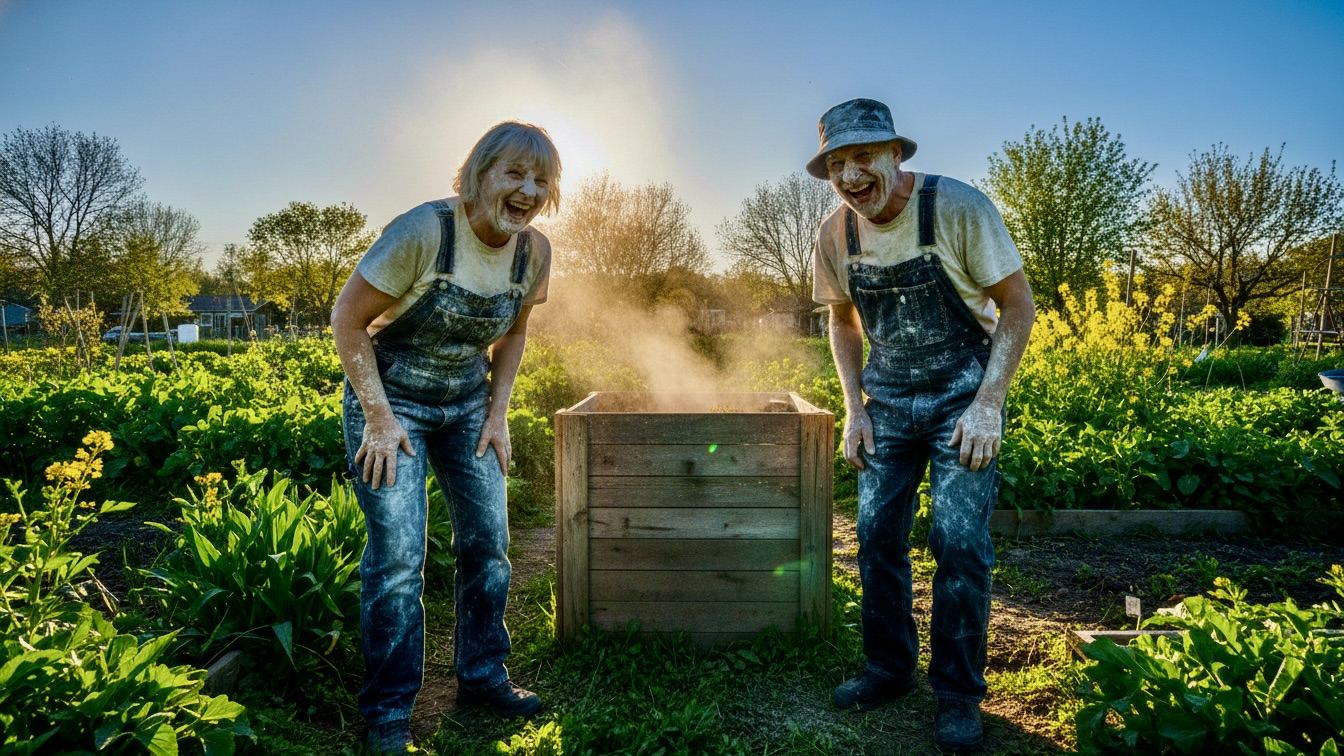
A massive, choking cloud of white bone meal explodes upward. It hits me directly in the chest. It billows up into my face. It coats my hair, my eyelashes, my linen shirt. It covers Toby. It turns his glasses completely opaque.
I gasp. I inhale a lungful of fine, chalky dust. I start coughing violently. I drop my side of the bag. The rest of the powder spills onto our boots.
I step back, waving my arms wildly in the cloud. I am coughing so hard my ribs ache. I try to wipe my eyes. The heavy work gloves just smear the powder across my forehead.
"Are you," Toby coughs. "Are you okay."
I look at him. He is covered in white dust. His bucket hat is white. His eyebrows are thick with it. He takes off his glasses. The skin around his eyes is clean, leaving reverse raccoon marks on his face. He looks absurd. He looks like a depressed baker.
I look down at myself. My expensive linen shirt is ruined. I am covered in powdered bone. I look ridiculous.
I let out a sound. It is a choke, a cough, and a hiccup all at once.
Toby wipes his mouth. He looks at me. "Did you just laugh."
"I am choking," I wheeze.
"You laughed."
I look at his reverse raccoon eyes. The sheer stupidity of the situation washes over me. The tension in my chest breaks. I let out a sharp, genuine laugh. It hurts my ribs. It shakes my shoulders.
Toby stares at me for a second. Then the corners of his mouth twitch. He starts to laugh too. It is a deep, booming laugh. It sounds nothing like his cheerful whistle. It sounds real.
We stand there in the dirt lot, covered in bone dust, laughing until we cannot breathe. I lean forward, resting my hands on my knees. My lower back screams in protest, but I do not care. The absurdity of it all is too much. The psychological warfare. The steaming garbage. The exploding bag.
"I am sorry," I say, gasping for air. "I am so sorry I called you a savior."
"I am sorry I called you a coward," he says, wiping a tear from his dusty cheek.
"I am a little bit of a coward."
"I am a lot of a savior."
He smiles. The real smile. The tired one. He reaches out a hand. He does not have the glove on. His hand is thick and calloused, stained with dirt.
I look at his hand. I look at the compost pile steaming in the morning sun. The rot. The mess. The potential.
I pull off my heavy canvas glove. I drop it on the ground. I reach out and take his hand. His skin is warm and rough.
"Nice to meet you, Renee."
"Nice to meet you, Toby."
We stand there for a moment, holding hands over the spilled bone meal. The traffic hums on the interstate. The flies buzz over the rotting fruit. It is not clean. It is not perfect. But it is real. We let go. We turn back to the pile. We pick up the shovels. We start to dig.
“We turn back to the pile, pick up the shovels, and finally start to dig.”


