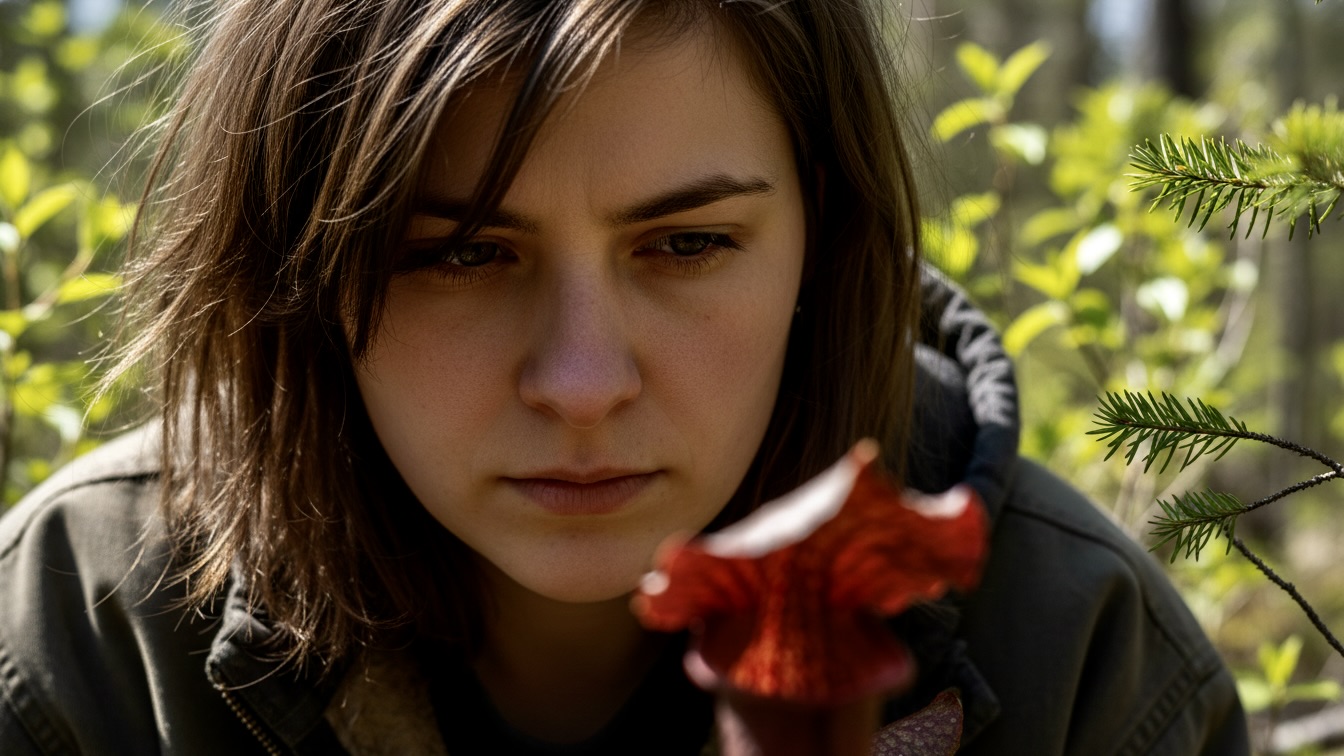
The narrative follows Stan and Renee as they navigate a treacherous, thawing bog in the wilderness near Thunder Bay. Stan is paralyzed by a combination of physical entrapment in the muck and a deep-seated psychological dread of the natural world. Renee, a photographer with a more pragmatic and clinical disposition, uses the discovery of a Northern Pitcher Plant to lecture Stan on the necessity of adaptation and survival. She encourages him to stop viewing the environment as a monster and instead see it as a system requiring a shift in his own internal rules.
As they transition from the oppressive humidity of the swamp to a higher granite ridge, the tension briefly dissipates when they find a trail marker and reach a scenic overlook. This relief is short-lived, however, as they witness a large, unidentified creature moving with predatory grace through the woods they just exited. The story concludes on a note of high-tension horror when the duo hears a sound that mimics the mechanical, predatory clicking of the pitcher plant they had just admired. This suggests that the metaphorical "death trap" Renee described has a literal, much larger counterpart hunting them from the shadows.
The central theme of the story is the brutal necessity of adaptation in an indifferent or hostile environment. Through the symbol of the Northern Pitcher Plant, the narrative explores how life must often become predatory or "ugly" to sustain itself when resources are scarce. Renee posits that the plant is not a mistake of nature but a "low-key genius" that changed the rules of the game to survive. This theme serves as a critique of modern human fragility, suggesting that the "victim" mindset is a luxury that the natural world does not afford.
Closely tied to adaptation is the theme of nature as a consumer. The bog is described not merely as a geographical feature but as a "mouth" or a "secret lake of prehistoric rot" that seeks to swallow the living. The pitcher plant mimics this on a small scale, while the final creature suggests a grander, more terrifying version of this predatory consumption. The story suggests that the boundary between the observer and the observed is thin, and that the landscape is always waiting to reclaim the energy of those who wander into it.
Finally, the text touches upon the "glitch" in reality, where the modern world and its digital distractions fail in the face of primal forces. Stan’s concern for his "fit" and his reliance on a phone that eventually loses service highlights the inadequacy of urban identities in the wilderness. The transition from the "script" of a marked trail to the "off-script" reality of the swamp represents a psychological descent into the subconscious. Here, the monsters are not just metaphors for anxiety but tangible threats that exist outside the map of human understanding.
Stan serves as the personification of modern anxiety and alienation from the physical world. He perceives the environment through a lens of victimhood, interpreting the natural process of displacement as a personal attack by the ground. His fear of becoming a "museum exhibit" reveals a deep-seated insecurity about his own relevance and a terror of being frozen in time, much like the bog bodies he mentions. He is a character who lives in his head, constantly projecting metaphors onto his surroundings to mask his lack of agency.
As the chapter progresses, Stan undergoes a fragile psychological shift prompted by Renee’s harsh but necessary guidance. He attempts to adopt the "vibe" of the pitcher plant, trying to integrate the "muck" of his experience into a new, more resilient self-image. This growth is portrayed as a desperate survival mechanism rather than a true epiphany. When the literal monster appears at the end, his hard-won composure instantly shatters, proving that his intellectual understanding of the "predator" was no match for the primal reality of being prey.
Renee acts as the story’s foil and psychological guide, maintaining a detached, almost clinical perspective on the dangers surrounding them. She uses her camera and her knowledge of botany as a shield, categorizing the world to keep its chaos at bay. Her dialogue is peppered with irony and a sense of superiority, as she views Stan’s panic with a mix of pity and professional interest. She values the "aesthetic" of survival, finding beauty in the ruthless efficiency of the pitcher plant’s death trap.
Despite her outward confidence, Renee’s character reveals a hidden vulnerability in the final moments of the story. Her insistence that they are merely "off-script" suggests that she, too, relies on a narrative framework to navigate the world. When the creature appears and the woods go "unnaturally silent," her ironic edge vanishes, replaced by a raw, urgent fear. This shift indicates that her intellectualization of nature was perhaps just another form of defense, one that fails when the environment stops being a subject for her photography and becomes an active threat.
The prose is characterized by a heavy use of visceral, sensory details that emphasize the "rot" and "upheaval" of the northern spring. Descriptions like "wet, flatulent sound" and "black, brackish water" create a sense of tactile discomfort for the reader. The author frequently employs personification to make the landscape feel sentient and aggressive, such as the spruce trees looking like "skeletal fingers." This creates a tone of atmospheric dread that persists even during the more conversational moments between the characters.
The pacing of the narrative mirrors the physical journey of the protagonists, starting with a slow, bogged-down opening that reflects Stan’s paralysis. As they move toward the granite ridge, the sentences become shorter and the action more fluid, providing a false sense of security. The final shift back into a state of high tension is achieved through auditory cues—the "wet, slurping noise" and "rhythmic clicking." These sounds serve as a brilliant narrative bridge, connecting the earlier botanical discussion to the immediate physical danger.
The narrative voice is third-person limited, staying close to Stan’s internal state while allowing Renee’s dialogue to provide the philosophical framework. This choice allows the reader to experience the claustrophobia of the bog through Stan’s eyes while also questioning his reliability as a witness. The ending is particularly effective because it leaves the threat partially obscured, relying on the reader's imagination to fill in the gaps. By ending on a sound rather than a visual description, the author ensures that the horror remains primal and unresolved.


