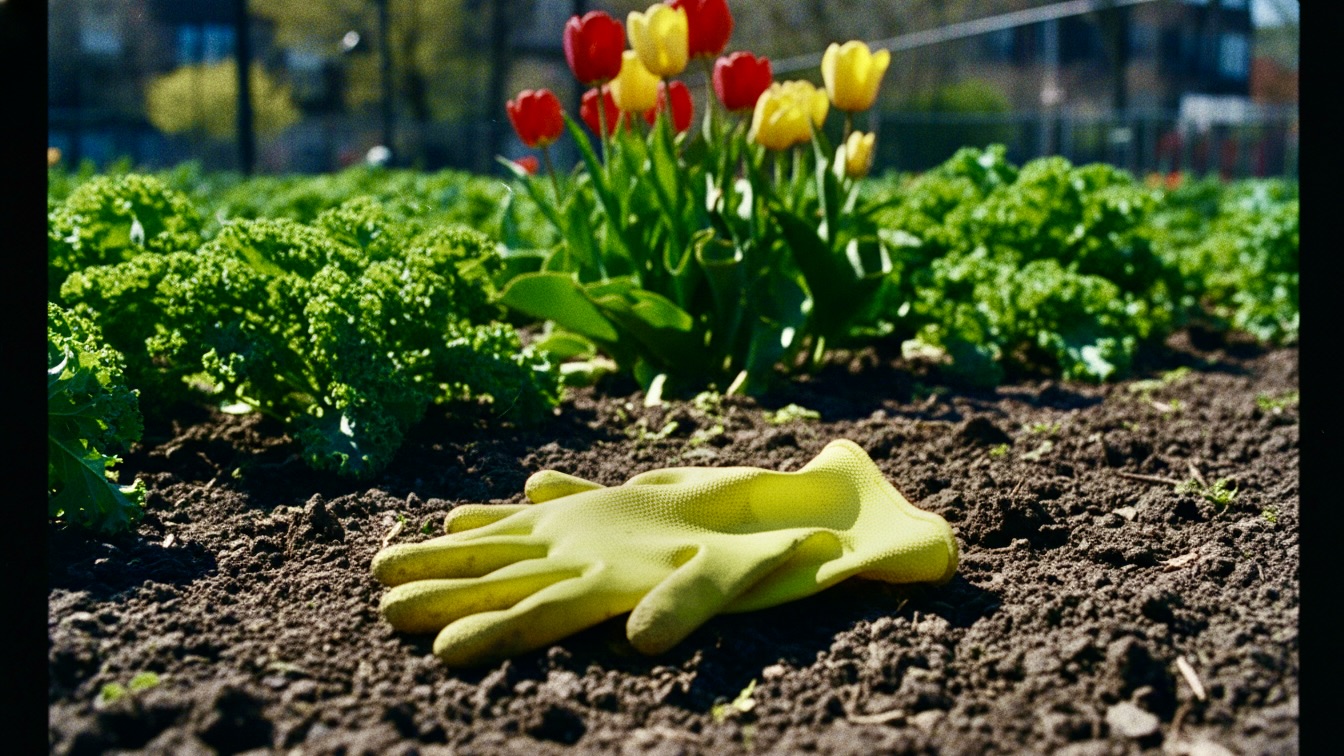
Lucy’s journey begins with the symbolic death of her smartphone, an event described as a "mercy killing" that leaves her in a state of sensory isolation. She seeks refuge in the Eastside Community Garden, a space that initially offers a reprieve from the crushing atmospheric pressure of suburban life. Once inside the gate, the environment shifts drastically, providing a sense of clarity and lightness that borders on the unnatural.
In the garden, she encounters a mysterious figure named Devon, who claims to "fix things" by burying people's regrets and burdens. He identifies the literal and figurative weight Lucy carries, specifically pointing out her damaged phone as a vessel for her anxiety. While his offer to bury the device seems tempting, Lucy grows suspicious of his unnervingly clean yellow gloves and his cryptic, predatory remarks about the "hungry" soil.
The encounter turns hostile when Lucy discovers a twitching human finger emerging from the earth, suggesting that Devon’s gardening involves more than just inanimate objects. Devon’s appearance begins to distort, revealing a skeletal, monstrous nature as he demands her phone. Lucy manages to escape the garden by leaping into a nearby alley, choosing the painful, heavy reality of the world over the sterile, dangerous peace Devon offered.
The narrative primarily explores the intersection of modern digital anxiety and the seductive, yet treacherous, lure of escapism. Lucy’s phone represents the "noise" of contemporary existence—the unrelenting pressure of social expectations, family demands, and academic performance. The garden serves as a liminal space where this noise is silenced, but the story suggests that such absolute silence is a form of death rather than true peace.
Another significant theme is the weight of human experience and the danger of trying to bypass it. Devon offers a shortcut to relief by burying Lucy's burdens, but the price is her "life" or her very humanity. The story posits that the "static" of the real world, though exhausting and heavy, is an essential component of being alive. By choosing to return to the loud, smelly, and painful alley, Lucy chooses the burden of existence over the void of perfection.
The motif of the "hungry" soil introduces a darker exploration of the cycle of life and decay. Devon presents the garden as a place of healing, but the presence of the twitching finger suggests that human suffering is being recycled or consumed rather than resolved. This subverts the traditional pastoral ideal, turning the garden into a site of horror where the earth feeds on the very essence of those who seek its comfort.
Lucy is portrayed as a young woman on the brink of a psychological collapse, evidenced by her literal crushing of her phone during a panic attack. She is acutely sensitive to the "pressure" of her environment, suggesting a high level of neuroticism and emotional exhaustion. Her initial relief in the garden highlights her desperation for a reprieve from the relentless demands of her social and digital life.
Despite her vulnerability, Lucy possesses a keen survival instinct and a grounded sense of intuition. She notices the incongruity of Devon’s pristine yellow gloves in a muddy environment, which serves as the catalyst for her realization of danger. This detail suggests that while she may be overwhelmed by her life, she is not entirely disconnected from reality. Her decision to jump into the alley demonstrates a courageous embrace of the "static" over a predatory, false serenity.
Devon functions as a personification of predatory nihilism or a supernatural entity that harvests human misery. He presents himself with a calm, fluid grace that masks a fundamental lack of humanity, emphasized by his "empty" eyes and his synthetic, sterile gloves. He is a master manipulator who uses the language of therapy and self-help to lure Lucy into a state of compliance.
His physical transformation near the end of the chapter reveals his true nature as something ancient and skeletal, a creature that requires "weight" to keep its victims suppressed. He does not offer healing; he offers a permanent burial of the self. His obsession with the "noise" of Lucy’s life indicates that he feeds on the energy of human conflict and regret, viewing her "life" as a resource to be harvested for his garden.
The author utilizes a sharp contrast in sensory details to establish the psychological shift between the suburbs and the garden. In the suburbs, the imagery is one of "pressure" and "violent green," suggesting a world that is straining under its own weight. Once Lucy enters the garden, the prose shifts to descriptions of "pure oxygen" and "thin, sharp" air, creating a sense of hyper-clarity that eventually becomes suffocating and alien.
The pacing of the narrative is expertly handled, beginning with a slow, atmospheric build-up that mirrors Lucy’s exhaustion. As the conversation with Devon progresses, the tension ratchets up through subtle, uncanny details—the smell of ozone, the vibrating eyes, and the "snap" of the nitrile gloves. The final transition from the garden back to the alley is marked by a sudden influx of unpleasant but grounding sensory data, such as exhaust and sirens, which signals the return to reality.
The use of the yellow nitrile gloves as a central symbol is particularly effective. The color yellow is often associated with both caution and sickness, and the synthetic material provides a stark, unnatural contrast to the organic setting of the garden. The gloves represent a barrier between the predator and his environment, highlighting Devon’s lack of genuine connection to the earth he claims to tend. This stylistic choice reinforces the theme of artificiality versus the raw, dirty truth of human life.


