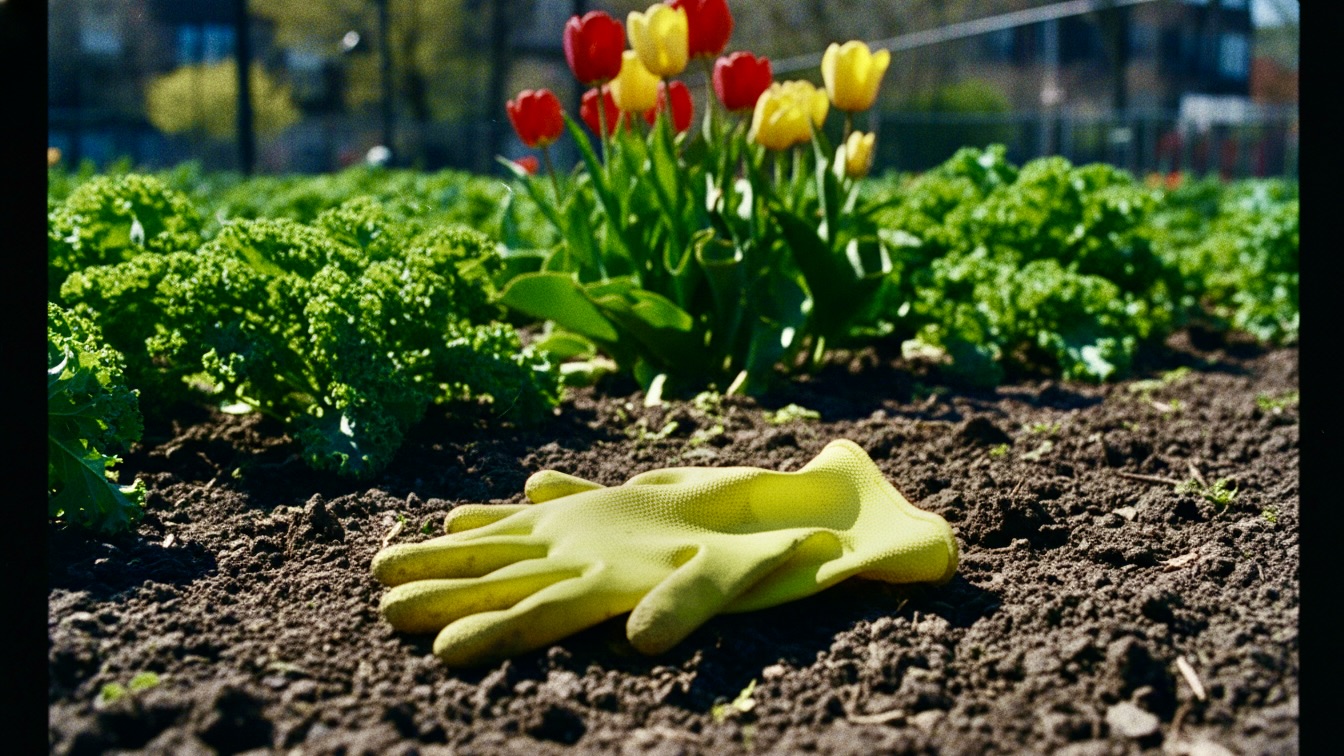
Lucy finds clarity in a community garden until the gardener’s clean gloves and dark soil reveal a hungry truth.
Lucy’s phone died at 3:14 PM. It was a mercy killing. The screen flickered, a jagged line of dead pixels cutting through a dozen unread texts from her mom, and then: black. The silence that followed was heavy. It felt like a physical weight pressing against her eardrums. She shoved the dead glass slab into her back pocket and kept walking. The suburbs were loud in a way that wasn't about sound. It was the pressure of the lawns. Every blade of grass looked like it was trying too hard.
She reached the Eastside Community Garden. It was a vacant lot between a dental office and a burnt-out laundromat. Someone had fought the city for it years ago. Now, it was a grid of wooden boxes overflowing with the violent green of early April.
She stepped through the chain-link gate. The latch clicked.
Suddenly, the pressure changed. It was like surfacing after being underwater too long. The air felt thin, sharp, and cold in her lungs. The static—that constant buzz of grades and unread messages—just stopped. She breathed. Her chest didn't feel tight anymore. The claustrophobia of the street, the houses, the dead phone... it all just evaporated. It was pure oxygen.
"You're trespassing," a voice said.
Lucy didn't jump. She felt too light to jump. She turned toward the back corner, near the compost bins.
A guy was kneeling in the dirt. He looked nineteen, maybe twenty. He wore a pair of bright yellow nitrile gloves that looked brand new. They were too clean for a gardener. His shirt was a faded black band tee for a group Lucy didn't recognize. He had a trowel in one hand and something small and white in the other.
"It's a community garden," Lucy said. "The sign says open till dusk."
"Dusk is a feeling," the guy said. He didn't look up. He kept digging. "Not a time."
"Okay. Deep." Lucy leaned against a raised bed full of kale. The leaves were crinkled and dark, like frozen waves. "I'm Lucy."
"Devon."
"You work here?"
"I fix things," Devon said. He finally looked up. His eyes were very pale. Not blue, not grey. Just empty. Like a screen with no input. "People plant stuff they shouldn't. They think they're growing tomatoes. They're actually growing regrets."
Lucy let out a short, dry laugh. "I wish I could grow regrets. At least I'd have something to show for my life."
Devon stood up. He was taller than he looked while kneeling. His movements were fluid, almost too smooth. He didn't have the jerky, awkward energy most guys his age had. He looked at Lucy's back pocket.
"Your phone is dead," he said.
"Yeah. Dropped it."
"No. You didn't drop it. You squeezed it. You were holding it so hard the motherboard cracked."
Lucy’s hand went to her pocket. How did he know that? She hadn't told anyone about the grip she’d had on the phone during the panic attack in the library. "Lucky guess."
"I don't guess," Devon said. He stepped closer. He smelled like ozone and wet copper. Not dirt. Not flowers. "I see the weight. It was hanging off you when you walked in. A big, grey shadow. Then you crossed the gate, and it stayed outside."
Lucy felt a chill that had nothing to do with the spring breeze. "Is that why it feels so easy to breathe in here?"
"It’s the soil," Devon said. He held up the white object he’d been holding. It wasn't a rock. It looked like a tooth. A large, flat molar. "It eats things. Bad memories. Old grudges. Dead phones. You should bury it, Lucy."
"Bury my phone?"
"Bury the noise," Devon corrected. He pointed to the dirt at his feet. "Give it to me. I'll put it where it won't hurt you anymore."
He smiled. It was a perfect smile. Too many teeth.
Lucy reached into her pocket. Her fingers touched the cold glass. She wanted to do it. The idea of the phone being under the dirt, silent forever, felt like a hit of pure oxygen. But then she looked at Devon’s yellow gloves. There wasn't a single speck of mud on them.
"Why are your gloves so clean?" she asked.
Devon’s smile didn't falter, but his eyes seemed to vibrate. "I don't like getting dirty. The dirt here is hungry. It doesn't like me as much as it likes you."
"What does that mean?"
"It means you have a lot of life," Devon said. He reached out. The yellow nitrile hissed as his fingers flexed. "Hand it over. Let me help."
Lucy took a step back. The clarity she’d felt moments ago started to curdle. The oxygen felt thin now, like she was standing on top of a mountain where the air was too pure to actually support a human heart. She looked down at the hole Devon had been digging. It wasn't a hole for a plant. It was deep. Narrow. And at the bottom, something was moving. Not a worm. Not a bug. It looked like a human finger, pale and twitching, trying to poke through the surface of the soil.
"What is that?" Lucy whispered.
Devon looked down. "That? That’s just a late bloomer. It’s been trying to get out for weeks. It needs more weight to push against."
He looked back at her. His face began to change. Not in a big, movie-monster way. It was subtle. His skin seemed to tighten over his skull until the bone showed through. The yellow of his gloves began to bleed, the color dripping onto the ground like melted wax.
"Give me the phone, Lucy," he said. His voice wasn't a voice anymore. It was the sound of a shovel hitting a rock. "Or I'll take the hand that’s holding it."
Lucy didn't think. She turned and ran. Not toward the gate—Devon was there—but toward the back wall. She scrambled over a pile of wooden pallets, her sneakers slipping on the damp wood. Behind her, she heard the sound of the yellow gloves. Snap. Snap. Snap.
"It's okay to be scared," Devon called out. His voice was right behind her ear, even though she’d just run twenty feet. "Fear is just another kind of noise. I can bury that too."
Lucy reached the top of the pallets and looked down into the alley behind the garden. It was a ten-foot drop. She looked back. Devon was standing at the base of the pallets. He wasn't climbing. He was just there. The yellow of his gloves was glowing now, a sickly, radioactive hue.
"Last chance," he said.
Lucy didn't give him the phone. She jumped. She hit the ground hard. Pain shot up her ankles, sharp and hot. But as soon as her feet touched the gravel of the alley, the oxygen feeling vanished. The static came rushing back—the smell of exhaust, the sound of a distant siren, the crushing weight of everything. It was horrible. It was exhausting. It was the best thing she’d ever felt.
She scrambled to her feet and didn't look back until she was two blocks away. When she finally stopped, gasping for breath, she reached into her back pocket. The phone was gone. There was no hole in her pocket. No way it could have fallen out. She looked down at her hands. They were shaking. And there, stuck under her thumbnail, was a tiny, jagged piece of bright yellow nitrile.
“She looked back toward the vacant lot, but the garden was gone, replaced by a single, twitching yellow glove lying in the weeds.”


