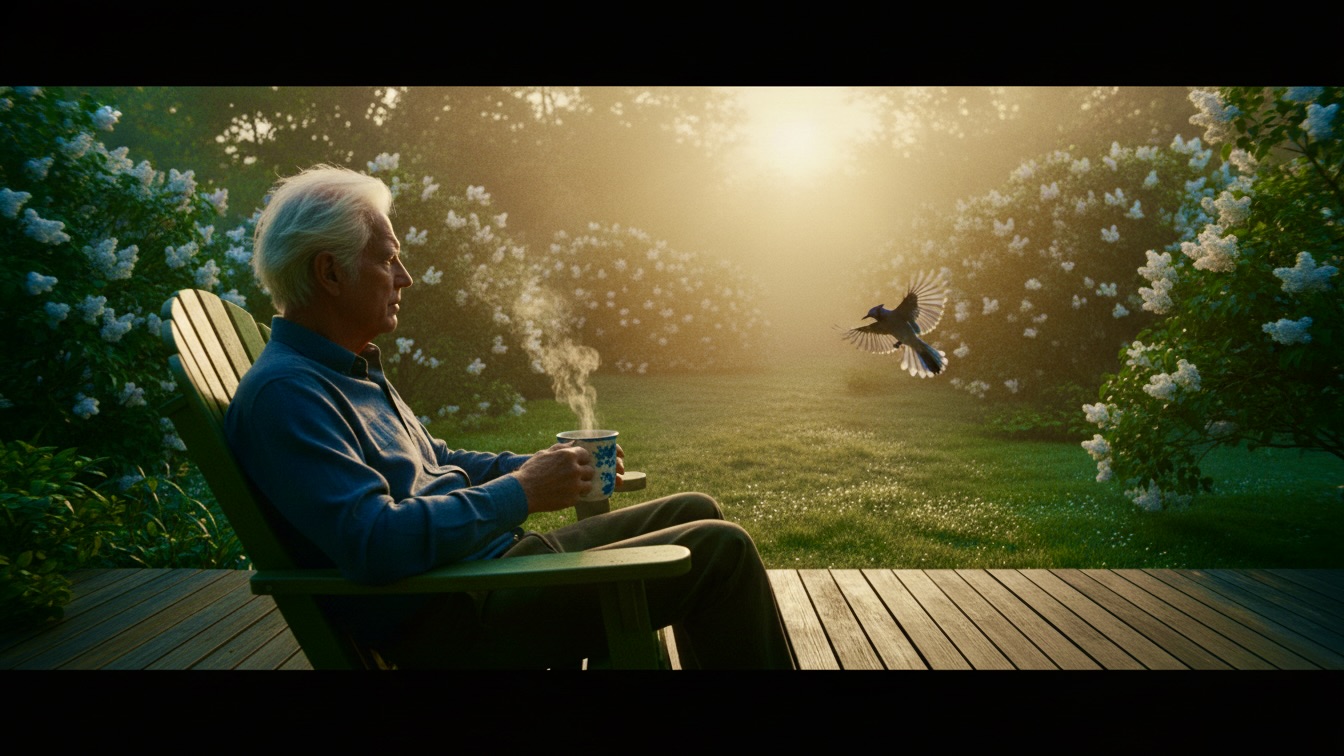
The story opens with Arthur, an eighty-year-old widower, sitting on his weathered porch during a damp, foggy spring morning. As he grips a familiar chipped mug of coffee, he experiences a profound sense of physical and emotional liberation from the stifling atmosphere of his home. The house has felt like a tomb since his wife Martha’s passing, but the cold morning air provides a much-needed sense of clarity.
While watching the fog begin to lift, Arthur descends into a deep internal monologue regarding his past. He reflects on his career-driven years and a pivotal moment of neglect toward his daughter, Sarah, which led to two decades of icy silence. He realizes that his resentment toward her was a shield used to hide his own parental failures. This epiphany is catalyzed by the sudden, aggressive appearance of a blue jay, which jolts him into the present moment.
In the final moments of the narrative, Arthur acknowledges his role in the estrangement and decides to bridge the gap. He retrieves his phone and initiates a call to Sarah, intending to start with simple observations about the morning rather than heavy apologies. As the connection rings, the fog outside completely vanishes, revealing a vibrant, clear world. This external transformation mirrors his internal resolution to face the truth and seek reconciliation.
The primary theme of the narrative is the struggle between isolation and the necessity of human connection. Arthur has spent years encased in various forms of "fog," ranging from the literal mist on his porch to the metaphorical haze of professional ambition and defensive pride. The story suggests that isolation is often a self-imposed prison, built from the "shroud" of lies one tells oneself to avoid the pain of accountability.
Regret and the passage of time also serve as central pillars of the text. The author uses the metaphor of a ticking clock and "silted rivers" of veins to emphasize Arthur’s mortality. At eighty, the weight of a twenty-year silence becomes unbearable, highlighting the tragedy of the word "later." The narrative explores how a single moment of neglect can calcify into a lifetime of distance if not actively challenged by the individual.
Nature acts as a powerful symbolic force for emotional catharsis and truth. The transition from the "thick, wet wool" of the morning to the "blinding white" light represents the painful but necessary process of gaining perspective. The blue jay, with its "harsh, ugly sound," symbolizes the honesty required to break a long-standing silence. It serves as a reminder that life is vibrant and demanding, existing entirely in the present moment regardless of past grievances.
Finally, the story touches upon the theme of redemption through vulnerability. Arthur’s decision to call Sarah is not portrayed as a grand, cinematic gesture, but as a quiet, shaky act of courage. By choosing to speak about the lilacs and the air rather than jumping into a heavy apology, he demonstrates a psychological shift. He moves from a state of frozen resentment to one of fluid, living engagement with the person he loves most.
Arthur is a man defined by a late-stage psychological awakening. For much of his life, he operated under the "fog of ambition," a state where he prioritized the "legacy of spreadsheets" over the emotional needs of his family. This workaholism functioned as a form of emotional avoidance, allowing him to feel productive while he was actually becoming a "ghost" in his own home. His current state is one of profound vulnerability, brought on by the twin forces of old age and the death of his wife.
His relationship with his daughter, Sarah, reveals a man who has struggled with the "quiet, cold kind" of anger. Instead of addressing his guilt over neglecting her during her youth, he projected his frustrations onto her, labeling her as difficult and ungrateful. This psychological defense mechanism allowed him to maintain a sense of righteousness while living in a "box with the lid taped shut." His internal journey on the porch represents the collapse of this defense as he finally recognizes that he was the one who "cut the rope."
Physically, Arthur is portrayed as fragile but grounded, finding comfort in the "tactile landmark" of a chipped mug. This preference for the imperfect suggests a subconscious readiness to accept his own flawed nature. When he finally picks up the phone, he is no longer the man who gave "one-word answers" to a teenage girl. He has become a man who understands the value of the "sudden oxygen" of truth, even if his hands shake as he reaches for it.
The narrative voice is intimate and sensory, utilizing a "stream of consciousness" style that blends the physical environment with internal memory. The pacing is deliberate and slow, mimicking Arthur’s own stillness in the Adirondack chair. This slow build-up is essential because it allows the reader to feel the weight of the "stale air" and the "suffocating layer of pride" before the climax occurs. The shift in pacing happens abruptly with the entrance of the blue jay, providing a sharp, kinetic contrast to the previous lethargy.
Sensory details are used with surgical precision to ground the reader in Arthur’s experience. The description of the air as "thick, wet wool" and the "staccato jerks" of a water droplet create a vivid, almost claustrophobic atmosphere. These details serve a dual purpose, acting as both literal descriptions of a spring morning and metaphors for Arthur's emotional stagnation. The use of "copper" to describe the taste of ambition and "parchment" for his skin adds a layer of visceral reality to his reflections.
The tone of the story undergoes a masterful transition from somber and suffocating to clear and hopeful. This is achieved through the evolving description of light, moving from "bruised orange" to "brilliant, blinding white." The author avoids sentimentality by focusing on the "harsh, ugly" honesty of the bird and the "cracked" screen of the phone. These imperfections reinforce the idea that the path to healing is not polished or easy, but it is nonetheless "painfully real."


