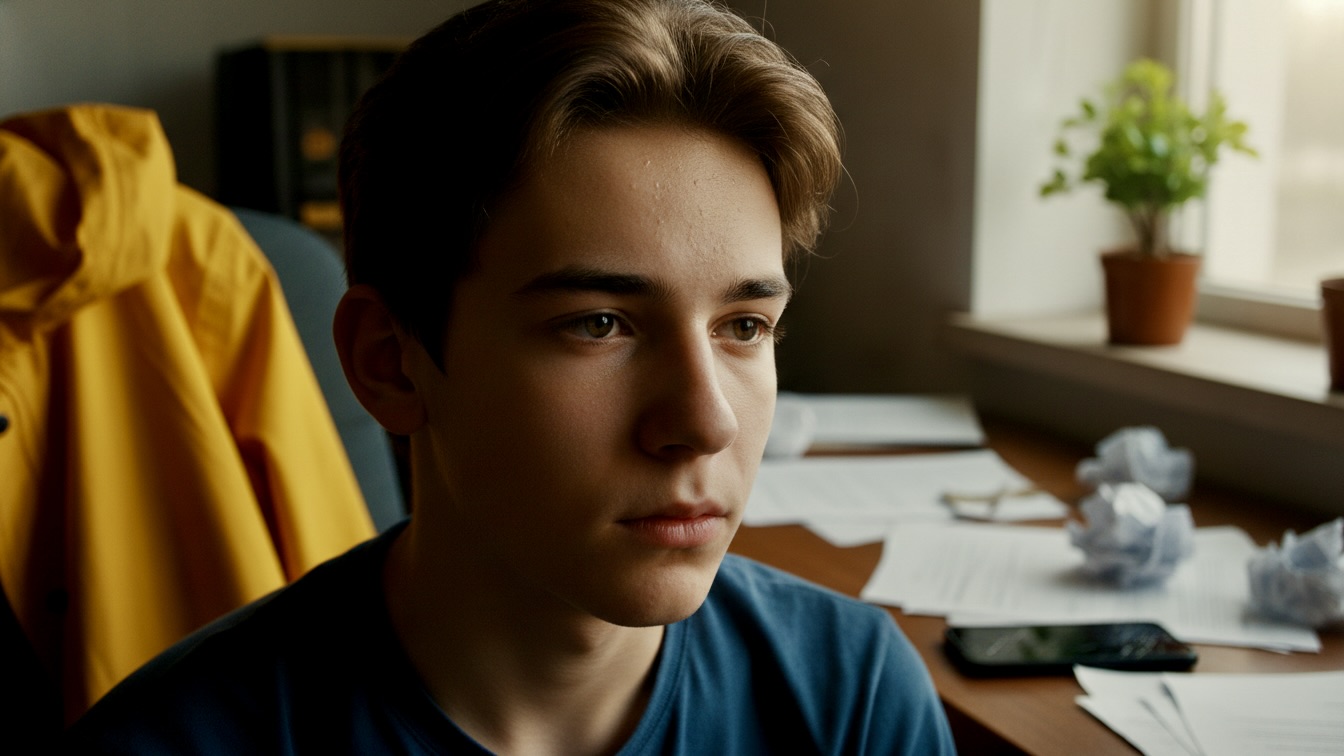
A dropped binder triggers a heated debate over nuclear waste, safety ramps, and the politics of being informed.
"Watch the coffee!" Terry yelled, but it was already too late.
I hit the corner of the heavy oak table with my hip, a sharp, biting pain that made my vision blur for a second. The three-ring binder I was clutching—four inches of regulatory jargon and technical diagrams—slipped from my grip. It didn't just fall. It exploded. The plastic rings gave way under the weight, and two hundred pages of the nuclear program's engagement strategy fluttered across the damp floor like a flock of panicked birds.
"Great," I muttered, dropping to my knees. The floor was covered in a thin film of melted slush tracked in from the street. It was mid-April in northern Ontario, that miserable window where the world is just grey ice and mud. "Perfect. Now the Impact Assessment is literal garbage."
Terry didn't help right away. He just stood there, holding two steaming paper cups, looking at the mess. "I mean, the optics are fitting. A total breakdown of the structural integrity. Very on-brand for the DGR project."
"Shut up and give me a hand," I said, grabbing a handful of damp pages. I looked at the one in my left hand. It was a map of the Revell site. A muddy boot print now obscured the proposed location of the ventilation shafts.
"You okay?" Terry asked, finally setting the coffees down on the only clear spot on the table and crouching next to me. "That was a solid hit. Sounded like a car crash."
"My hip is going to be purple by tomorrow, but I'm fine," I said, my heart still hammering against my ribs. The impact had knocked the wind out of me, that frantic, sharp shock that leaves no room for thinking. "I was just trying to get the Summary of Issues out before the meeting. My brain is fried from reading this stuff."
Terry picked up a page titled 'Section 5.4: Engagement Tiers.' He wiped a drop of grey water off it with his thumb. "Is this the part where they tell us we don't matter?"
"Basically," I said, sitting back on my heels. "It’s the 'Involve' versus 'Inform' hierarchy. The community milking the system gets the 'Involve' tier. They get the seats at the table, the binding agreements, the infrastructure promises. We’re in Melgund, which means we’re in the 'Inform' bucket. We get the newsletters and the 'thanks for your feedback' emails that go straight to a server in Toronto to be ignored."
Terry whistled, a low, sharp sound. "So it's a tiered subscription for democracy? We’re on the free plan while they have the Pro version?"
"Except the free plan involves twenty thousand tons of used nuclear fuel driving past our front doors on Highway 17," I said. I started shoving the pages back into the binder in no particular order. The order didn't matter anymore; the logic was already broken. "It’s a haves and have-nots dynamic. The Impact Assessment actually flagged it. They called it 'distribution of economic benefits.'"
"They have a fancy word for everything," Terry said, standing up and handing me a stack of papers. "I was looking at the design specs last night. The shaft thing. It’s bothering me."
"The vertical shafts?" I asked, standing up and wincing as my hip throbbed. I leaned against the table and took my coffee. It was lukewarm and tasted like cardboard, but I needed the caffeine.
"Yeah," Terry said, pacing the small, cramped office. Outside the window, the sky was the color of a wet sidewalk. "They’re going with a shaft-only design. No ramp. Just a big elevator for the waste and the people. The people in Melgund are calling it a 'single point of failure.' If that hoist fails, or if there’s a fire, or if the power goes out, you’ve got guys a hundred meters underground with no way out except a vertical climb. It’s sketchy."
"The nuclear program says it’s fine," I said, playing devil’s advocate because I knew it would get him going. "They say it’s been 'proactively' studied for twenty years. They call the concerns 'areas of focus.'"
Terry stopped pacing and looked at me, his eyes narrow. "'Areas of focus' is corporate-speak for 'we hear you, but we’re not changing the blueprints.' It’s gaslighting with a budget. If I’m working down there and the elevator snaps, I don't want an 'area of focus.' I want a ramp. A big, wide, concrete ramp I can drive a truck up."
"The community asked for a Comparative Risk Assessment," I said, remembering the notes I’d highlighted before the binder-pocalypse. "They want the nuclear project to actually prove why a shaft is better than a ramp. But the document frames it as a 'learning' issue. Like, if we just understood the engineering better, we’d stop being scared."
"I hate that," Terry said, hitting the table with the palm of his hand. The coffee cups rattled. "It’s so patronizing. 'Oh, you're just worried because you don't have a PhD in nuclear physics.' No, I'm worried because I’ve seen what happens when equipment isn't maintained in the bush. This isn't a lab in Oakville. This is the North. Things break. Cables rust. The cold does weird things to steel."
I looked down at the mess of papers. "They’re also worried about the worker camp. A thousand people living in the next community over, but commuting right through here. Every day. Twice a day. On a highway that’s already a death trap in the winter."
"And they want to put the camp in community because that's where the 'willingness' is," Terry said, his voice dropping an octave. "It’s a bribe, Peter. 'We’ll give you a new hospital and housing, but only if you host the trash.' Meanwhile, we get the noise, the traffic, and the risk of a leak in the watershed, but we don’t get the hospital."
"The 'Inform' tier," I said, nodding. "We get the 'Inform' tier and a front-row seat to the boom-bust cycle. Once the repository is built and the construction crews leave, what happens to the Dyment Recreation Hall? What happens to the small businesses that geared up for a population that’s suddenly gone?"
"The Impact Assessment actually mentioned the Rec Hall?" Terry asked, surprised.
"In a roundabout way," I said, pulling a damp sheet from the pile. "They talked about 'social cohesion and community wellbeing.' The people here were more specific. They called it a 'community hub.' It’s where people actually meet. If the project ruins the local vibe, or the traffic makes it impossible to get there, that’s a loss you can’t put in a spreadsheet."
Terry sat back down, his energy shifting from frantic to reflective. "It’s the watershed that gets me. Revell Lake. All those systems are connected. You can’t 'inform' a lake that the waste is only being hosted by the town next door. The water doesn't care about municipal boundaries or who signed a 'willingness' agreement."
"The document says they’re using 'Gender-based Analysis Plus' to be inclusive," I said, trying to find a silver lining.
Terry snorted. "GBA+? That’s great. I’m sure the different genders will be equally 'informed' while the 'involved' people decide where to bury the plutonium. It’s a buzzword shield. They’re using it to look progressive while maintaining a hierarchy that’s basically feudal."
I started sorting the pages back into their sections—Safety, Environment, Socio-Economic. My hip was screaming now, a dull, rhythmic thud. "We have to go to the meeting, Terry. We can’t just sit here and complain. If the Impact Assessment Team is asking for a response to the Summary of Issues, this is the only window we have to push back on the 'Inform' status."
"What are we even going to say?" Terry asked, looking defeated. "'Please involve us more'? They’ll just send us a nicer brochure."
"No," I said, my voice firmer than I felt. "We demand the Regional Impact Committee. That’s in the recommendations. A formal seat for the neighboring towns. Not just a seat to listen, but a seat to vote on the transport routes and the emergency protocols. If the waste goes through our backyard, we hold the gate."
Terry looked at me, a small smile tugging at the corner of his mouth. "'We hold the gate.' That’s punchy. You should lead with that."
"And the ramp," I added. "No ramp, no deal. We back up Northwatch and the other 'critical voices.' The community calls them a 'tension,' but they’re the only ones asking the questions that actually matter. We need to stop letting the corporate guys frame dissent as a 'technical misunderstanding.' Dissent is a safety feature."
Terry stood up and grabbed his coat. It was a rugged, salt-stained thing that had seen too many winters. "Alright. Let’s go tell them their 'Inform' tier is a glitch. We’re upgrading ourselves to 'Problematic.'"
I gathered the damp, disorganized binder and hugged it to my chest. The pain in my hip was a sharp reminder of the collision, a physical marker of the moment things got real. We stepped out of the office and into the raw, biting spring air. The smell of wet earth and rotting snow was thick.
"Hey," Terry said as we walked toward my beat-up truck. "What if they actually listen? What if they build the ramp and give us the committee?"
I looked at the grey horizon, where the trees were just starting to show the faintest hint of green, a promise of life that felt fragile against the weight of what was coming. "Then we spend the next eighty years making sure they don't forget we're here."
We got into the truck, the engine groaning as it turned over. The heater kicked on, blowing a smell of old dust and damp upholstery. I put the binder on the dashboard. It looked like a mess, but the words inside were still there, waiting to be used. As we pulled out of the muddy lot, I saw a hawk circling over the Highway 17 corridor, hunting in the narrow space between the asphalt and the pines.
"Check the GPS," I said to Terry. "How long to the community hall?"
Terry tapped his cracked phone screen. "Twenty minutes if the slush doesn't get worse. But wait—there’s a notification from the Impact Assessment portal."
I gripped the steering wheel tighter as we hit a pothole. "And?"
Terry’s face went pale in the light of the screen. "They just released a revised timeline. They’re moving the final decision up by six months."
I felt a new kind of impact then, one that didn't hit my hip but went straight to my gut. The game was changing before we’d even reached the field.
"The window just closed halfway," I said, accelerating onto the highway. "We’re not just going to a meeting anymore."
"What are we doing then?" Terry asked.
I looked at the road ahead, the long, grey ribbon that carried everything from families to fuel. "We’re starting a fire."
As we sped past the turn-off for Revell Lake, the sky finally broke, a single, sharp ray of spring sunlight hitting the windshield like a warning. The ground was still frozen deep down, but the surface was shifting, and I knew that once the thaw really started, there was no way to hold back the flood.
“The ground was still frozen deep down, but the surface was shifting, and I knew that once the thaw really started, there was no way to hold back the flood.”


