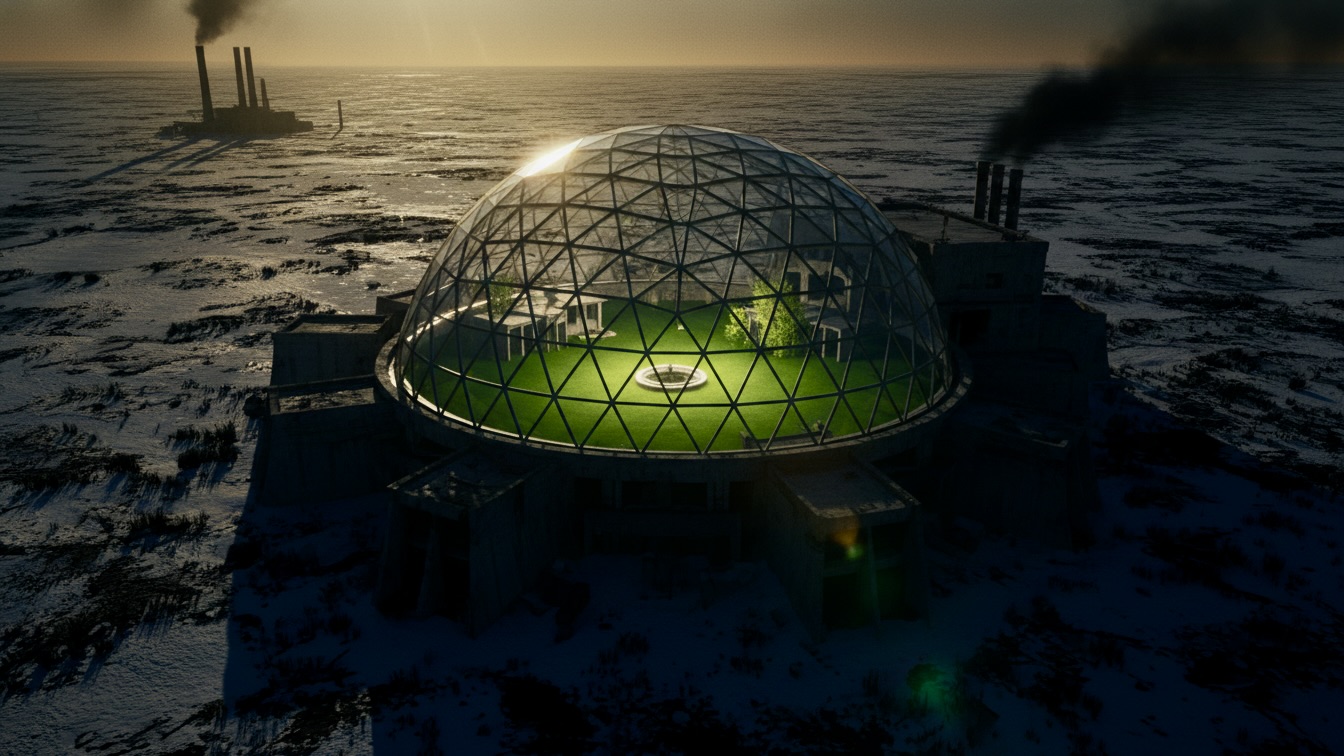
Gary stood by the perimeter glass, watching the April snow melt into a toxic, greasy wet black.
Gary woke to the sound of the air filtration unit grinding against its own housing. It was a metal-on-metal screech that had become the baseline rhythm of his life over the last four months. He lay in the dark. The mattress was thin, resting on a frame made of welded pipe. His lower back ached. The cold in the room was a physical weight pressing down on his chest. It was supposed to be spring. The calendar on his digital console, its screen cracked down the middle, read April the fourteenth.
He threw off the wool blanket. The air hit his bare arms like cold water. He shivered, his jaw clacking together once before he clenched his teeth. He dressed in the dark. Two layers of thermal shirts, worn thin at the elbows. A thick canvas jacket that smelled like stale sweat and dried dust. He sat on the edge of the bed to pull on his boots. His knees popped in the quiet room. The boots were leather, but the leather was dried out and splitting near the soles. He tied the heavy laces, feeling the stiff cold of the strings against his raw knuckles.
He walked out into the corridor of Sector 4. The lighting here was a sickly, dim yellow. The fluorescent tubes in the ceiling had not been replaced in over a year. Some of them blinked rapidly, casting a stuttering light over the concrete walls. The air smelled of copper, unwashed bodies, and the sharp chemical tang of the synthetic cleaning solution the maintenance crews used on Sundays.
Gary walked toward the perimeter. The enclave was built like a massive, shallow bowl, covered by a geodesic dome of climate-controlled glass and electromagnetic shielding. It was designed to keep the brutal, endless winter out. It was designed to simulate the seasons. But the generators were dying. The winter had overstayed by four months, and the shield was faltering.
He reached the outer observation deck. No one else was here. Most people stayed near the central heating vents in the morning, huddling for warmth before the rationing lines opened. The glass of the perimeter wall was thick and frosted with condensation on the inside. Gary took his gloved hand and wiped a circle in the frost. The moisture smeared, leaving a streaky window to the outside world.
He looked out. The landscape was flat and dead. The trees were black sticks poking out of deep, hard-packed snow. The sky was the color of dirty iron. But it was not the sky that caught his attention. It was the ground directly outside the glass.
The snow was changing. The temperature outside the glass fluctuated wildly as the shield generators surged and failed, creating a weird micro-climate right at the boundary. Gary leaned closer, his nose almost touching the cold glass. The snow was not melting into water. It was rotting.
As he watched, a patch of white frost seemed to cave in on itself. It turned gray, then a dark, sickly brown, and finally a greasy wet black. It looked like old motor oil. The blackness spread, eating into the surrounding snow. It bubbled slightly, a thick, viscous movement. The soil underneath was entirely toxic. The chemical fallout from the old wars had finally saturated the frost. When the shield's ambient heat hit the snow, it did not create water; it created a corrosive sludge.
Gary felt his stomach turn over. A heavy, unnatural silence hung in the observation deck. The light outside shifted. The sun, hidden behind layers of gray cloud, changed position, but the light filtering through the dome bent at an odd angle. It created a strange, heavy shadow over the black snow. The shadow mass. It felt wrong to look at it. It made Gary's eyes water. It was a physical sense that the geometry of the world was breaking down.
He stepped back from the glass. His breath plumed in the cold air. The enclave was not just freezing; it was being surrounded by poison.
He turned and began the long walk to the administrative sector. The walk took him through the residential blocks. The concrete structures were stacked tightly together. People were beginning to emerge. They moved slowly. A man in a torn gray coat leaned against a wall, coughing a dry, hacking sound. A woman pulled a small cart filled with empty plastic jugs, the wheels squeaking loudly on the concrete floor.
Gary watched them. They were tired. They were hungry. The rationing had been cut by half three weeks ago. There were no fresh vegetables. There was no real meat. There was only the synthetic slurry produced by the central vats. It kept them alive, but it did not keep them healthy. People's skin had taken on a gray, translucent quality. Their hair was thinning.
He reached the heavy metal doors of the administrative sector. The guards at the door were two young men in oversized tactical vests. They looked bored and cold. They held their rifles loosely.
"Morning, Gary," the taller guard said. His name was Miller. His lips were chapped and bleeding.
"Miller," Gary said. "I need to see the Mayor."
Miller sniffed. "He is in a meeting. Strategy session."
"It is not a strategy session," Gary said. "He is eating breakfast. Let me in."
Miller hesitated, then pressed the button on the wall. The heavy doors clicked and slid open on rusty tracks.
Gary walked down the hallway. The air here was slightly warmer. The lighting was better. Mayor Oliver's office was at the end of the hall. Gary pushed open the wooden door to the outer office. The secretary, a woman named Sarah with deep circles under her eyes, looked up from her screen.
"He is busy, Gary," she said.
Gary did not stop. He walked past her desk and pushed open the door to the inner office.
Oliver sat behind a large oak desk. The desk was scratched and water-stained, a relic from the old world. Oliver was a man who cared deeply about presentation. He wore a tailored suit jacket over a thick, gray hooded sweatshirt. His hair was slicked back. He held a silver spoon in his hand, hovering over a bowl of thick, gray paste.
"Gary," Oliver said, not looking up. "You have a profound lack of respect for closed doors. It is a character flaw."
"The snow outside Sector Four is turning black," Gary said. He stood in the center of the room.
Oliver took a bite of the paste. He chewed slowly, swallowed, and wiped his mouth with a cloth napkin. "The environmental reports indicate a slight fluctuation in soil acidity. It is being monitored."
"It is not a fluctuation," Gary said, stepping closer to the desk. "It is a total failure of the perimeter soil. The snow is melting into a toxic sludge. The shield is failing, Oliver. The heat bleed is causing a chemical reaction. If the shield drops entirely, that sludge will flood the vents."
Oliver leaned back in his leather chair. The chair squeaked loudly. He looked at Gary with a mixture of pity and annoyance. "Brother, I implore you to look at the metrics. We are surviving. The generators are operating within acceptable margins. Do not rock the vessel."
"The vessel is sinking," Gary said. His voice was tight. His jaw ached from clenching it. "People are starving. The children are getting sick. And now the ground outside is turning to poison."
Oliver sighed dramatically. He placed both hands flat on the desk. "Gary, I understand you fancy yourself a man of the people. A tragic hero of the lower sectors. But you must grasp the grander narrative. We are a beacon in the dark. The optics of a panic right now would be catastrophic. If I tell them the shield is failing, we will have riots. They will tear this place apart before the cold ever touches them."
"So we just wait to freeze?" Gary asked.
"We endure," Oliver said. His tone was theatrical, practiced. He sounded like a man giving a speech to a mirror. "We simply bow our heads. We weather the storm. Go back to your sector, Gary. Tell your people the technicians are working on it. Tell them spring is coming. Keep your head down and eat your protein paste."
Gary looked at the bowl of gray paste on the desk. He looked at Oliver's clean hands. "There are no technicians left, Oliver. They died in January. You are lying to them."
"I am managing morale," Oliver said sharply. "Which is more than you are doing. Now get out of my office. You are bringing a terrible energy into my space."
Gary did not argue further. He turned and walked out. The anger in his chest was a hot, sharp thing. It made his breath come shallow. He knew Oliver would do nothing. Oliver was paralyzed by his own bureaucracy, more concerned with maintaining the illusion of control than actually saving lives.
Gary walked back through the administrative sector, past the shivering guards, and out into the dim light of the residential blocks. He had a plan. It was a desperate plan, and it relied on a holiday that no one had celebrated properly in a decade.
He returned to his quarters. The room was even colder now. Anna was already there. She sat on the edge of his thin mattress. She wore a heavy gray sweater that hung loosely on her frame. Her hair was entirely white, a change that had happened over the last few brutal months. Her glasses were cracked in the left corner, taped together with a small piece of yellow adhesive.
"Did you speak with him?" Anna asked.
"He told me to eat my protein paste," Gary said. He locked the door behind him.
Anna let out a short, bitter laugh. "Of course he did."
Gary walked to his small metal locker. He entered the code, his cold fingers fumbling on the keypad. The locker opened. Inside, hidden beneath a stack of folded gray shirts, was a heavy metal lockbox. He pulled it out and set it on the floor. He opened it with a small key he kept on a chain around his neck.
Inside the box were two items. The first was a plastic bag filled with a dozen cheap, brightly colored plastic eggs. They were pink, yellow, and blue. They were relics, scavenged from a ruined department store years ago.
The second item was a small black pouch.
Gary sat on the floor opposite Anna. He opened the pouch and poured its contents onto the metal lid of the lockbox. Five small, square micro-drives clattered against the metal. They were black, sleek, and entirely illegal.
"Are these the coordinates?" Anna asked, leaning forward.
"Yes," Gary said. "The actual safe zones. The subterranean bunkers the government built before the collapse. They have geothermal power. Clean water. Oliver knows about them, but he refuses to authorize an evacuation. He says the journey is too dangerous, that it would fracture the community. He wants to stay here and rule over a dying enclave."
"And the access codes are on these?" she asked, touching one of the sharp metal corners.
"Everything is on them. Topography maps, hazard warnings, the door cipher. Everything they need to get out."
Gary reached into his coat pocket. He pulled out a small, dented tin. He opened it. Inside were small, dark brown cubes.
Anna looked at them. "Is that...?"
"Synthetic chocolate," Gary said. "Contraband. I traded three weeks of my water ration to a scavenger for it. It smells awful."
Anna picked up a cube. She smelled it. "It smells like chemicals and fake vanilla. It is perfect."
They worked in silence. Gary took a yellow plastic egg. He pinched the sides. The plastic was brittle and cold. It gave a loud, sharp snap as it popped open. He placed one of the micro-drives inside the bottom half. He took a cube of the synthetic chocolate and pushed it down over the drive, hiding the metal entirely. He snapped the top half of the egg back on.
He handed the yellow egg to Anna. She placed it carefully into a small canvas bag.
They repeated the process. The snapping of the cheap plastic was loud in the quiet room. Gary's hands shook slightly. The cold was settling deep into his bones. His joints ached. He focused on the task. Blue egg. Drive. Chocolate. Snap. Pink egg. Drive. Chocolate. Snap.
"How are we doing this?" Anna asked quietly.
"The courtyard," Gary said. "I announced an Easter egg hunt for the children of Sector Four. Oliver's security detail will ignore it. They think it is just a morale-boosting exercise. A pathetic attempt to hold onto the old world. They won't inspect the eggs. They don't care enough to stop children from running around on fake grass."
"And the parents?"
"I have already spoken to the ones we trust. Five families. They know what to look for. When their child finds an egg with a drive, they are to pack whatever they can carry and head for the secondary airlock. I have bypassed the door locks. We leave during the hunt, while the guards are distracted by the noise."
Anna looked at the last egg in her hands. It was bright pink. "It is a massive risk, Gary. If the perimeter shield fails entirely while we are out there..."
"The shield is already failing," Gary said. "The snow is turning to black acid. If we stay, we die in our sleep. If we run, we might freeze, but we might make it to the bunkers. It is a choice between certain death and a chance."
Anna nodded slowly. She dropped the pink egg into the bag. "Let's go."
They left the quarters and walked toward the central courtyard. The courtyard was the largest open space in the enclave. The floor was covered in a sprawling mat of green synthetic grass. It was meant to simulate a park. In the center stood a large, dead oak tree, its trunk preserved in chemical resin, its branches bare and reaching up toward the glass dome.
The lights in the courtyard were set to maximum output. It was a glaring, aggressive brightness that hurt the eyes. It was supposed to look like a sunny spring afternoon. Instead, it looked like an interrogation room. The yellow light of the shield above hummed loudly, a constant, vibrating noise that rattled the teeth.
The children were already gathering. There were about twenty of them. They looked small and fragile in their oversized winter coats. Their breath plumed in the air. The heating vents in the courtyard were pushing out lukewarm air, but it was not enough to fight the cold bleeding down from the dome.
Parents stood on the edges of the artificial grass. They stood with their arms crossed, shivering. Gary recognized the five families he had spoken to. They stood close to the exits, their faces tense. They carried small backpacks.
Gary walked to the center of the courtyard. He held the canvas bag. He looked at the children. They were staring at the bag with wide, desperate eyes. They did not care about the cold. They did not care about the failing generators. They had been told there was chocolate.
"Listen to me," Gary called out. His voice echoed off the concrete walls. "Spread out. The eggs are hidden around the tree, near the vents, and under the benches. When I say go, you look. Only take one egg each. Everyone gets one."
He had already scattered the empty eggs and the five loaded eggs around the courtyard before returning to his room. He had placed the loaded eggs in specific spots, making eye contact with the parents of the chosen families to indicate the locations.
"Ready?" Gary shouted.
The children nodded, shifting their weight from foot to foot.
"Go."
The children ran. It was a chaotic scramble. They dove under the metal benches. They clawed at the base of the dead tree. The sound of their boots on the synthetic grass was a dull thudding.
Gary stood back. He watched a young boy in a blue hat grab a yellow egg from near a heating vent. The boy's mother immediately stepped forward, grabbing the boy's hand and pulling him toward the perimeter corridor.
One.
A girl with thick, dark hair found a pink egg under a bench. Her father scooped her up, his eyes meeting Gary's for a brief second before he turned and walked quickly away.
Two.
The plan was working. The guards stationed at the far end of the courtyard were leaning against the wall, laughing at something one of them had said. They were not paying attention. They thought it was just a sad display of nostalgia.
Then, the hum changed.
The loud, vibrating noise of the shield generator above them stuttered. It sounded like a massive engine choking on bad fuel. A deep, grinding crunch echoed through the dome.
Gary looked up. The glaring yellow light of the shield flickered.
The shadow mass returned. It swept across the courtyard. The artificial light bent and warped. The shadows of the children stretched out across the green plastic grass, growing long and distorted. The air pressure dropped instantly. Gary felt his ears pop. A sharp pain stabbed behind his eyes.
"Gary," Anna said, stepping up beside him. She grabbed his arm. Her grip was terrifyingly strong.
"The generator," Gary said.
Above them, the yellow light died.
It did not fade. It simply snapped out of existence. The dome went completely dark for a fraction of a second, before the dim emergency lights flickered on, casting the courtyard in a bloodless, gray pallor.
The hum stopped. The silence that followed was absolute. It was a heavy, dead silence.
And then the cold hit.
It was not a gradual dropping of the temperature. It was a physical wall of frost that crashed down from the glass dome. The ambient heat of the enclave vanished, sucked out into the dead world above.
Gary felt the cold punch through his heavy jacket. It hit his skin like needles. His breath froze in his throat. He gasped, the air burning his lungs.
The children stopped running. They stood frozen on the fake grass. A small boy near the center of the courtyard dropped his plastic egg. It hit the ground and shattered.
"Shield failure!" one of the guards screamed from the far wall. The guard fumbled for his radio.
The temperature plummeted. Gary watched in horror as frost instantly crystallized over the metal benches. The green synthetic grass turned white, covered in a sudden layer of ice.
The airlock doors at the edge of the courtyard slammed shut automatically. The lockdown protocols had engaged.
"We have to move," Anna shouted. Her voice was thin and panicked.
Gary looked around. The children were starting to cry. The sound was muffled by the crushing cold. The remaining families were frozen in shock.
"The secondary airlock!" Gary yelled. He grabbed Anna's hand.
They ran. The cold was a physical resistance. Every step felt like pushing through deep water. Gary's knees screamed in pain. His lungs felt like they were bleeding. He could see the frost forming on Anna's white hair.
A loud cracking sound echoed from above. Gary looked up as he ran. A massive web of cracks was spreading across the glass dome. The structural integrity was failing. The black snow outside was pressing down, the toxic sludge eating at the seals.
They reached the secondary airlock corridor. The heavy metal door was sliding shut.
"No!" Gary yelled. He let go of Anna and lunged forward. He shoved his arm into the gap just before the door sealed. The metal jaws bit down on his heavy canvas jacket. The motors ground in protest, trying to crush his arm. Pain shot up to his shoulder.
He kicked the door with his heavy boot. He kicked it again. The locking mechanism, already compromised by his earlier tampering, gave way with a loud metallic snap. The door slid back open a few feet.
Gary pulled his arm free. He was panting, his breath coming in ragged white clouds.
Anna squeezed through the gap. Gary grabbed a small girl who was standing nearby, paralyzed by the cold, and shoved her through the opening. He looked back at the courtyard.
It was a scene of absolute devastation. The frost was covering everything. People were falling to their knees, unable to breathe the sub-zero air. The guards were pounding on the locked main doors, their rifles forgotten on the ground. The brutal finale of Mayor Oliver's lie was playing out in terrifying silence. The enclave was dead.
Gary stepped through the gap and pulled the heavy door shut behind him. He threw the manual override lever, sealing them in the narrow concrete tunnel that led outside.
The tunnel was freezing, but it was insulated from the immediate drop in the main courtyard. The girl Gary had pulled through was crying silently. Anna was kneeling beside her, wrapping her own gray sweater around the child's shoulders.
Gary stood leaning against the cold concrete wall. He reached into his pocket and pulled out one remaining plastic egg. It was blue. He snapped it open. The smell of the synthetic chocolate filled the small space, sickly sweet and chemical. He pulled the black micro-drive from the chocolate.
He held the drive up to the dim emergency light in the tunnel. The coordinates were etched into the metal. The safe zone. Three hundred miles across the frozen, toxic waste.
He looked at Anna. She was looking back at him, her eyes wide, her breath pluming in the air. The enclave behind them was a tomb. The world outside was poison.
Gary tightened his fist around the cold metal of the drive. The journey into the endless dark had begun.
“Gary tightened his fist around the cold metal of the drive as the journey into the endless dark began.”


