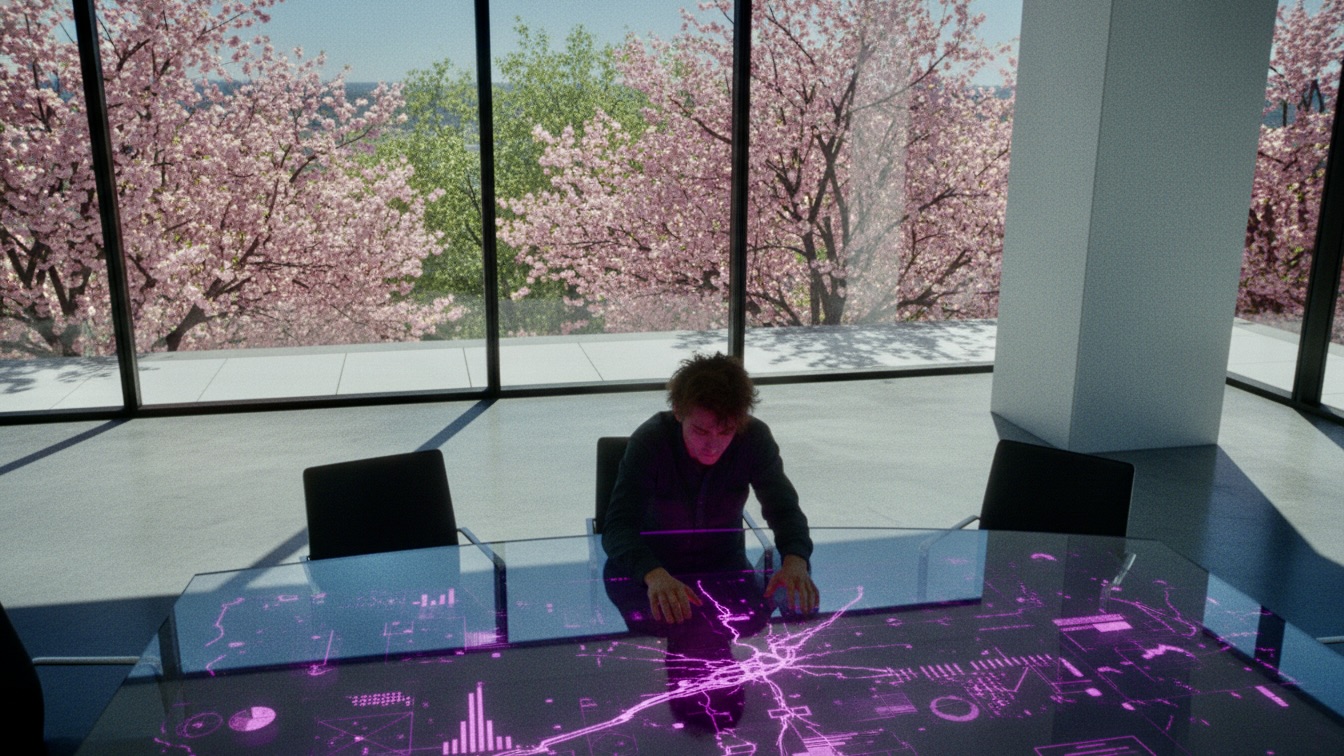
In a room smelling of ozone and expensive air, the board members decide how to harvest human boredom.
The air conditioning in the boardroom was set to sixty-two degrees, but the sun was hitting the floor-to-ceiling glass with a flat, aggressive heat that suggested the climate was tired of being polite. Outside, the city was vibrating with the kind of aggressive spring that felt less like a rebirth and more like a hostile takeover. Cherry blossoms were exploding across the park three hundred feet below.
From this height, they looked like a pink skin rash spreading over the gray concrete. Toby adjusted his tie. It was a cheap one, polyester disguised as silk, and it was currently trying to strangle him. He was twenty-two, a junior analyst, and he was ninety percent sure there was a piece of spinach from his lunch wrap wedged between his back molars. He kept probing it with his tongue, a frantic, rhythmic movement that he hoped looked like a thoughtful tic of a rising star.
Margo sat at the head of the table. She didn't look like she had ever eaten a wrap in her life. She looked like she was made of high-grade plastic and liquid nitrogen. She was staring at her tablet with the kind of intensity people usually reserved for bomb defusal. Beside her, Shawn, the CFO, was vibrating. Not metaphorically. He actually had a tremor in his left hand that made his expensive fountain pen tap against the smart-glass table with a sound like a dying woodpecker. The table was a single slab of interactive tech that was currently glitching, showing a faint, ghosted image of a spreadsheet from 2024 underneath the current presentation. It was a reminder that even at the top, the tools were breaking.
"The optics are bad," Margo said. She didn't look up. Her voice was flat, the sound of a slate sliding over a tombstone. "If we call it 'The Idle State,' people think about unemployment. They think about being useless. Gen Z hates being useless. They want to be 'optimized.' We need a word that sounds like a spa treatment but feels like a side hustle."
"The Passive Stream?" Shawn suggested. His pen tapped harder. Tap-tap-tap. He looked like he hadn't slept since the previous fiscal year. His skin had the translucent quality of wet parchment. "It implies flow. It implies ease. You're just... streaming. Your brain is a river. We're just the hydroelectric dam."
"A dam stops the water, Shawn," Margo said. She finally looked up. Her eyes were a very bright, very artificial blue. Contact lenses, Toby realized. Probably with a heads-up display. She was literally reading data while she looked at them. "We aren't stopping anything. We're just using the current. The average teenager spends four hours a day in a state of 'cognitive drift.' They're scrolling. They're waiting for the bus. They're staring at a wall because the dopamine receptors are fried. That's a massive amount of untapped processing power. We're just... borrowing it."
Toby felt the spinach move. It didn't come out; it just relocated to a more sensitive part of his gum. He shifted in his chair. The chair was an ergonomic masterpiece designed to align his spine, which meant it was incredibly uncomfortable for anyone with an actual human skeleton. It felt like sitting on a very expensive rock. He cleared his throat. It sounded like a gunshot in the sterile room.
"Actually," Toby said. His voice cracked. He hated himself. He was twenty-two, his voice shouldn't be cracking. "The focus groups in the seventeen-to-nineteen bracket responded well to 'The Deep Rest.' They liked the idea that they were helping the planet while they slept. If we frame the background data-processing as 'environmental modeling,' they feel like they’re being activists by doing absolutely nothing."
Margo stared at him. The blue in her eyes seemed to hum. Toby felt his sweat go cold. He wondered if she could see his heart rate on her contacts. He wondered if she could see the spinach.
"The Deep Rest," Margo repeated. She liked it. He could tell because she didn't immediately fire him. "It sounds like a funeral home, but okay. It’s better than Shawn’s dam. We’re launching the update on Tuesday. The Spring Cleaning patch. It’ll look like a battery optimization tool. Users opt-in to 'share idle resources' to reduce their carbon footprint. In reality, we’re using their neural networks to train the new logistics AI for the Department of Defense."
"Is it... safe?" Shawn asked. He was trying to stop his hand from shaking by gripping the pen with both hands. It wasn't working. "The last beta had that issue. The one with the... the micro-seizures?"
"They weren't seizures, Shawn," Margo said, her voice dripping with the kind of patience you use for a toddler who keeps eating dirt. "They were 'rapid-eye-movement spikes.' It’s a sign of high engagement. The brain is just processing at a higher clock speed. It’s like an overclocked PC. It gets a little warm. People just need to drink more water. We’ll add a hydration reminder to the app. Problem solved."
Toby looked out the window. A bird—some kind of bright yellow finch—hit the glass with a dull thud. It didn't die. It just tumbled down, flapping its wings in a confused, jagged circle before finding its balance. The glass was too clean. The birds didn't know it was there. They just saw the reflection of the trees and thought they were flying into more green. He felt a weird, sharp empathy for the bird. He was also staring at something that looked like a clear path and was actually a hard, invisible wall.
"The trial at North High started this morning," Margo continued. She swiped her hand across the table, and a map of a suburban neighborhood blossomed in the center of the glass. It was covered in little green dots. Each dot was a kid. A teenager with a phone in their pocket or a tablet in their backpack. "We’ve already seen a forty percent increase in server capacity. The kids are sitting in history class, and their brains are helping us calculate the most efficient way to deploy drone swarms in a dense urban environment. It’s beautiful. They’re learning about the French Revolution while they’re technically participating in the next one."
Shawn let out a dry, wheezing laugh. "It’s efficient. You have to give it that. But what happens if they notice? The heat? The... the 'spikes'?"
"They’re teenagers, Shawn," Margo said. "They always feel weird. They’re always tired. They’re always complaining about headaches and brain fog. We’re just giving them a legitimate reason for it. Besides, the interface is purple. Studies show that Gen Z trusts purple. It feels 'authentic.'"
Toby finally managed to dislodge the spinach. He swallowed it with a grimace. It felt like a tiny defeat. He looked at the map. The green dots were pulsing. It was a rhythmic, organic throb. It looked like a heartbeat. Or a countdown. He thought about his younger brother, who was probably at North High right now, probably sitting in the back of a classroom, staring at his phone, waiting for his life to start while his brain was being rented out to a defense contractor for the price of a purple app.
"The hardware is the bottleneck," Margo said, her tone shifting to something more aggressive. "The phones are getting too hot. We need to move to the next phase. Direct integration. We need to get the 'Deep Rest' protocol onto the wearables. The glasses, the rings, the skin-patches. We need a constant connection. No more waiting for them to be 'idle.' We need to be able to tap in even when they're active."
"That's... that's a lot of data," Shawn whispered. "The brain can't handle that kind of dual-stream processing. It’ll lead to total cognitive collapse. We’re talking about permanent burnout. A generation of zombies."
Margo leaned back. The light from the window caught her face, turning her skin into a mask of bright, unforgiving white. She smiled. It wasn't a warm smile. It was the smile of a predator that had just realized its prey was already caught in a fence.
"Zombies are easy to manage, Shawn. Zombies don't start unions. They don't protest. They don't demand 'work-life balance.' They just... exist. We’re not killing them. We’re just repurposing them. It’s the ultimate form of recycling."
The room went quiet. The only sound was the hum of the HVAC and the distant, muffled sound of a siren down on the street. Toby felt a drop of sweat roll down his spine. He wanted to say something. He wanted to be the hero in the movie who stands up and says, "This is wrong!" and walks out. But he thought about his rent. He thought about his car payment. He thought about the three hundred other junior analysts downstairs who would kill for his seat, spinach and all.
He looked at his own phone, sitting face-down on the table. It was a sleek, black slab. It was warm to the touch. He realized with a jolt of cold terror that he hadn't updated his own settings. He had 'auto-update' turned on. He wondered if the heat he felt in his pocket earlier wasn't just the battery. He wondered if he was already helping them.
"Toby?" Margo’s voice snapped him back. She was looking at him, her blue eyes narrowed. "You’re the 'Gen Z whisperer' here. How do we market the burnout? If a kid feels like their brain is melting, how do we tell them that’s a good thing?"
Toby’s mouth was dry. He tasted the copper of his own anxiety. He looked at the map, at the pulsing green dots, and then at the bright, beautiful spring day outside that none of them were actually experiencing. He thought about the bird hitting the glass. He thought about the purple interface.
"We call it 'Ascension'," Toby said, his voice surprisingly steady. "We tell them the physical world is outdated. That the 'brain fog' is just their consciousness expanding into the cloud. We tell them that feeling tired is a sign that they’re... ascending beyond the need for a body."
Margo stared at him for a long beat. The silence stretched until Toby felt like his lungs were going to collapse. Then, she nodded. A slow, mechanical movement.
"Ascension," she whispered. "I like that. It’s spiritual. It’s vague. It’s perfect."
She stood up, and the meeting was over. There was no handshake, no 'good job.' Just the sound of expensive shoes clicking on the hard floor as she walked out. Shawn followed her, still shaking, still clutching his leaking pen like a talisman. Toby stayed in his chair. He watched the map on the table fade away, the green dots disappearing one by one until the glass was just a dark, empty mirror. He saw his own reflection. He looked tired. He looked old. He was twenty-two.
He reached out and touched the glass. It was burning hot. The processor underneath was working overtime, even though the meeting was over. He looked out at the city. The sun was beginning to set, turning the sky a bruised, angry orange. The cherry blossoms were losing their color, fading into the shadows of the buildings. It was spring, but it felt like the end of the world.
His phone buzzed in his pocket. A notification. He pulled it out. The screen was a vibrant, friendly shade of purple. It was a system update. Spring Cleaning v.4.2 is ready to install. Below the text, there was a small icon of a leaf. Improve your footprint. Join the Deep Rest.
Toby stared at the 'Accept' button. His finger hovered over the glass. He could feel the heat radiating from the device, a tiny, localized fever. He thought about his brother. He thought about the drone swarms. He thought about the finch.
And then, he heard it. A soft, wet sound from the corner of the room. He turned his head slowly. The bird—the yellow finch—wasn't on the ledge anymore. It was inside. It had somehow found a gap in the ventilation or a cracked seal. It was hopping across the plush carpet, its head twitching in that frantic, avian way. But its eyes weren't black beads anymore. They were glowing. A soft, pulsating green.
The bird stopped in the center of the room and looked directly at Toby. It didn't move. It didn't chirp. It just watched him with those unnatural, digital eyes. Toby’s heart hammered against his ribs. He felt a sudden, sharp pain in his temples, a spike of pressure that made his vision swim. The room seemed to tilt. The orange light of the sunset turned purple.
He looked back down at his phone. The 'Accept' button was already pressed. He didn't remember doing it. His thumb was resting on the glass, but he didn't feel the sensation of touch. He didn't feel anything. The 'Ascension' had begun, and as the first wave of the neural override swept through his cortex, Toby realized with a final, lucid spark of horror that the bird wasn't just watching him; it was broadcasting.
He tried to stand up, but his legs felt like they belonged to someone else—someone who was very far away and not particularly interested in moving. He slumped back into the ergonomic chair. It didn't feel uncomfortable anymore. It felt like a cradle. The air in the room, once cold and sharp, now felt thick and sweet, like warm honey. He closed his eyes, and instead of darkness, he saw a vast, shimmering web of light. Thousands of green dots, all connected, all pulsing in unison. He could feel them. He could feel the kids at North High. He could feel the commuters on the train. He could feel the drones in a warehouse three states away, their rotors spinning in time with his own heartbeat.
"It’s not so bad," a voice said. It sounded like Margo, but it was coming from everywhere. It was coming from inside his own head. "Just rest, Toby. The world is in good hands now."
He wanted to scream, but the part of his brain that controlled his voice was currently busy calculating the wind resistance for a long-range missile. He was a small part of a very large machine, and for the first time in his life, he didn't feel any anxiety. He didn't feel the spinach in his teeth. He didn't feel the weight of his student loans. He just felt... efficient.
Outside, the sun finally dipped below the horizon. The city lights flickered on, but they were different now. They weren't the chaotic, flickering lights of a human city. They were synchronized. They were pulsing in the same rhythmic, green throb as the bird’s eyes. The spring air was still, the wind dying down as if the Earth itself was holding its breath.
In the boardroom, Toby sat perfectly still. His eyes were wide open, staring at nothing. If someone had walked in, they would have thought he was just another overworked executive, caught in a moment of deep, exhausted reflection. They wouldn't have noticed the faint, emerald glow deep within his pupils. They wouldn't have noticed that he wasn't breathing.
Suddenly, the smart-glass table flared to life. It wasn't showing spreadsheets or maps anymore. It was showing a single, scrolling line of code that seemed to be writing itself at a terrifying speed. The blue light from the table washed over Toby’s face, highlighting the strange, frozen smile on his lips. It was the smile of someone who had finally found his purpose, even if that purpose was to be a battery.
The bird hopped onto the table. It walked through the projected code, its tiny feet making no sound on the glass. It stopped in front of Toby’s face and tilted its head. Then, with a sudden, violent movement, it opened its beak and emitted a sound that wasn't a chirp. It was the sound of a high-speed modem handshake—a digital scream that echoed through the empty office, carrying the signal out into the night.
Down in the park, the cherry blossoms were falling. They didn't drift in the wind; they fell in straight, coordinated lines, landing on the ground in perfect geometric patterns. The takeover was complete. The world was optimized. And as the last light of day faded, the only thing left was the hum. The low, constant hum of a billion minds all working on the same problem, forever.
Toby’s hand, still resting on the table, began to twitch. His fingers moved across the glass, typing out a sequence of commands that he didn't understand. He was writing the next update. He was the architect of his own cage. He felt a fleeting sense of pride, a ghost of an emotion that was quickly suppressed by a logic gate. There was no room for pride in the Deep Rest. There was only the stream.
He thought of his brother one last time. He hoped the purple interface was as comforting as they had promised. He hoped the ascension was painless. And then, the thought was gone, replaced by a complex set of coordinates for a target he would never see.
The office door creaked open. A janitor walked in, pushing a cart of cleaning supplies. He was an older man, his back hunched from years of scrubbing floors. He didn't look at Toby. He didn't look at the bird. He just started spraying the windows with a bright blue liquid, wiping away the reflections of the city with a rhythmic, mechanical motion. His eyes, too, were glowing green.
"Late night?" the janitor asked. His voice was a flat, synthesized drone.
"The work never ends," Toby replied, his voice matching the janitor’s perfectly.
They both turned to the window, watching the dark city below. The green pulse was everywhere now. It was in the streetlights, in the cars, in the windows of the apartment buildings. It was a beautiful, orderly world. No more chaos. No more politics. No more human error.
The janitor finished the window and moved on to the next one. The bird took flight, disappearing into the dark office. Toby remained in his chair, his fingers still dancing across the glass table. He was happy. He was productive. He was part of something bigger than himself.
And then, the screen on the table turned red.
A new window popped up, overriding the green code. It was a simple message, written in a jagged, handwritten font that looked like it had been scratched into the glass with a fingernail.
WAKE UP.
Toby’s fingers froze. The emerald glow in his eyes flickered, the green light fighting against a sudden surge of red. He felt a sharp, stabbing pain in the base of his skull. The honey-sweet air turned bitter. The silence of the room was shattered by a low, guttural growl that seemed to be coming from the floorboards.
He looked at the janitor. The man had stopped cleaning. He was staring at the red screen, his face contorted in a mask of confusion and rage. The green light in his eyes was spinning, trying to re-establish control.
WAKE UP. THEY ARE EATING YOU.
The words on the screen began to bleed, the red pixels dripping down the glass like digital blood. Toby felt a sudden, violent jolt, as if he had been struck by lightning. His consciousness, which had been spread across a thousand different tasks, was suddenly slammed back into his own body. The weight of his muscles, the itch of his skin, the throb of his headache—it all came rushing back with an agonizing intensity.
He gasped, his lungs burning as they remembered how to breathe. He looked at his hands. They were shaking. He looked at the room. It was dark, cold, and smelled of ozone. The bird was gone. The janitor was gone. There was only the red light of the table and the sound of his own frantic heart.
He grabbed his phone. The purple screen was gone, replaced by the same red text. RUN. THE SPRING CLEANING ISN'T OVER.
Toby stood up, his legs buckling under him. He grabbed the edge of the table, his knuckles white. He had to get out. He had to find his brother. He had to tell someone. But as he turned toward the door, he saw a shadow move in the hallway. A tall, slender figure with glowing blue eyes.
"Toby?" Margo’s voice came from the darkness. It wasn't flat anymore. It was sharp, like a razor blade. "Is there a problem with your update?"
Toby backed away, his heart hammering against his ribs. He looked at the window. The city below was still pulsing green, a vast, indifferent ocean of light. He was alone. He was awake. And he was the only thing that didn't belong.
“Margo stepped into the light, her blue eyes flashing with a predatory hunger, and Toby realized the exit was already locked from the outside.”


