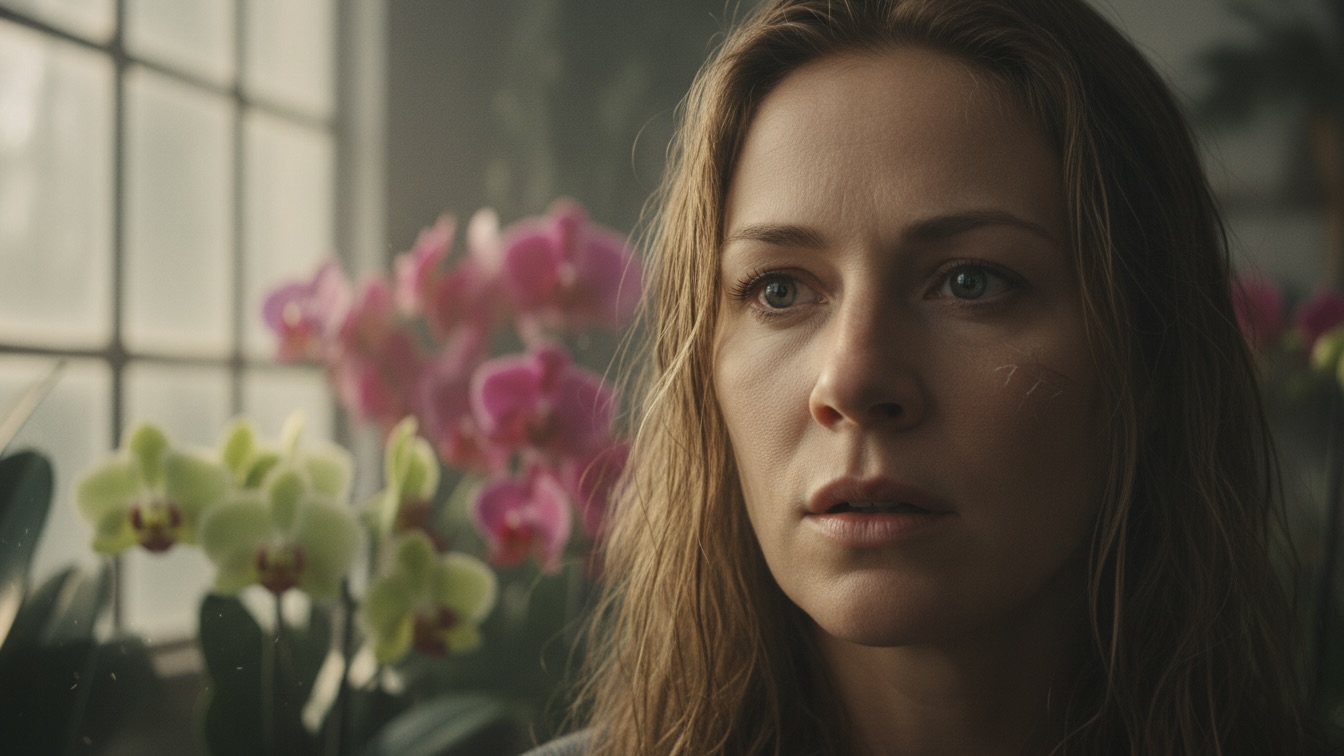
Two rival campaign managers meet in a humid greenhouse to trade threats and ghost stories of their shared past.
"You’re late," Maria said. She didn't look up from her phone. The screen was a spiderweb of cracks, a map of every time she’d dropped it while yelling at a donor or a staffer. The glass bit into her thumb as she scrolled through the latest internal numbers from the Tri-State area. The numbers were soft. Too soft.
Jared didn't apologize. He never did. He just sat on the edge of the damp wooden bench. "The traffic on I-95 is a hate crime. You know that."
"I know you like to make an entrance," she countered. She finally looked at him. He looked rested. It was insulting. His skin was clear, his hair was perfectly messy in that way that cost eighty dollars at a salon in Brooklyn, and he wasn't vibrating with caffeine-induced anxiety. He looked like a man who was winning.
They were in the Orchid House. It was mid-April, and the air inside the glass dome was thick, smelling of wet dirt and the cloying, sweet rot of tropical flowers. Outside, the DC spring was trying to happen—cherry blossoms were dying in the wind—but in here, everything was forced. Artificial. Just like the race.
"I saw the new ad," Maria said, tucking a loose strand of hair behind her ear. Her hair felt greasy. She’d been living on dry shampoo and three hours of sleep for a month. "The one where your guy is leaning against a tractor. Very subtle, Jared. Really speaks to the soul of the American farmer. Especially the part where he’s wearing a Carhartt jacket that still has the fold lines from the packaging."
Jared smirked. He pulled out his own phone. It was the newest model, pristine. "Voters don’t see fold lines, Maria. They see a color palette that suggests reliability. They see a guy who isn't afraid to get his hands dirty, even if he’s never actually touched a shovel in his life. It’s about the vibe. You’re still stuck in the data. People don't vote for data. They vote for the version of themselves they see in the candidate."
"My candidate actually grew up in a triple-decker in Southie," she said, her voice dropping an octave. "She doesn't need a vibe. She has a biography."
"And a thirty-point deficit with suburban men," Jared added. He leaned back, his arm brushing against a hanging orchid that looked like a bruised throat. "Which is why we’re here. Before things get... messy."
Maria felt a familiar tighten in her chest. Not the fluttery kind. The kind that felt like a heart attack. "We’re already messy, Jared. Your PAC is running those 'questions about her residency' spots. It’s bottom-tier stuff. It’s desperate."
"It’s effective," he corrected. "But I’m willing to pull them. If you stop the deep dive into my guy’s offshore holdings. Let’s keep it to the issues. Education. Infrastructure. The boring stuff that makes people change the channel."
Maria laughed, a short, sharp sound that didn't reach her eyes. "You want a truce because you’re scared. You know we’re about to leak the deposition from his second divorce."
Jared didn't flinch. He just swiped on his screen and turned it toward her. "I don't care about the divorce. Everyone’s divorced. It’s 2026. Nobody has a clean record anymore. But this? This might be a problem for your 'progressive champion of the people'."
He showed her a photo. It was grainy, shot from a distance through a fence. It showed Maria’s candidate, Senator Halloway, sitting at a long, linen-draped table. She was laughing, a crystal glass of something amber in her hand. In the background was the unmistakable logo of the Belvedere Club—the kind of place where the initiation fee alone could pay for a fleet of school buses. The kind of place Halloway had spent the last six months calling a 'bastion of inherited greed'.
Maria’s stomach turned. She kept her face flat. "It’s a fundraiser. Everyone goes to the Belvedere."
"Not everyone gets caught looking that happy about it," Jared said. "She looks like she belongs there, Maria. She looks like she’s finally home. If this hits the socials tonight, your base stays home on Tuesday. The activists? They’ll eat her alive. They hate a hypocrite more than they hate a Republican."
He was right. The purity tests were the one thing Maria couldn't control. The left would burn their own house down if they smelled a hint of compromise.
"What do you want?" she asked.
"I told you. A truce. We both go clean for the next seventy-two hours. We let the voters decide on the platforms. No more personal oppo. No more Belvedere photos. No more Carhartt jokes."
They sat in silence for a moment. The humidity was making Maria’s skin itch. A bead of sweat rolled down her spine. She remembered a time, three years ago, when they’d sat in a different garden—a messy, overgrown park in Boston. They’d been working for the same non-profit then. They’d talked about changing the world. They’d shared a single order of fries and a dream that politics could be more than a series of transactions.
Now, they were just two people in expensive-adjacent clothes, trading blackmail like it was currency.
"Do you remember that night in Somerville?" she asked suddenly. It was a tactical error. She knew it as soon as the words left her mouth.
Jared’s expression softened for a microsecond. The mask slipped, showing the tired guy underneath who used to read poetry to her when she couldn't sleep. "The night the heat went out?"
"Yeah. We spent four hours arguing about whether the Green New Deal was too radical or not radical enough. We thought it mattered."
"It did matter," Jared said. "Then we grew up. We realized you can’t pass a bill if you don't win the seat. And you can’t win the seat if you’re a martyr."
"Is that what you tell yourself when you’re photoshopping your candidate into a cornfield?" she asked.
"It’s what I tell myself so I can sleep," he said. He stood up, smoothing his trousers. "The offer stands until midnight, Maria. Check your emails. I sent over a memorandum of understanding. Digital signature only. No paper trail."
"I’ll talk to the Senator," she said. She didn't stand up. She felt heavy, anchored to the bench by the weight of the photo on his phone.
"You do that," Jared said. He started to walk away, then stopped and looked back over his shoulder. "You look tired, Ri. You should take a vacation after this. Regardless of who wins."
"Don't call me that," she said.
He didn't answer. He just walked out of the Orchid House, the automatic glass doors hissing shut behind him.
Maria stayed on the bench. She looked at the orchids. They were beautiful, but they were also parasites. They clung to the trees, stealing what they needed to survive. She pulled her phone out and opened her messaging app. She had a draft ready. It was a link to a folder containing the tax returns of Jared’s candidate’s brother-in-law. It would be a nuclear strike.
Her thumb hovered over the send button. The greenhouse was quiet, except for the rhythmic drip of a leaky irrigation line. Drip. Drip. Drip.
She thought about the photo of Halloway at the Belvedere. She thought about the fold lines on the Carhartt jacket. She thought about the way Jared’s voice had cracked, just for a second, when she mentioned Somerville.
It was a chess match. But in this game, both kings were already in check.
She looked at the time. 5:45 PM. The news cycle was ramping up for the evening. If she sent the file now, it would be the lead story by 11:00. If she didn't, she was trusting a man who made a living out of being untrustworthy.
She stood up, her knees popping. She felt every one of her twenty-six years. She felt fifty. She walked toward the exit, the humid air clinging to her clothes like a second skin. As she reached the door, her phone buzzed in her hand.
A new notification. An anonymous tip line. Someone had just uploaded a video to a local news portal.
She tapped the link, her heart hammering against her ribs.
It wasn't the Belvedere photo. It was something else. Something much, much worse.
Maria stopped dead in the middle of the path, the glass doors humming as they sensed her approach, waiting to let her out into the cold spring air.
“Maria stopped dead in the middle of the path, the glass doors humming as they sensed her approach, waiting to let her out into the cold spring air.”


