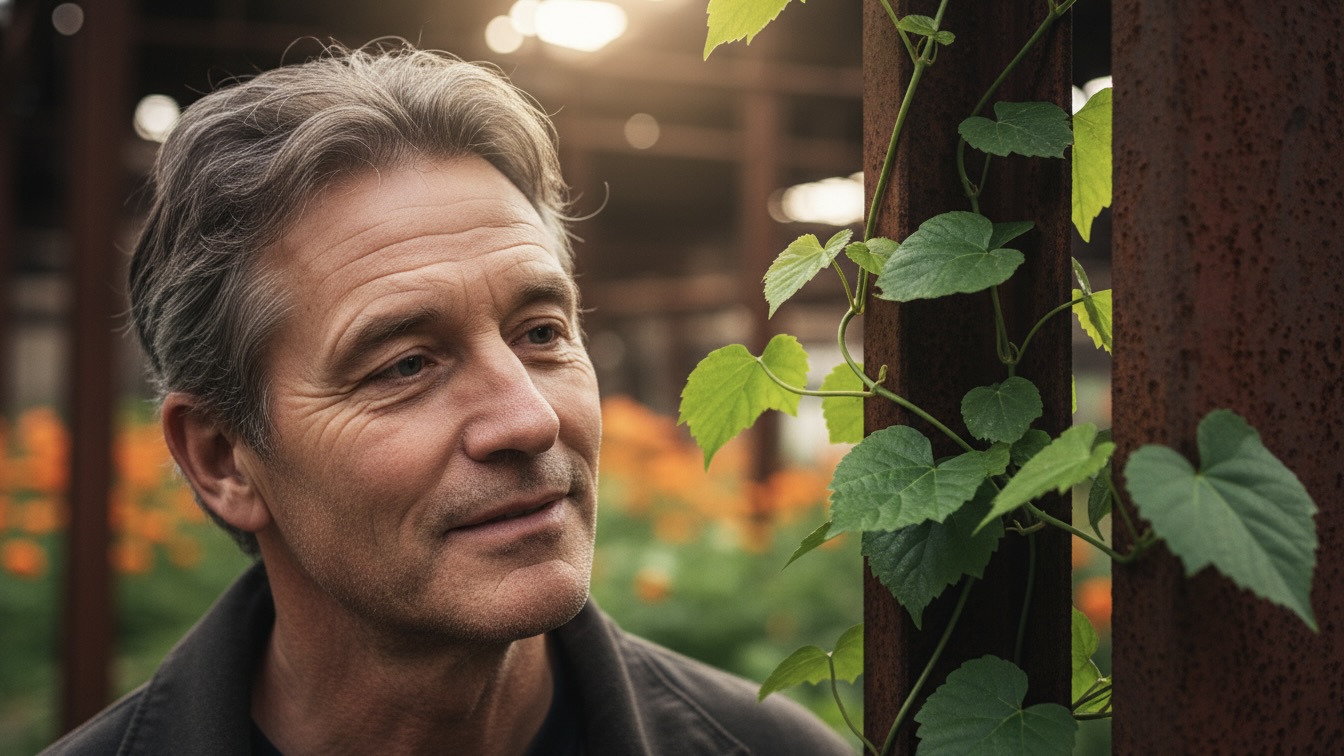
Mike returns to his rusted hometown to find a kid growing impossible plants in a dead steel mill.
My knees clicked like a cheap socket wrench as I stepped over the rusted-out shell of a 1994 sedan. This place didn't just smell like decay; it smelled like the specific, metallic sweat of an era that had been left to rot in the rain. The Bethlehem Steel sign was hanging by a single bolt, swinging in the spring wind with a sound that reminded me of a guillotine. It was a hell of a place to spend my severance package. My lungs felt tight, restricted by the ghost of the smog that used to hang over this valley. I checked my watch. 2026, and I was still wearing a mechanical piece that cost more than the average house in this zip code. I felt like a fraud.
"You're late," a voice called out from the shadows of the blast furnace.
I squinted. Sam was perched on a stack of reclaimed timber, looking like a stray cat with a data pad. He was maybe seventeen, wearing a hoodie that had seen more grease than a deep fryer and sneakers that were mostly duct tape. He didn't look like a revolutionary. He looked like he was waiting for a bus that hadn't run since the Bush administration.
"The GPS doesn't exactly recognize 'behind the giant pile of slag' as a valid destination," I said, wiping a smear of soot from my sleeve. It was useless. The soot here was permanent. It was in the soil, in the water, probably in my DNA by now.
Sam jumped down, landing with a soft thud. "GPS is for people who want to be found. This place is off the grid for a reason. You bring the credits?"
"I brought the capital. Whether it's a good investment remains to be seen," I said, looking up at the skeletal remains of the roof. Gaps in the corrugated iron let in shafts of bright spring sunlight, illuminating the dust motes dancing in the air. "This place is just a graveyard for the 20th century, Sam. We're standing in a tomb."
Sam didn't look offended. He just walked over to a massive I-beam that had buckled under the weight of decades of snow. He pointed to a small, vibrant green streak snaking its way through a crack in the steel. It wasn't just growing on the beam; it was growing through it. The leaves were thick, waxy, and a green so sharp it looked like it had been saturated in a lab.
"Graveyards have better grass," Sam said, a smirk tugging at the corner of his mouth. "Look at this. It's a poly-synthetic hybrid. Genetically resilient. It doesn't just eat CO2; it processes heavy metals from the rust. It's a sign of a new ecosystem, Mike. One that doesn't need your old world to survive."
I knelt down, my joints protesting. I touched the leaf. It felt cold, almost like plastic, but I could feel the faint vibration of water moving through its veins. It was alive. Truly alive, in a place where nothing should have been. The tightness in my chest eased, just a fraction. It was the first time I'd felt a draft of clean air in years.
"It’s beautiful," I admitted.
"It’s a machine," Sam corrected. "A green one. And it needs help. The local soil is too toxic for it to spread fast enough on its own. If we want this mill to become a sanctuary before the city council sells the land to that data center conglomerate, we need to move. Fast."
I pulled out my phone. The bank balance was a series of numbers that used to mean power. Now, they were just fuel for Sam’s fire. "I ordered the drones. Growth-acceleration models. They should be arriving at the perimeter by noon."
Sam’s eyes lit up. "The V-4s? With the nutrient misting arrays?"
"The ones with the high-yield sprayers and the AI-mapping software," I said. "They cost more than my last three cars combined. If this doesn't work, I’m moving into your mom's basement."
"My mom's basement is full of old monitors and a very territorial raccoon," Sam said. "You wouldn't like it. Let's get to the roof."
We spent the next four hours hauling crates of bio-gel up the service stairs. My heart was hammering against my ribs like a trapped bird. I wasn't built for this anymore. I was built for boardrooms and ergonomic chairs. But every time I looked out over the valley, seeing the grey, stagnant town where my father had died of lung disease, I felt a surge of something that wasn't just exhaustion. It was a strange, frantic clarity.
By mid-afternoon, the drones were humming. They looked like giant, white dragonflies, hovering over the rusted iron structures of the mill. They moved with a precision that was almost graceful, spraying a fine, translucent mist over the vines Sam had planted. Within minutes, the green started to deepen. The vines didn't just grow; they moved, creeping along the steel like they were reclaiming lost territory.
"Look at that," Sam whispered, standing on the edge of the catwalk.
I looked. The mill was changing. The harsh, jagged lines of the industry were being softened by a wave of emerald. It was a physical sense of a burden being lifted. The claustrophobia of the dead city was being replaced by the sudden oxygen of the new growth. I breathed in, deep and slow. It didn't taste like soot. It tasted like wet earth and something sharp, like crushed mint.
Suddenly, a siren wailed from the main gate. I looked down. Two black SUVs and a city council truck were idling by the chain-link fence. A man in a suit—Councilman Miller—stepped out, holding a megaphone.
"This is private property!" Miller’s voice echoed through the mill, distorted and thin. "Cease all activity immediately! You are in violation of city ordinance 402! This site is slated for demolition!"
Sam looked at me, his face pale. "They're going to kill it, Mike. They're going to tear it all down for a server farm that'll employ five people and suck the grid dry."
I looked at the drones, then at the vines. I felt a cold, hard anger settle in my gut. I’d spent thirty years playing by their rules. I’d helped write them.
"They have to get past the gate first," I said, reaching for my radio. "And they have to explain to the fifty people standing behind them why they’re killing the only thing that’s grown in this town for twenty years."
I pointed toward the road. A small crowd was gathering. Word had spread on the local forums. People from the town—my neighbors, Sam’s friends, the retired steelworkers—were standing there, watching the green bloom through the rusted iron. They weren't shouting. They were just looking. For the first time in a generation, there was something to see.
"You think they'll stay?" Sam asked.
"People like to watch things grow," I said. "It’s a novelty around here."
Miller was shouting again, but no one was listening. One of the drones banked low over the fence, trailing a cloud of nutrient mist that caught the light like a prism. The crowd cheered. It was a small sound, but in the silence of the valley, it sounded like a landslide.
I looked at Sam. He was grinning, a real, wide-eyed kid's grin. I realized then that I wasn't just saving a mill. I was trying to save myself from becoming another piece of scrap metal.
"What now?" Sam asked.
I looked at the vines, which were already reaching for the highest points of the blast furnace. The spring sun was warm on my neck, and for the first time in a decade, my head didn't ache.
"Now," I said, "we see if we can make it rain."
We stood there together, the executive and the kid, watching the iron disappear under a blanket of green. The air was thick with the scent of new life, and for a moment, the graveyard was gone. There was only the sound of the drones, the wind, and the slow, steady heartbeat of a town waking up. But as the sun began to dip below the ridge, I saw Miller picking up his phone, his face twisted in a snarl that promised this was only the beginning of a very long war.
“As the sun began to dip below the ridge, I saw Miller picking up his phone, his face twisted in a snarl that promised this was only the beginning of a very long war.”


