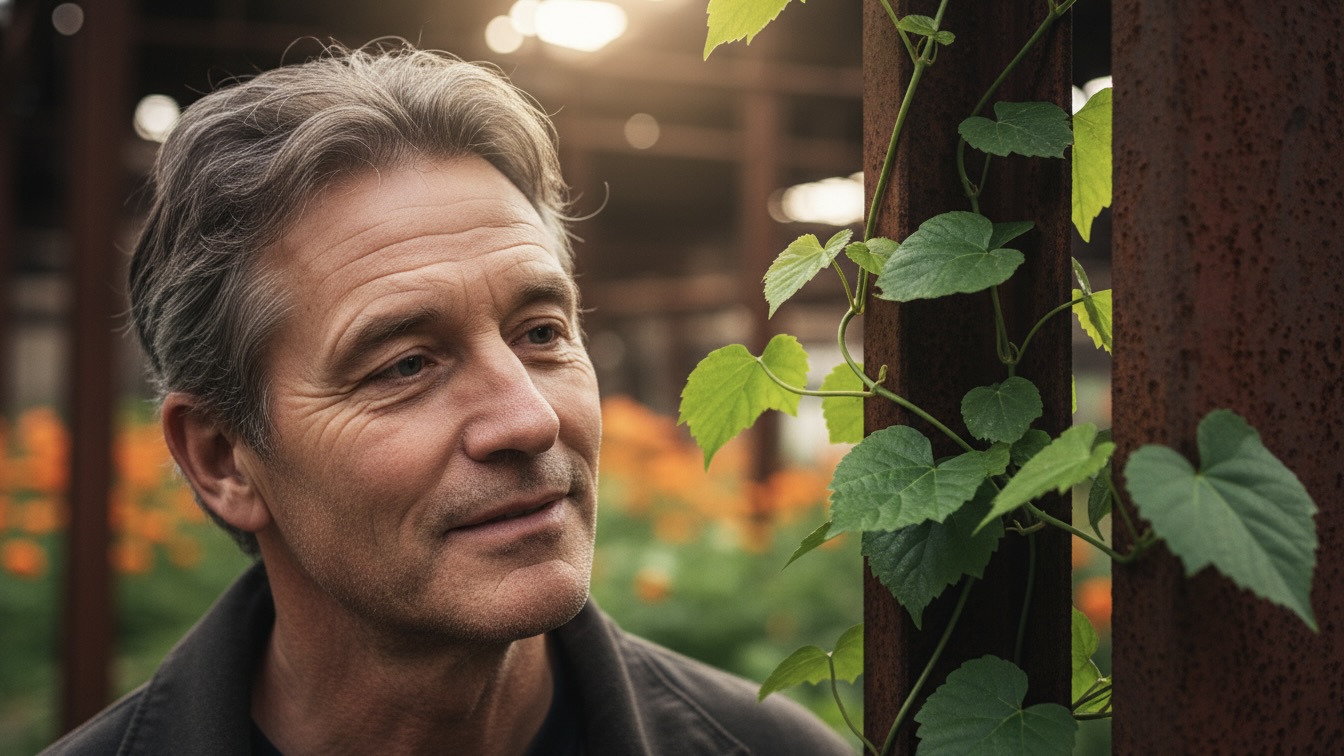
The story follows Mike, a disillusioned former executive who ventures into the decaying ruins of the Bethlehem Steel mill in the year 2026. He meets Sam, a tech-savvy teenager who has developed a genetically modified, poly-synthetic hybrid plant capable of thriving on industrial waste and heavy metals. Mike has invested his substantial severance package into this project, viewing it as a desperate attempt to reclaim a sense of purpose and environmental health. Together, they deploy high-end drones to accelerate the growth of these vines across the rusted iron structures of the mill.
As the mill begins to transform into a vibrant green sanctuary, the process is interrupted by the arrival of Councilman Miller and local authorities. They represent the corporate interests of a data center conglomerate that intends to demolish the site for a sterile server farm. Despite the legal threats, a crowd of local residents gathers at the gates, captivated by the sudden appearance of life in their stagnant town. Mike decides to resist the demolition, finding a new sense of clarity and resolve as he stands alongside Sam to protect the burgeoning ecosystem.
The central theme of the narrative is the tension between industrial decay and ecological rebirth. The story explores the concept of "Iron and Ivy," where the rigid, dead structures of the 20th century serve as the literal framework for a new, resilient form of life. This synthesis suggests that the future does not require the total erasure of history, but rather its transformation through innovative stewardship. The plants do not just grow over the rust; they process it, suggesting that the mistakes of the past can be metabolized into the growth of the future.
Another prominent theme is the search for personal and communal redemption. Mike’s journey from a high-powered executive to an environmental saboteur reflects a psychological need to atone for a career spent in "boardrooms and ergonomic chairs." His financial capital is repurposed as biological fuel, indicating that true value is found in creation rather than accumulation. Similarly, the townspeople’s silent support for the project highlights a collective yearning for beauty and vitality in a landscape that has been defined by stagnation for decades.
The story also critiques the dehumanizing nature of modern corporate development. The proposed data center represents a form of progress that offers no real benefit to the local population, serving only to "suck the grid dry" while providing minimal employment. In contrast, the greening of the mill is presented as a grassroots reclamation of space. By choosing the "green machine" over the "server farm," the characters assert that human well-being is inextricably linked to the health of the environment and the preservation of community identity.
Mike is a man grappling with a profound sense of "moral injury" resulting from his years in the corporate world. He views his own body as a reflection of the industrial decay surrounding him, noting how his knees click like a "cheap socket wrench." This physical manifestation of aging and obsolescence fuels his desire to find something "truly alive" in a place where nothing should be. He is haunted by the ghost of the smog that killed his father, making his mission at the mill a deeply personal act of vengeance against the industry that claimed his family.
Psychologically, Mike is undergoing a transition from a passive observer of decline to an active participant in renewal. His initial feelings of being a "fraud" stem from the disconnect between his high-priced mechanical watch and the poverty of the zip code he inhabits. By the end of the chapter, this dissonance is resolved through action. The "frantic clarity" he feels during the labor of hauling bio-gel suggests that he has finally found a way to align his external resources with his internal values.
Mike’s decision to stand his ground against Councilman Miller marks the completion of his character arc within this chapter. He moves from using his bank balance as a shield to using it as a weapon for social change. He recognizes that he is not just saving a mill, but saving himself from "becoming another piece of scrap metal." His final resolve to "make it rain" indicates a newfound sense of agency and a willingness to engage in a "long war" for the sake of the community’s future.
Sam serves as the narrative’s bridge between the digital age and the natural world. He is a "youthful visionary" who lacks the cynicism of the older generation, viewing the rusted mill not as a tomb but as a fertile laboratory. His reliance on duct-taped sneakers and greasy hoodies contrasts with his sophisticated understanding of poly-synthetic hybrids. This suggests that the future of environmentalism lies in the hands of those who are comfortable operating outside the traditional systems of power and prestige.
He acts as a psychological catalyst for Mike, providing the technical expertise and the raw hope necessary to spark the executive's transformation. While Mike is initially focused on the "graveyard," Sam directs his attention to the "new ecosystem" that doesn't need the old world to survive. His grin at the end of the chapter signifies a moment of pure, unadulterated success. He has managed to turn a symbol of industrial failure into a beacon of biological triumph, effectively recruiting the "old world" in the form of Mike to protect the new one.
The narrative employs a gritty, industrial-noir tone that is punctuated by moments of vivid, high-saturation imagery. The author uses mechanical metaphors to describe the setting and the protagonist’s physical state, creating a sense of coldness and rigidity. Descriptions like the Bethlehem Steel sign swinging like a "guillotine" establish a mood of looming threat and historical weight. This makes the eventual introduction of the "vibrant green" vines feel like a sensory explosion, providing a relief for both the characters and the reader.
The pacing of the chapter is handled with a deliberate sense of acceleration. It begins with a slow, labored trek through the slag, mirroring Mike’s exhaustion and the stagnant nature of the town. Once the drones are deployed, however, the narrative rhythm quickens to match the "creeping" growth of the vines and the arrival of the authorities. This shift from the lethargic past to the frantic present emphasizes the urgency of the environmental crisis and the high stakes of the confrontation with the city council.
Sensory details are used effectively to track the emotional arc of the story. The initial "metallic sweat" and "permanent soot" give way to the scent of "wet earth" and "crushed mint" as the drones work their magic. This olfactory transition serves as a powerful metaphor for the purification of the site and Mike’s own internal cleansing. By the end of the chapter, the air no longer tastes like soot, symbolizing that the "tightness" in Mike’s chest has been replaced by the possibility of a new, breathable future.


