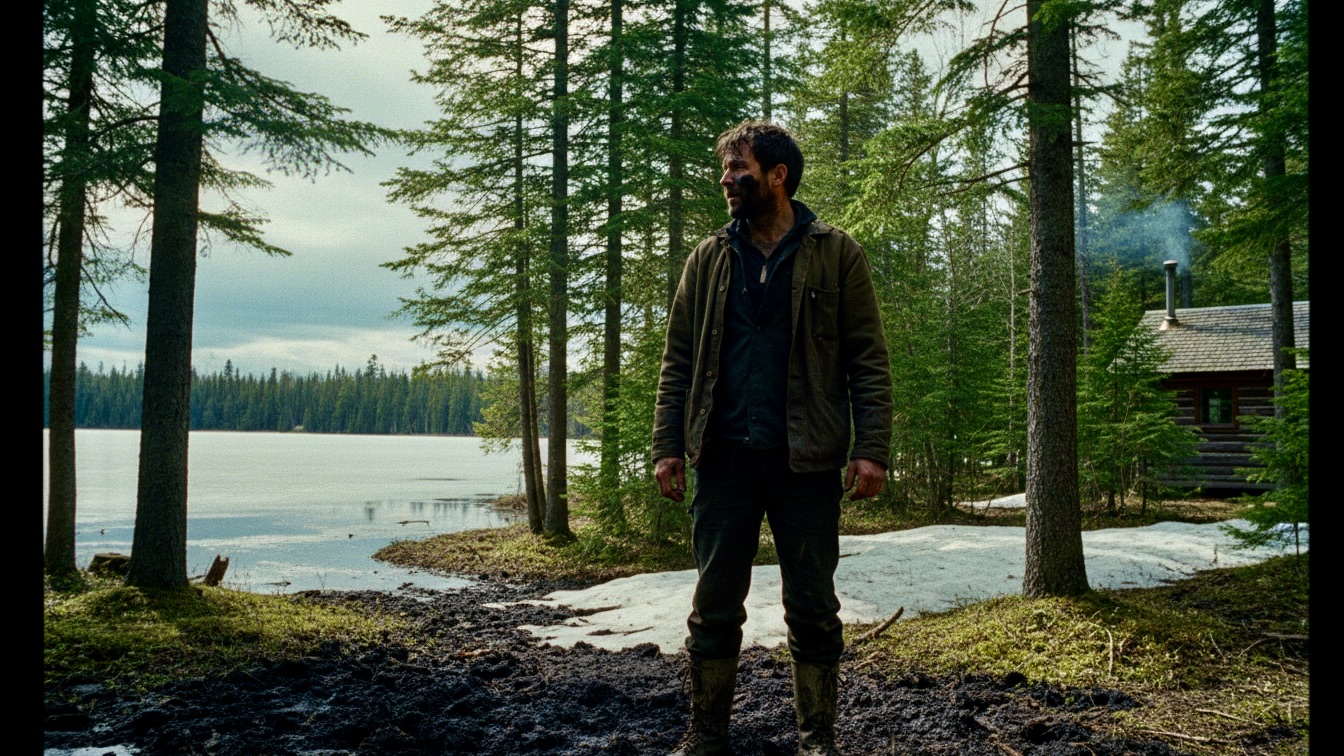
Andy returns to the northern woods, trading city noise for the raw, muddy reality of a lingering spring.
The winch groaned. It was a high, thin sound that set Andy’s teeth on edge, vibrating through the cold metal of the handle and into the meat of his palms. He wasn’t used to this. His hands were soft, calloused only by the friction of a mouse and the occasional gym session. Now, they were slick with a mix of old grease and the freezing slush that coated everything in the bush.
The truck’s tires were buried halfway to the rims in the black, muskeg mud of the driveway—if you could even call it a driveway anymore. It was more of a suggestion, a scar in the earth that the forest was aggressively trying to heal. He wiped sweat from his forehead with the back of a muddy glove, leaving a dark smear across his skin. The air was sharp. It didn't just smell like pine; it smelled like wet stone and decaying leaves and the promise of something green. It was a lot. After four years in a Toronto condo where the windows didn't even open, the sheer volume of the atmosphere felt like a physical weight.
He took a breath. It was deep, deeper than he’d managed in months. In the city, the air always felt secondhand, like it had been breathed by six million other people before it got to him. Here, it felt new. It felt like oxygen was a brand-new invention. He looked up at the sky, a hard, brilliant blue that seemed to stretch out forever, uncontained by glass towers or smog. The crows were back, circling the tops of the jack pines and screaming at each other. They sounded like they were laughing at him. 'Yeah, yeah,' Andy muttered, his voice sounding small and brittle against the silence of the woods. 'I know. I'm a mess.'
'You’re more than a mess, you’re stuck,' a voice called out. Andy turned, his boots squelching in the mud. Cathy was standing by the porch of the cabin, her hands shoved deep into the pockets of a faded work jacket. She looked like she belonged here. She’d stayed in Kenora while he’d gone off to chase the 'future,' and the difference was written in the way she stood—balanced, grounded, like she had roots of her own. She wasn't looking at him with pity, exactly. It was more like she was watching a dog try to walk on its hind legs. Amused, but skeptical.
'I’ve got it,' Andy said, though the winch had stopped moving entirely. 'The tension is just... it’s a lot.'
'It’s a winch, Andy, not a yoga class,' Cathy said, stepping off the porch. Her boots were worn, the leather cracked at the creases. She walked through the mud with a practiced indifference that he envied. 'You’re going to snap the cable if you keep cranking like that. Look at the angle. You’re pulling against the stump, not over it.'
'I see that,' he lied. He didn't see anything but the mud and the rusted bumper of his SUV. The vehicle looked ridiculous here—too shiny, too white, like a tooth dropped in a bowl of dirt. He let go of the handle, and it kicked back, nearly catching his wrist. He swore, a short, sharp sound that the trees seemed to swallow instantly.
'Language,' Cathy joked, though there was no heat in it. She reached him and shoved him gently aside. 'Get the boards from the shed. The cedar ones. We need to create a ramp, or you're just digging a grave for that thing.'
Andy didn't argue. He walked toward the shed, his legs feeling heavy. Every movement felt deliberate here. In the city, everything was automated, frictionless. You pressed a button, and food appeared. You tapped a screen, and a car arrived. Here, if he wanted to move, he had to fight the earth itself. He reached the shed and pulled at the door. It was swollen shut from the damp, resisting him. He threw his shoulder against it, once, twice, and on the third hit, it gave way with a wood-on-wood shriek. The interior smelled of motor oil, mothballs, and mouse droppings. It was a familiar smell, one that triggered a sudden, sharp memory of his father standing in this exact spot, holding a rusted handsaw and swearing about the price of gas. Andy stood there for a second, the darkness of the shed cooling the heat in his face. He felt a lump in his throat that had nothing to do with the dust. It was the realization that he was the adult now. He was the one responsible for this rotting wood and this stubborn land.
He found the boards under a pile of blue tarps that had turned brittle with age. He dragged them out, the wood rough against his fingers. When he got back to the truck, Cathy was already clearing the mud from the tires with a shovel. She looked up, her face flushed. 'Took you long enough. Find a ghost in there?'
'Maybe,' Andy said. He dropped the boards. 'The door was stuck.'
'Everything’s stuck in April,' she said. 'The ground’s still frozen six inches down. The top is just... soup. It’s the worst time to be here, you know. You could have waited until June.'
'I couldn't,' Andy said. He hadn't told her the full story. He hadn't told her about the panic attack in the middle of a board meeting, or the way he’d stared at his reflection in a darkened monitor and realized he didn't recognize the man looking back. He’d just told her he needed a break. A 'sabbatical.' The word felt fake now, a corporate term for a soul-deep collapse. 'I needed to see the ice break.'
Cathy stopped shoveling. She looked at him, really looked at him, and for a second, the sarcasm vanished. 'It’s loud,' she said softly. 'When the lake goes. It sounds like a gunshot. People think it’s peaceful, but it’s violent. It’s a struggle.'
'Good,' Andy said. 'I’m tired of peaceful.'
They worked in silence for the next hour. It was a rhythmic, grueling process of jacking up the car, shoving boards under the tires, and trying again. The sun climbed higher, turning the slush into a blinding, shimmering sheet. The air warmed, bringing out the scent of wet cedar. Andy’s back ached, a dull, pulsing heat at the base of his spine, but he didn't stop. He liked the ache. It was real. It was something he could point to and say, 'I did that.' By the time the truck finally lurched forward, gripping the wood and hauling itself onto the firmer gravel near the cabin, Andy was covered in filth. He stood there, chest heaving, watching the mud drip from the wheel wells.
'You look like hell,' Cathy said, leaning on the shovel. But she was smiling. It was the first real smile she’d given him since he’d pulled up the day before.
'I feel like it,' Andy admitted. He wiped his face, probably just making the mud smear worse. 'But the truck's out.'
'The truck's out,' she agreed. 'Now come inside. I made coffee. Real coffee, not that instant garbage you brought.'
Inside, the cabin was cold. Not the sharp cold of the outdoors, but a damp, lingering chill that seemed to live in the floorboards. Cathy had started a fire in the woodstove, and it was beginning to crackle, throwing a flickering orange light across the pine-paneled walls. The furniture was a hodgepodge of eras—a plaid sofa from the eighties, a heavy oak table their grandfather had built, and a couple of modern folding chairs Andy had brought. On the wall, a framed map of the Lake of the Woods was yellowed with age, the edges curling under the glass.
Andy sat at the table, his muscles twitching as they began to relax. Cathy set a heavy ceramic mug in front of him. The steam smelled like heaven. 'So,' she said, sitting across from him. 'How long, really?'
'I don't know,' Andy said. He took a sip of the coffee. It was strong enough to peel paint. 'My boss thinks I'm coming back in a month.'
'And you?'
'I think I deleted the app from my phone.'
Cathy raised an eyebrow. 'The email one? Or the one that tells you how many steps you took?'
'All of them. I threw the phone in the glove box when I hit the border. It’s probably dead by now.'
'That’s a start,' she said. She looked around the room, her gaze lingering on the water stains on the ceiling. 'The roof needs work. The shingles on the north side are gone. Winter was hard this year. Lots of heavy snow. I came up in February to shovel it off, but I couldn't get everything.'
'I'll fix it,' Andy said. The words felt heavy, but not in a bad way. They felt like a commitment.
'You don't know how to shingle a roof, Andy.'
'I can learn. There's probably a book in the shed. Or I'll just... figure it out.'
'It’s not a YouTube tutorial world out here,' she warned. 'You mess up a roof, and the next rainstorm ruins the floor. Then you’ve got mold. Then you’ve got a teardown.'
'I know, Cathy. I’m not an idiot.'
'I didn't say you were an idiot. I said you were out of practice. There’s a difference.' She reached across the table and tapped his hand. 'Don't try to do everything at once. The land doesn't move at your speed. It moves at its own. You try to rush it, you’ll just break something. Usually yourself.'
Andy looked out the window. From here, he could see a sliver of the lake through the trees. The ice was grey and honeycombed, pulling away from the shore. It looked fragile, yet massive. He thought about his life in the city—the constant pings, the 'urgent' messages about things that didn't matter, the feeling of being a small gear in a machine that was grinding itself to dust. He’d spent a decade building things that didn't exist, digital platforms and marketing strategies that disappeared the moment someone closed a tab. Here, if he fixed a roof, it stayed fixed. If he pulled a truck out of the mud, it stayed out. It was a different kind of reality.
'I just want to feel like I’m actually standing on the ground,' he said, mostly to himself.
'Well,' Cathy said, standing up. 'You’re covered in it. So I’d say you’re off to a good start.' She headed toward the door. 'I’ve got to get back to the shop. Ben’s coming by tomorrow with the tractor to help you clear those downed trees by the creek. Don't try to do it yourself with a chainsaw. You’ll lose a leg.'
'Ben? Is he still...'
'Still grumpy? Yes. Still the best mechanic in the district? Also yes. He’ll charge you a case of beer and a lot of your pride. Pay him both.'
She left, the screen door banging shut behind her. The sound echoed in the quiet cabin. Andy sat there for a long time, listening to the fire and the wind whistling in the eaves. The silence wasn't empty; it was full of small noises. The house creaking. The ice shifting. His own breathing. He felt a strange sensation in his chest—a loosening. Like a knot that had been pulled tight for years was finally beginning to fray.
He stood up and walked to the door, stepping out onto the porch. The sun was starting to dip, casting long, dramatic shadows across the melting snow. The temperature was dropping fast, the damp air turning crisp. He walked down the steps, his boots no longer sinking as deep into the mud as the surface began to crust over with ice. He walked toward the lake, pushing through the brush. The alder branches swiped at his jacket, and the scent of crushed needles was sharp in his nose.
He reached the shore. The lake was a vast, silent expanse of grey. He walked out onto a flat granite rock that jutted into the water. The stone was cold and rough, covered in patches of pale green lichen. He sat down, wrapping his arms around his knees.
In the distance, he heard it.
A low, guttural moan that seemed to come from the very bottom of the water. It was followed by a sharp crack, like a rifle shot, echoing off the distant hills. The ice was moving. It was breaking apart, yielding to the pressure of the season. It wasn't a pretty process. It was messy and loud and chaotic. But it was happening.
Andy closed his eyes. He felt the cold air on his face, the weight of the mud on his boots, and the solid, unyielding strength of the rock beneath him. He wasn't thinking about his emails. He wasn't thinking about his bank account or his career or the 'metrics' of his life. He was just there. A man on a rock, in the middle of a forest, watching the world wake up.
He felt a sudden, sharp pang of hunger—a real, physical hunger, not the bored craving for snacks he usually felt at his desk. He needed to eat. He needed to sleep. He needed to get up tomorrow and face the roof and the trees and Ben’s grumpy face.
He stood up, his joints popping. The shadows were deep now, the woods turning into a wall of black and grey. He turned back toward the cabin, the small glow of the window a beacon in the twilight. As he walked, he noticed something near the base of a birch tree. A small, bright green shoot poking through the matted brown leaves. It was tiny, barely an inch high, but it was there.
He stopped and looked at it. It seemed impossible that something so delicate could survive the weight of the snow and the violence of the thaw. But it had.
'Okay,' he whispered. 'Okay.'
He reached the porch and kicked the mud off his boots one last time. He felt lighter. The claustrophobia of the last decade hadn't vanished, but it had shifted. It was no longer a cage; it was just a memory. He went inside and closed the door, the click of the latch sounding final.
The next morning, the world was different again. A light dusting of snow had fallen overnight, a final gasp of winter, covering the mud in a thin veil of white. Andy woke up before the sun, his body stiff but his mind clear. He made more of the strong coffee and stood by the window, watching the light slowly fill the yard.
A truck rumbled in the distance. Ben.
Andy felt a surge of something he hadn't felt in a long time. It wasn't quite excitement—it was too grounded for that. It was purpose. He went to the closet and pulled out his father’s old work gloves. They were stiff and smelled of cedar, but they fit. He pulled them on, flexing his fingers.
He walked out to meet the tractor, the cold air hitting him like a splash of water. Ben pulled up, the old diesel engine rattling the air. He was a barrel-chested man with a beard the color of wood smoke and eyes that had seen a thousand springs just like this one. He hopped down from the cab, his movements slow and deliberate.
'You Andy’s boy?' Ben asked, his voice like gravel.
'I'm Andy,' Andy said, holding out a hand.
Ben looked at the hand, then at Andy’s face. He didn't shake it. He just nodded toward the fallen trees by the creek. 'Tough spot. You picked a hell of a time to come home.'
'The best time,' Andy said.
Ben grunted. It might have been a laugh. 'We’ll see. Grab the chain. And try not to get in the way.'
They worked through the morning. The work was louder and more dangerous than the winch struggle. The tractor roared, the chains clanked, and the sound of the chainsaw ripped through the stillness of the woods. Andy learned how to set a choke, how to read the lean of a tree, and how to stay out of the 'kill zone' when a trunk finally gave way. It was exhausting. It was dirty. It was perfect.
By noon, they had cleared the creek. The water was running faster now, freed from the debris, a bright, cold ribbon of life cutting through the mud. They sat on the tailgate of Ben’s truck, eating sandwiches that were mostly bread and thick slices of ham.
'Your dad used to talk about you,' Ben said, staring out at the water. 'Said you were good with numbers. Said you were going to build things.'
'I did,' Andy said. 'But they weren't... they weren't this.'
'Numbers are fine,' Ben said. 'But you can't stand on a number. You can't burn a number to keep your house warm.' He stood up and slapped the side of the truck. 'I’m headed into town. You need anything?'
'Shingles,' Andy said. 'And a ladder. A good one.'
Ben nodded. 'I’ll drop 'em off tomorrow. And Andy?'
'Yeah?'
'Don't fall off. I don't feel like hauling your carcass to the hospital. It’s a long drive.'
'I’ll try to keep that in mind,' Andy said.
As the tractor rumbled away, Andy stood by the creek. The sun was warm on his neck, but the air coming off the water was still ice-cold. He felt a sudden, overwhelming sense of clarity. The 'burden' he’d been carrying—the expectations, the stress, the constant noise—it hadn't just been lifted. It had been replaced. By the weight of the wood, the cold of the water, and the reality of the work.
He looked toward the cabin. It was small and weathered and needed a lot of love. But it was his. And for the first time in his life, he knew exactly what he had to do next.
He walked back to the house, his stride longer, his head up. He didn't look at his hands. He didn't look at the mud. He looked at the roof, planning the lines of the shingles, imagining the way the new wood would smell.
There was a quest here. Not one involving spreadsheets or quarterly goals. This was a quest for stability. A quest to build something that could withstand the thaw.
He stepped into the kitchen and saw the old logbook his father had kept, tucked into a nook by the stove. He opened it. The last entry was from five years ago. 'Ice out late. Roof holding. Need to paint the porch.'
Andy picked up a pencil. His hand was steady.
'April 14th,' he wrote. 'Ice is breaking. Creek is clear. Starting the roof tomorrow.'
He closed the book. The house was quiet, but it wasn't lonely. It was waiting. And so was he.
He walked back outside, the sun now high and bright. He didn't feel like a city man playing at being a woodsman. He just felt like a man. And that was enough. More than enough.
The afternoon stretched out before him, vast and unscripted. He took a deep breath, the 'sudden oxygen' filling his lungs again, and started toward the shed. There was a ladder to find, and a world to rebuild, one shingle at a time.
“He reached for the rusted latch of the storage chest, wondering if the old man had left the one thing he actually needed to survive the night.”


