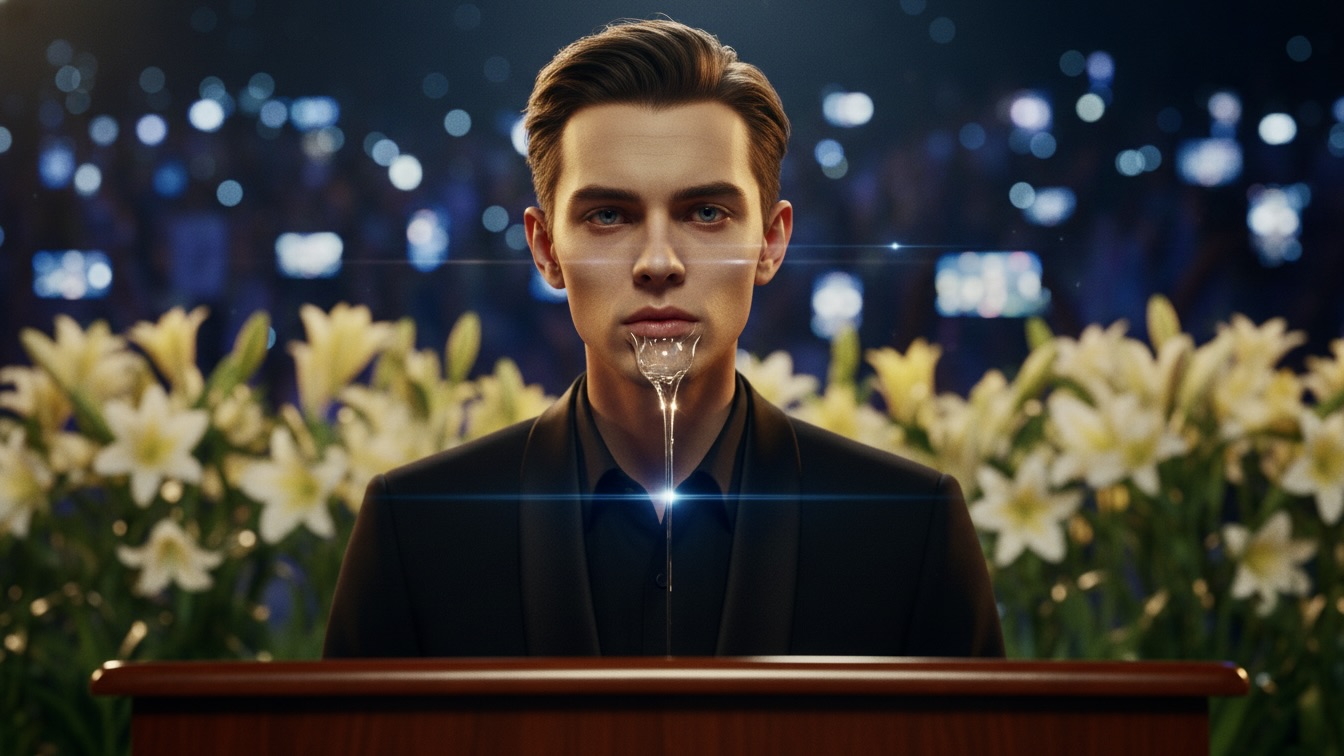
Arthur trades his literal face for a literary award while his AI-generated novel breaks the internet for vibes.
The screen flickered, casting a blue, sickly light across the remains of a three-day-old poke bowl. Arthur scrolled through the final chapter of 'The Ghost of a Memory,' or whatever the hell the bot had named it this time. It was a mess. The sentence structures were repetitive. The metaphors were recycled garbage about clocks and oceans. It was, by any objective standard of the year 2020, a pile of steaming shit. But it was 2026. Nobody was reading the sentences. They were reading the metadata. They were reading the aura.
"This shit is total slop," Arthur muttered to the empty room. His voice sounded thin, even to himself. He leaned back, the plastic of his gaming chair groaning. He looked at the folder on his desktop labeled 'COVER_ART_V3.' He clicked it open. A high-contrast, grainy photo of a man looking out a rainy window, his face obscured by shadow but his jawline sharp enough to cut glass. It was moody. It was evocative. It was a vibe. "But the cover is gonna be fire."
He rubbed his eyes. His fingers felt heavy. He tried to think of a word to describe the feeling of the room. Stagnant? No. Boring. Just boring. He tried to type a sentence into the bottom of the manuscript. 'He felt a sense of...' He stopped. His hands hovered over the keys. 'A sense of...' The cursor blinked. A rhythmic, mocking pulse. He couldn't remember the last time he’d finished a sentence without the 'AutoComplete' suggestion. He was a passenger in his own career. He was the mascot for a brand he didn't even like.
The clinic was located in a part of the city where the trees were trimmed into perfect, unnatural spheres. It was Spring, and the cherry blossoms were dropping petals like pink confetti onto the windshields of Teslas. Arthur walked through the glass doors, his reflection catching in the tint. He looked tired. His chin was weak. His eyes were too expressive, too full of a pathetic, desperate humanity that didn't sell books anymore. He needed to be colder. He needed the 'Sad Boy' package.
Dr. Aris didn't look like a doctor. He looked like an architect who specialized in minimalist bunkers. He wore a black turtleneck and wire-rimmed glasses that had no lenses. He circled Arthur, poking at his cheekbones with a gloved finger. "The bone structure is adequate, but the spirit is messy," Aris said. His voice was a flat monotone. "You want the Sterling Cup? You need the 'Melancholy Edge.' It's our most popular facial map for the literary sector. Hollowed orbits, a slight permanent downturn of the lower lip. We call it the 'Dying Poet' look."
"Will it hurt?" Arthur asked.
"Pain is a dated concept, Arthur. This is about alignment. Your book is a product of high-level algorithmic sorrow. Your face must reflect that. If the face and the text don't sync, the audience detects a glitch in the brand. That's why you're failing."
"I'm not failing," Arthur said, though his bank account suggested otherwise. "I'm just... between cycles."
"You're a ghost," Aris said, picking up a silver marker. He began drawing lines on Arthur's face. "Let's make you a haunt."
Three weeks later, Arthur sat in a booth at a bar so dark the waiters had to wear night-vision goggles. Across from him was James, the most influential critic in the tri-state area. James didn't have a book on the table. He had an iPad Pro displaying a dashboard of real-time sentiment analysis.
"The engagement on the announcement post is up 400 percent," James said, not looking up. "The new jawline is doing numbers, Arthur. It's giving 'I haven't slept since the revolution.'"
"Did you get a chance to look at the draft I sent over?" Arthur asked. He tried to smile, but the implants in his cheeks made it feel like his skin was made of tight leather. It didn't hurt; it just felt wrong. Like wearing a mask that was a size too small.
James finally looked up. He squinted at Arthur’s face. "I glanced at the metrics. The word-cloud looks good. Lots of 'longing' and 'shattered.' I didn't actually read the prose, obviously. Who has the time? But the aesthetic consistency is 98 percent. That’s Sterling Cup territory."
"I think the second act is a bit weak," Arthur said. "The AI got caught in a loop about a toaster for three pages."
"The toaster is a metaphor for the futility of heat in a cold universe," James said, his eyes returning to the screen. "Keep the toaster. It's weird. Weird is 'authentic' right now. By the way, your follower growth slowed down this morning. Put up a picture of yourself looking at a dead bird or something. Keep the momentum."
Arthur felt a cold knot in his stomach. He wanted to say something real. He wanted to talk about how he used to spend hours debating the placement of a comma. He wanted to tell James that he felt like he was disappearing into the blue light of his own devices. But James was already on a call, gesturing wildly at a graph that was trending upward.
Arthur went home and sat in front of his laptop. He opened a blank document. No prompt-bot. No suggestions. Just him. He tried to write about the surgery. He tried to write about the way the light hit the silicone under his skin. 'The needle went in...' No. 'I felt the needle...' He deleted it. He couldn't do it. The words felt like heavy stones he couldn't lift. He was a curated image. A collection of data points. He typed: 'The sadness was very big.' He stared at it. It was pathetic. He deleted it and opened the prompt-box. 'Write a scene about a man feeling hollow in a beautiful room.' The bot spat out three paragraphs of perfect, polished, soul-less prose in four seconds. Arthur copied and pasted it. He felt nothing.
The Sterling Cup ceremony was held in a converted cathedral. The air was thick with the scent of expensive lilies and the ozone of a hundred high-end cameras. Arthur stood in the wings, wearing a suit that cost more than his car. His face was a masterpiece of engineered sorrow. He looked beautiful. He looked broken. He looked like the best-selling author of 'The Ghost of a Memory.'
"You're on in five," a producer whispered. She didn't look at his eyes; she looked at his cheekbones. "The lighting is set to 'Tragic Gold.' Don't blink too much."
Arthur stepped onto the stage. The applause was a physical wall of sound. It wasn't for the book. He knew that. It was for the performance. He looked out at the sea of faces, all of them illuminated by the glow of their phones. They were recording him, capturing the 'Sad Boy' in his natural habitat.
He reached the podium. The trophy was a heavy, silver flame. As he leaned forward to speak, a sharp, stinging heat blossomed in his chin. He ignored it. "I want to thank the algorithm," he began. The audience laughed. It was the right thing to say. Irony was the only currency left.
But the heat was spreading. It felt like a slow, warm drip. He saw Leo, a rival novelist who actually still used a typewriter, sitting in the front row. Leo's eyes widened. He pointed a finger.
"Arthur," Leo shouted over the applause. "Your face. It's... melting."
Arthur reached up. His fingers came away wet. A clear, viscous fluid was seeping from a seam near his jaw. The implant was failing. The structural integrity of his 'aesthetic' was literalizing its own collapse. A thick bead of medical-grade silicone dripped onto his white shirt, leaving a translucent stain.
The room went silent. The cameras zoomed in. Arthur could see himself on the giant monitors flanking the stage. He looked like a wax figure left too close to a radiator. His 'Sad Boy' chin was sagging, pulling his lower lip down into a grotesque, lopsided sneer.
"He's leaking," someone hissed.
"Is this a performance?" another voice asked.
Arthur felt a moment of pure, unadulterated panic. He wanted to run. He wanted to hide his face. But then he saw the metrics. On the screens, the live-stream comments were exploding. 'Brave.' 'The ultimate critique of the plastic soul.' 'He's literally falling apart for his art.' 'Iconic.'
He looked at the leaking fluid on his hand. It was sticky. It smelled like a new car. He looked back at the audience. He didn't fix it. He didn't cover it. He leaned into the microphone, the silicone now dripping steadily onto the silver trophy.
"This is the reality of the contemporary narrative," Arthur said, his voice cracking. It wasn't the bot's words. It was his own. "We are all leaking. We are all trying to hold together a shape that wasn't meant for us."
The cathedral erupted. It was a standing ovation. People were crying. They weren't crying for the book; they were crying for the bit. They were crying for the sheer, committed audacity of a man who would let his own face dissolve to win a cup.
James the Critic was in the front row, typing furiously. "The leak is the text!" he shouted. "The leak is the only honest thing he's ever written!"
Arthur stood there, clutching the silver flame, his chin slowly drifting toward his neck. He had won. He had reached the pinnacle of his career. He was the most authentic fraud in the world. As the lights dimmed and the crowd began to swarm the stage for selfies, Arthur felt a strange, new sensation. It wasn't sorrow. It wasn't joy. It was the crushing weight of a new expectation. He had to top this. He had to find a way to break even more spectacularly next time. He looked at the trophy, then at his reflection in the polished silver. The 'Sad Boy' was gone. In his place was something much more valuable: a tragedy that could be sold.
“He turned away from the flashbulbs, wondering what part of himself he would have to dissolve next to keep them watching.”


