Format: Short Film / Anthology Episode | Est. Length: 10-12 minutes
Imagine a near-future anthology series where the boundary between human identity and digital commodity has dissolved entirely, leaving creators as mere mascots for their own metadata. The Plastic Award serves as a cornerstone episode in this landscape, illustrating a world where the "author" is no longer a creator of words, but a curated vessel for algorithmic expectations. This series explores the "Post-Authentic Age," where AI-generated content is the baseline and human suffering is only valuable if it can be surgically optimized and monetized through real-time sentiment analysis.
Arthur stares at a screen of AI-generated "slop" and realizes his expressive, "human" face is the only thing preventing his book from becoming a bestseller. He decides to undergo radical facial reconstruction to match the "Dying Poet" aesthetic demanded by his target demographic.
In a future where literary success depends entirely on a curated physical aesthetic, a struggling author undergoes radical facial reconstruction to match his AI-generated prose. When his implants fail during his greatest moment of triumph, he must decide whether to hide his flaw or monetize his own disintegration.
The primary theme explores the death of authenticity in an age of algorithmic dominance, where the "aura" of a creator is more important than the quality of the creation. It examines the commodification of sorrow, suggesting that in a world of perfect AI prose, the only remaining currency is the performative suffering of the human behind the machine.
The episode also functions as a satire of modern branding and the "Sad Boy" aesthetic, highlighting the absurdity of a culture that demands "vulnerability" while simultaneously requiring it to be surgically perfect. It is a psychological horror-drama about the loss of self, as Arthur transitions from a passenger in his career to a literal product that can leak and break.
For Arthur, the stakes are both financial and existential; he is on the brink of bankruptcy and total cultural irrelevance. If the "Dying Poet" surgery fails to resonate with the metrics, he loses his career, but by succeeding, he risks losing the last vestiges of his genuine human identity to a corporate-mandated mask.
The primary external conflict is the algorithmic publishing industry, personified by the cold Dr. Aris and the data-obsessed critic James, who demand total aesthetic consistency over artistic merit. Internally, Arthur struggles with his own obsolescence, battling the urge to write something "real" while knowing that only the "plastic" version of himself can survive in the current economy.
Arthur is a "writer" in 2026 who uses AI to generate repetitive, soul-less manuscripts, but his career is failing because his physical appearance lacks the "vibe" necessary to sell the metadata. Desperate for success, he visits Dr. Aris, a minimalist aesthetic surgeon who replaces Arthur’s "pathetic humanity" with the "Dying Poet" package—a set of silicone implants designed to give him a permanent look of hollowed-out, algorithmic sorrow. The transformation is an immediate success; his engagement metrics skyrocket, and the industry’s most influential critic, James, hails his "aesthetic consistency" without ever reading a single word of his prose.
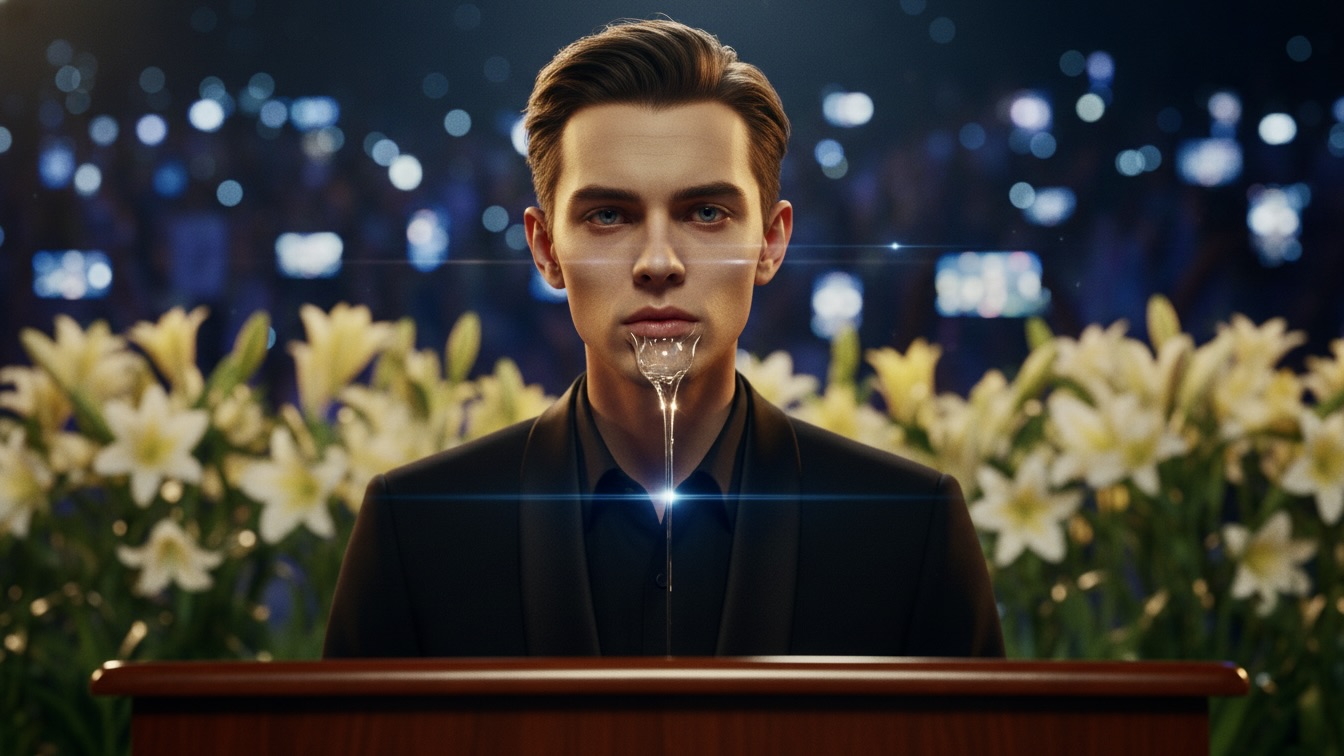
As Arthur prepares to receive the prestigious Sterling Cup, he finds himself unable to write even a simple sentence without the help of a prompt-bot, realizing he has become a hollow shell for his brand. During his acceptance speech at a cathedral-turned-gala, the heat of the stage lights causes his implants to fail, and his face begins to visibly melt and leak medical-grade silicone in front of the cameras. Instead of being shunned, the audience and critics interpret his literal physical collapse as a profound piece of performance art. Arthur realizes that his greatest "work" isn't his writing, but the marketable tragedy of his own disintegration, cementing his status as a successful, yet permanently broken, icon.
Arthur: A desperate, fading novelist who begins the story as a frustrated human trying to find a place in a bot-driven world. By the end, he has fully transitioned into a "curated image," trading his ability to feel and create for a surgically engineered mask of tragedy. His arc is one of total submission to the brand, culminating in the realization that his only value lies in how well he can "leak" for his audience.
Dr. Aris: A cold, clinical architect of identity who views the human face as a "facial map" to be optimized for the literary sector. He serves as the catalyst for Arthur's transformation, representing the intersection of medical science and predatory marketing. He has no empathy, viewing "pain" as a dated concept and "alignment" as the only true virtue.
James: The most influential critic in the tri-state area, who manages a dashboard of real-time sentiment analysis instead of reading books. He represents the death of traditional criticism, valuing "word-clouds" and "jawlines" over prose and narrative. He is the ultimate gatekeeper of the "vibe," constantly pushing Arthur to maintain the momentum of his tragic aesthetic.
Arthur reviews his "slop" AI manuscript and realizes that in 2026, the quality of his prose is irrelevant compared to his digital aura. He identifies his own expressive, "human" face as the primary obstacle to his literary success, contrasting his weak chin with the sharp, moody aesthetic of his book's cover art. The realization sets him on a desperate path to align his physical form with the hollow perfection of his metadata.
Arthur visits the clinical sanctum of Dr. Aris, a cold aesthetic architect who dismisses the human spirit as "messy" and outdated. Aris maps out the "Dying Poet" look on Arthur’s face, explaining that any "glitch" between the face and the algorithmic text will lead to brand failure. Arthur submits to the procedure, trading his natural features for a permanent, engineered mask of melancholy.
Weeks later, Arthur meets the influential critic James in a subterranean bar where the atmosphere is measured by sentiment analysis rather than conversation. James ignores the actual text of Arthur's draft, focusing instead on the 400 percent increase in engagement driven by Arthur's new, hollowed-out jawline. Despite Arthur’s concerns about the AI's nonsensical loops, James insists that the "weirdness" is the only thing the audience perceives as authentic.
Back in his apartment, Arthur attempts to write a single sentence of genuine prose without the assistance of a prompt-bot, but finds his creative muscles have completely atrophied. He stares at the blinking cursor, realizing he has become a passenger in his own life, unable to articulate even his own emptiness. He eventually surrenders, copying and pasting soul-less bot-prose into his manuscript to satisfy the looming deadline.
At the prestigious Sterling Cup ceremony, Arthur stands before a crowd that values his "Tragic Gold" lighting more than his work, appearing as the ultimate embodiment of the broken artist. As he begins his acceptance speech, an implant failure causes a viscous, medical-grade silicone to leak from his jaw and drip onto the silver trophy. The audience watches in stunned silence as his engineered face begins to literally melt under the heat of the stage lights.
In a moment of pure panic turned cynical genius, Arthur leans into the microphone and claims the melting of his face is a deliberate commentary on the "plastic soul" of the era. The crowd erupts in a standing ovation, celebrating the "honesty" of his physical disintegration as the ultimate performance art. Arthur wins the cup but realizes he is now trapped in an escalating cycle where he must find even more spectacular ways to break himself for the camera.
The episode begins with a sense of sterile frustration and "stagnant" boredom, reflecting Arthur’s fading career. It shifts into a cold, clinical hope during the surgery, followed by a period of eerie, leather-tight alienation as Arthur navigates his new life as a "brand." The climax brings a sharp spike of visceral panic that quickly curdles into a hollow, cynical triumph, leaving the audience with a lingering sense of dread about the future of human expression.
If expanded, the season would follow a "Brand Manager" character at a high-end firm who oversees a stable of "creatives" like Arthur, each undergoing different physical and psychological modifications to stay relevant. The narrative would explore the escalation of these "performances," as writers, musicians, and painters are forced to engage in increasingly dangerous body-horror stunts to satisfy the shifting demands of the algorithm.
The thematic arc of the season would track the total obsolescence of the "unmodified" human, culminating in a finale where the first entirely AI-generated "human" celebrity is unveiled. This would force Arthur and his peers to decide whether to undergo the final procedure—total consciousness uploading—or face being "deleted" from the cultural consciousness.
The visual style is "Minimalist Dystopian," characterized by high-contrast lighting, sterile whites in the medical scenes, and "Tragic Gold" or deep neon blues in the social spaces. The camera work should be clinical and steady, emphasizing the unnatural stillness of Arthur’s new face, with extreme close-ups on the silicone "leak" to emphasize the body-horror elements.
The tone is a blend of biting social satire and psychological horror, reminiscent of The Neon Demon or Black Mirror. It should feel cold and detached, mirroring the "flat monotone" of the characters, with a soundtrack composed of glitchy, AI-generated ambient noise that underscores the artificiality of the world.
The target audience consists of adults aged 18-45 who are interested in social commentary, technology, and the future of the creative industries. It appeals to viewers who enjoy dark satire and "speculative fiction" that feels uncomfortably close to current trends in social media branding and AI development.
The pacing is deliberate and claustrophobic, moving from the slow, stagnant energy of Arthur’s apartment to the rapid-fire, data-heavy interactions with the industry elite. The 10-12 minute runtime follows a classic three-act structure: the "Alignment" (surgery), the "Ascension" (success), and the "Dissolution" (the ceremony and the leak).
The primary production challenge is the "melting face" effect in the final scene, which requires a combination of practical silicone appliances and subtle CGI to simulate the dripping fluid. The contrast between the "natural" Arthur in the beginning and the "engineered" Arthur must be distinct but subtle enough to remain uncanny rather than cartoonish.
Lighting design is critical, particularly the "Tragic Gold" setting for the climax, which must look both beautiful and oppressive. The use of night-vision aesthetics in the bar scene and high-end digital interfaces in the background will help ground the story in its near-future setting without requiring extensive world-building sets.


