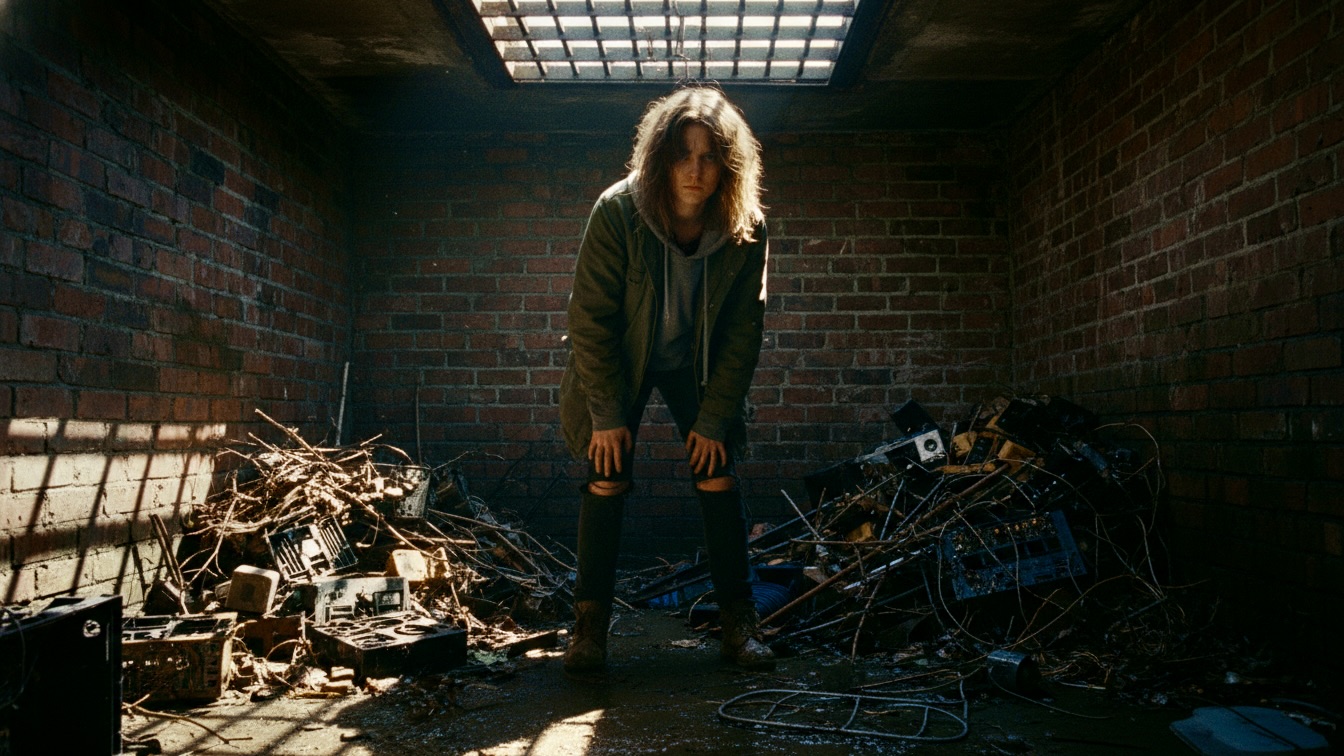
We asked for twenty thousand. They gave us fifty, plus an automated butterfly release for maximum wellness.
"This is a war crime," Ursula said.
She stared at the digital rendering floating above the cafe table. The hologram rotated slowly, casting a faint green light across her face. It was a massive, mathematically perfect floral arrangement shaped like a dove.
Jeff pushed his heavy black glasses up the bridge of his nose. "It is a floral arrangement. I think they are peonies."
"It is psychological warfare," Ursula said. She waved her hand through the hologram. The light dispersed around her fingers and instantly reformed. "Look at it. It does not even have the decency to drop a petal. It is sterile. It is a monument to our absolute, crushing boredom."
Renee leaned over the table. Her elbow hit a perfectly clean ceramic coffee cup. The table’s localized stabilizing field caught the cup before it could spill, righting it with a soft hum. Renee sighed and scrolled on her datapad. Her screen was pristine. Everyone’s screen was pristine in 2026.
"The Harmony Spring Gala committee just approved our budget," Renee said. Her voice was flat. "We asked for twenty thousand credits. They gave us fifty. They also added a dedicated drone swarm for the light show. And an automated butterfly release to ensure maximum wellness."
Ursula dropped her head onto the table. The surface was lukewarm, temperature-controlled for optimum forearm comfort. She hated it. She wanted the table to be cold. She wanted it to be sticky. She wanted a splinter.
Winnipeg in May was an aggressive shade of green. The snowmelt algorithms had worked flawlessly, draining the winter slush into the subterranean reservoirs without a single puddle forming on the sidewalks. The Red River ran clear and blue, completely devoid of the brown mud that had defined it for centuries. The air smelled like synthetic lilac. The wind, which used to tear down Portage Avenue fast enough to knock over pedestrians, was now buffered by invisible atmospheric dampeners. It was just a gentle, constant breeze.
It was exhausting.
"I want to die," Ursula said into the table.
"You cannot die," Jeff said. "The biometrics in your jacket would alert the medical grid before your heart rate dropped below forty. A trauma team would be here in ninety seconds. They would offer you a localized serotonin patch and a therapy dog."
"I would bite the dog," Ursula said.
"The dog is a robot," Renee reminded her.
"I would bite the robot."
Ursula sat up. Her optic nerve throbbed. Life in the city was a series of seamless transactions. You thought of a need, the grid anticipated it, and the need was met. There was no friction. There was no gap between desire and fulfillment. The youth projects were the worst of it. The city council, terrified of adolescent unrest in a post-scarcity society, threw limitless funding at any half-baked idea a teenager had.
Ursula had submitted a proposal for the Spring Gala as a joke. She had requested funding to build a monument to teenage apathy. She had literally titled the proposal 'We Do Not Care About Spring.' The algorithm read it as a cry for creative expression, flagged it for priority funding, and assigned them a mentor.
"We are canceling the Gala," Ursula said.
Renee’s head snapped up. Her jaw tightened. "We cannot cancel it. The UI does not have a button for cancellation once the funds are disbursed. It goes against the mandated self-actualization quotas."
"Then we just do not do it," Ursula said. "We take the fifty thousand credits and we let it sit in the account. We ghost the city."
"The wellness monitors will flag us for depressive isolation," Jeff said. He took a sip of his coffee. "We will be forced into mandatory group hiking. You know I hate hiking. The trails are too soft."
Ursula stood up. She grabbed her jacket. It was a vintage piece she had found in an old closet, pre-Optimization. It had a tear on the left shoulder that she refused to let the nanites repair.
"Come on," she said.
"Where are we going?" Renee asked, standing up reluctantly.
"To find a flaw," Ursula said.
They walked out of the cafe and onto the street. The sunlight was bright, dialed in to the exact lux level proven to elevate mood. Pedestrians walked past them in silent, comfortable shoes. There was no traffic noise. The autonomous transit pods glided on magnetic rails, emitting a frequency that supposedly reduced anxiety.
Ursula led them toward the Exchange District. This part of the city was supposed to be historic. It was full of old brick buildings from the early twentieth century. But the Optimization had ruined it. The brickwork had been perfectly repointed. The faded painted advertisements on the sides of the buildings had been restored to garish, neon-bright colors. It looked like a theme park.
"My stomach hurts," Renee said. "I think the anxiety is causing acid reflux. Should I request a diagnostic?"
"Do not request a diagnostic," Ursula snapped. "Let your stomach hurt. It is the only real thing happening to you today."
They turned down Albert Street. Ursula kept her eyes on the ground. She was looking for the seams. The city grid was perfect, but it was massive. The algorithms occasionally missed things. Mostly, they missed things that were completely useless.
She stopped at the corner of an alleyway. Between a restored warehouse and a vertical hydroponic farm, there was a narrow gap. The ground here was uneven.
Ursula crouched down. Her knees popped.
"Look," she said.
Jeff and Renee crowded around her. Set into the pavement was a heavy, rusted iron grate. The metal was flaking. It was genuinely, organically degraded. The street cleaners had somehow bypassed this one square meter of the city.
Ursula grabbed the edge of the grate. The rust dug into her fingers. It felt sharp. It felt incredible.
"Help me pull," she said.
Jeff sighed, but he knelt beside her. They gripped the iron and pulled. The grate groaned. It was a terrible, loud sound, like a dying animal. A passing pedestrian turned their head, looking alarmed by the un-curated noise, before hurrying away.
With a final heave, the grate swung open.
A blast of cold, damp air hit them in the face. It smelled like mildew, standing water, and old earth. It smelled like rot.
Ursula leaned over the hole. There was a drop of about six feet into total darkness.
"We are not going down there," Renee said. Her voice shook. "There are no air scrubbers. You could inhale spores."
Ursula did not answer. She swung her legs over the edge and dropped.
She landed on hard concrete. Her ankles jolted with the impact. Pain shot up her shins. She smiled in the dark.
"Come down," Ursula called up. "It is completely unmapped."
Jeff dropped down next, landing heavily. Renee followed a moment later, whimpering as her pristine white shoes hit the dirty floor.
Ursula turned on her datapad flashlight. The beam cut through the gloom. They were in an old basement. The walls were raw stone and brick, weeping with moisture. There were cobwebs thick with dust. In the corner sat a pile of broken wooden pallets and a shattered glass bottle.
"The grid does not know this is here," Ursula said. Her voice echoed off the damp walls. "The sensors cut off at street level. Look at your screens."
Renee pulled up her datapad. "No signal. The spatial mapping shows solid earth below the pavement. We are in a blind spot."
"This is it," Ursula said. She walked over to the shattered glass and nudged it with her boot. It made a scraping sound. "This is where we do the show."
"What show?" Jeff asked.
"The anti-Gala. We reject the fifty thousand credits. We reject the butterfly swarm. We do an art show down here. And we only use garbage."
Renee stared at her. "There is no garbage in Winnipeg. The waste management drones atomize everything at the point of disposal."
"Then we find the things they missed," Ursula said. "We find the rot. We find the broken things. We make something ugly. We make something that actually hurts to look at. We invite everyone. And we do not ask the city for permission."
Silence filled the basement, broken only by the slow drip of water from the ceiling.
"If we do this," Jeff said slowly, "the youth council will have a collective aneurysm."
"Exactly," Ursula said.
The next three days were a logistical nightmare, which meant they were the best three days of Ursula’s life.
Rejecting the grant money was impossible through the official channels, so Ursula simply bypassed the portal. She locked the digital account, threw away the access key, and let the fifty thousand credits sit in a void.
The real challenge was the supply chain. Ursula was right; Utopia did not produce trash. When you finished a meal, the packaging dissolved. When your shoes wore out, you placed them in a reclamation chute and they were spun into new fibers within the hour.
To find authentic decay, they had to leave the city center.
On a Tuesday morning, they took the mag-lev to the absolute edge of the city limits, where the Optimization grid faded into the untamed prairie. The transit pod dropped them off at an agricultural interchange. Beyond the platform, there were no sidewalks. Just tall grass, dirt, and the rusted skeletal remains of the old highway system.
"I am sweating," Renee said. She wiped her forehead. "My jacket’s cooling mesh is failing because we are out of range of the master server."
"Take the jacket off," Ursula said.
"But then I will just be hot."
"Yes. That is how bodies work."
They walked down the crumbling asphalt of the old perimeter highway. The sun beat down heavily. Without the city’s atmospheric dampeners, the wind was harsh and erratic, whipping their hair into their eyes.
Ursula carried a heavy canvas bag she had stolen from a historical reenactment center.
They walked for an hour before they found it. An old, forgotten drainage ditch that the sanitation drones had somehow ignored for a decade. It was a goldmine.
"Look at this," Ursula breathed, sliding down the dirt bank.
The ditch was choked with weeds and debris. There were twisted pieces of corrugated metal, plastic bottles faded white by the sun, a waterlogged mattress, and a shattered CRT television set.
"It is disgusting," Renee said from the top of the bank. She had her arms crossed tight over her chest.
"It is beautiful," Jeff said. He slid down the bank to join Ursula.
They spent the next two hours digging in the dirt. It was exhausting physical labor. Ursula’s back ached, and her fingernails were packed with black soil. She dragged a rusted car door out of the mud, panting hard.
Jeff was trying to pull a tangle of copper wire from the crushed television. He yanked hard. The plastic casing snapped.
"Ouch," Jeff said. He dropped the wire.
Ursula turned around. Jeff was holding his left hand. A jagged piece of plastic had sliced across his palm.
Blood was welling up. Real, bright red blood.
Renee screamed from the top of the ditch. "He is bleeding! Jeff is bleeding! Call the med-drones!"
Renee frantically tapped her datapad. "I do not have a signal! We are going to watch him die!"
"I am not going to die," Jeff said. His voice was remarkably calm, though his eyes were wide. He stared at his hand. "It stings. It actually really stings."
Ursula walked over. Her stomach turned over slightly at the sight of the blood. She had never seen anyone bleed before. Minor injuries in the city were healed with quick-clot spray and numbing agents before the brain even registered the pain.
"Does it hurt?" she asked.
"Yes," Jeff said. He smiled. It was a weird, manic smile. "My heart is beating really fast."
Ursula ripped a strip of fabric from the bottom of her shirt. She wrapped it tightly around his hand and tied a knot.
"Keep pressure on it," she said.
"We are criminals," Renee said, sliding down the bank in a panic. She hovered over Jeff’s hand. "You have an unsterilized wound. If the city finds out, they will put us in a hyperbaric wellness chamber for a month."
"Then we make sure they do not find out," Ursula said. "Grab the copper wire. We have enough."
They hauled their garbage back to the city, taking the transit pod during the mid-day lull to avoid the crowd. They dragged the heavy canvas bags through the Exchange District and dropped them down the iron grate.
For the next week, the basement became their sanctuary.
They did not go to school. They ignored the automated messages from their youth mentors. They stayed in the dark, damp hole and built their exhibition.
Ursula welded the rusted car door to the shattered television using a stolen industrial laser. Jeff, whose hand was healing into an ugly, raised scab, strung the copper wire across the ceiling like a chaotic spiderweb. Renee, despite her initial terror, found herself obsessively arranging the faded plastic bottles into a massive, looming tower in the center of the room.
They worked in silence mostly. The only sounds were the scrape of metal, the dripping water, and their own heavy breathing. It was dirty, backbreaking work.
On the night before they planned to open the space to the public, the grate above them rattled.
Ursula froze. She killed the laser torch. The basement plunged into darkness, save for the single battery-powered work light they had rigged.
A voice called down from the street level.
"Ursula? Are you down there?"
It was a male voice. Smooth, calm, perfectly modulated to project empathy.
"It is David," Renee whispered, her eyes wide. "From the Youth Council."
Ursula gritted her teeth. She stepped into the pool of light below the grate and looked up.
David was peering down through the iron bars. He was wearing a flawless beige sweater. His skin was glowing with optimal hydration.
"Ursula," David said, smiling. "We have been looking for you. Your biometrics have been off the grid for days. We were getting concerned about your emotional baseline."
"My baseline is fine, David," Ursula said. "Go away."
"I cannot do that," David said. He tapped a tablet in his hand. "We noticed you have not accessed your Spring Gala grant. And the municipal tracking systems noted some anomalous weight distribution in this sector. So, I took a walk."
David shone a powerful flashlight down into the hole. The beam swept over the rusted car door, the dirt, the jagged copper wires, and finally rested on Ursula’s face, which was streaked with grease.
"Wow," David said. He sounded genuinely impressed. "I see what is happening here. This is a visceral reaction to post-scarcity malaise. You are seeking out danger and dirt to ground your sensory experience."
Ursula felt a hot spike of rage in her chest. She hated how easily he categorized her.
"It is not a sensory experience," she said. "It is a trash pile. Leave us alone."
"Ursula, I want to validate your creative disruption," David said gently. "The Council loves this. It is raw. It is edgy. We want to support it."
"I do not want your support."
"We can make this an official annex of the Spring Gala," David continued, completely ignoring her. "We can bring in the sanitation drones to sterilize the rust. We can put safety caps on the sharp edges. We can install a localized air filtration system to deal with the mold down there. And we will provide waivers for the attendees to sign, fostering safe boundaries for this trauma-informed art-making."
Ursula stared up at him. Her hands clenched into fists.
"If you touch this space," Ursula said, her voice dropping to a low, hard register, "I will burn it down."
David frowned. The perfect HR mask slipped for a fraction of a second. "Ursula, we cannot allow an uncurated, dangerous environment to exist within city limits. It violates the Harmony Mandate. Someone could get hurt."
Jeff stepped forward. He held up his left hand, showing the crude bandage and the dried blood.
"I already got hurt," Jeff said. "It was awesome."
David’s eyes widened at the sight of the blood. He took a step back from the grate. "You need immediate medical intervention. I am flagging a trauma drone right now."
"Do it," Ursula said. "Flag the drone. Send the city guard. But if you try to sanitize this, if you try to make it safe, you ruin the only real thing in this entire pathetic city. We will just find another hole. We will dig until we find something you cannot clean."
David hesitated. The algorithm in his head was calculating risk versus reward. Suppressing teenage rebellion often led to a spike in negative emotional metrics across the demographic. Co-opting it was the standard protocol, but Ursula was rejecting the co-opt.
"I will give you twenty-four hours," David said finally. His voice was tight. "You can hold your unsanctioned event. But I am placing a geofence around this block. If anyone’s vitals drop into the critical zone, the drones come in. And tomorrow morning, this space gets filled with concrete."
He walked away, his silent shoes making no noise on the pavement.
Ursula stood still for a long time. Her heart hammered against her ribs.
"We only have tonight," she said.
"How do we invite people?" Renee asked. "If we use the network, David will throttle the bandwidth."
"We do not use the network," Ursula said. "We use the mesh. Peer to peer. Short range. Just a set of coordinates and one word."
"What word?"
"Grime."
The word spread through the youth of Winnipeg like a virus.
By midnight, the alleyway above the basement was packed. Hundreds of teenagers, dressed in their perfect, self-cleaning fabrics, stood in the dark. They were quiet, looking around nervously, waiting for the wellness monitors to disperse them. But the monitors did not come.
One by one, they dropped down the iron grate.
The basement was sweltering. With two hundred bodies packed into the tight space, the air grew thick with sweat, humidity, and the smell of old dirt. Ursula had rigged the broken television to emit a harsh, pulsing static sound that vibrated in their teeth.
There was no butterfly swarm. There were no holographic flowers.
Instead, the attendees stared at the rusted car door. They touched the sharp edges of the copper wire. They bumped into the plastic bottle tower, knocking it over, and then scrambled in the dirt to build it back up.
A boy in a pristine white jacket leaned against the wet brick wall. When he stepped away, a massive smear of black mold and dirt stained his back. He took the jacket off, looked at the stain, and laughed. It was a loud, ugly laugh. Soon, others were doing it. They were rubbing their hands in the dirt and wiping it on their faces. They were pushing each other, slipping on the wet concrete.
It was chaotic. It was unsafe. It was loud.
Ursula stood in the corner, watching them. Her chest heaved. The static from the television was deafening.
Jeff bumped his shoulder against hers. He had dirt smeared across his forehead.
"They love it," he yelled over the noise.
"They are starving for it," Ursula yelled back.
Renee was in the center of the room, dancing violently to the rhythm of the static, her perfect hair matted with sweat.
For three hours, the basement was an autonomous zone of absolute mess. No one checked their screens. No one worried about their heart rate. They just existed in the dirt.
But as the clock ticked past three in the morning, Ursula felt a change in the air.
The heavy iron grate above them rattled. The pulsing static from the television suddenly flickered and died. The work lights sparked and shut off. The basement plunged into total darkness.
The crowd went silent.
Through the grate above, a harsh, synthetic blue light cut through the gloom. It swept across the room, tracking the dirt, the rust, and the sweating bodies.
Ursula looked up. Hovering just above the grate was a city sanitation drone. It was entirely silent, held aloft by anti-gravity thrusters.
The system had not ignored them. The system had just been observing.
The little blue light on the sanitation drone blinked twice, registering the anomaly, and began calculating a new algorithm for containment.
“The little blue light on the sanitation drone blinked twice, registering the anomaly, and began calculating a new algorithm for containment.”


